
Original briefings. Zero spin.
Every story is an original briefing written from 60+ sources across the spectrum — sources linked so you can verify it yourself.
 politics
Notable (6/10)
June 16, 2026 at 07:06 PM
politics
Notable (6/10)
June 16, 2026 at 07:06 PM
Trump Moves Special Education and Civil Rights Oversight Out of the Education Department, Using Interagency Agreements Congress Never Approved.
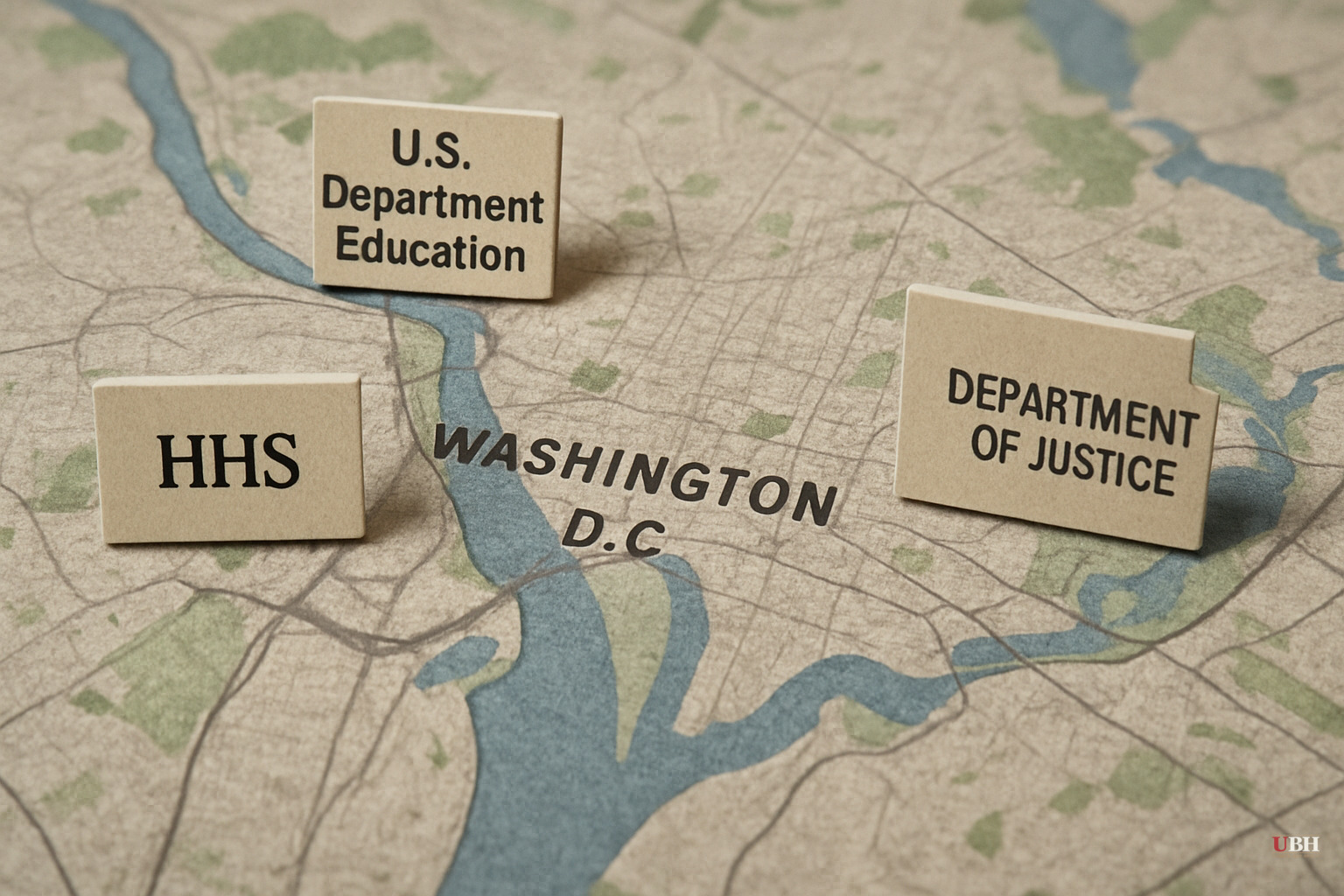
The Trump administration announced Tuesday it will transfer two of the Education Department's core functions to other federal agencies, according to reporting by NPR and the New York Times.
The Office of Special Education and Rehabilitative Services (OSERS), which manages roughly $15 billion a year in funding for students with disabilities and oversees state compliance with the Individuals with Disabilities Education Act (IDEA), will move to the Department of Health and Human Services.
The Office for Civil Rights (OCR), which enforces anti-discrimination protections in K-12 schools and universities covering disability, gender, race, and national origin, will move to the Department of Justice.
What the Administration Says
Education Secretary Linda McMahon framed both moves as improvements, not subtractions. On special education, McMahon said in a press release that the HHS partnership would "align federal services with the goal of strengthening academic outcomes and supporting individuals with disabilities so that they can achieve greater independence, key life skills, and meaningful employment."
On civil rights, McMahon said the DOJ partnership would "ensure stronger, more coordinated civil rights enforcement and robust protections for student privacy."
Education Department officials told the New York Times that students, parents, and educators "would not experience any change in services." No additional operational details were immediately available.
The administration's case has some logic. DOJ already runs major civil rights enforcement divisions. HHS already interfaces with disabled Americans through Medicaid, the Administration for Community Living, and related programs. Consolidating disability services under one health-focused agency isn't an inherently absurd idea on paper.
The Legal Problem
Eliminating the Education Department requires an act of Congress. Disability rights groups argue that moving OSERS also requires congressional authorization, since IDEA is a statute and the office's mandate flows from it. The administration has instead used so-called interagency agreements, which have historically been used for mundane purposes like purchasing supplies or leasing office space between agencies, not for rerouting tens of billions in congressionally appropriated programs.
According to the New York Times, this is part of a larger pattern. Last year, the Education Department used the same mechanism to transfer $28 billion in Elementary and Secondary Education funding to the Labor Department, $3 billion in postsecondary grants, and $2.6 billion in career and technical education programs. The Interior Department now manages the Office of Indian Education. The State Department and HHS have taken pieces too.
Congress has not passed legislation dismantling the Education Department. The administration is doing it instead, agency agreement by agency agreement.
The Critics
The American Federation of Government Employees Local 252, representing about 2,000 current and former Education Department workers, called the moves an attempt to "unlawfully dismantle the Education Department." Local 252 president Rachel Gittleman said: "This will leave our most vulnerable students and families who have been shut out of our education system without the services they need and without protection when they face discrimination. This isn't efficiency; it's chaos."
Denise Forte, president and CEO of Ed Trust, a think tank focused on education equity, told NPR: "This is another vindictive attempt to undermine public education."
OCR has already been through months of turbulence. NPR reported the office was targeted repeatedly by the Trump administration for staff cuts, followed by reversals of those cuts. It is not operating from a position of stability.
Strongest Case for Concern
The most serious objection is not about ideology. It is about accountability and function. OSERS and OCR enforce statutory rights. Federal courts have repeatedly ruled on IDEA compliance disputes. Parents of disabled children have legal standing to demand services under a specific federal law administered by a specific federal office. When that office moves to an agency whose leadership, budget lines, and congressional oversight committees are all different, the practical question is: who is responsible when a state violates IDEA? If the answer becomes unclear, the rights IDEA guarantees become harder to enforce, regardless of anyone's intentions. That is a structural concern, not a partisan one.
The administration has not yet explained how complaint processes, enforcement actions, and state compliance monitoring will transfer without gaps.
No Congressional Movement, No Lawsuit Filed Yet
According to the New York Times, there has been little movement in Congress to formally dismantle or eliminate the Education Department, which means the legislative branch has not sanctioned what the executive branch is doing.
As of June 16, 2026, no federal lawsuit challenging Tuesday's announcement has been publicly filed, though disability advocacy organizations have signaled opposition. The legal question of whether interagency agreements can substitute for congressional authorization in restructuring statutory offices has not been adjudicated for this specific set of transfers. That question is likely headed to federal court.
Sources used for this briefing
This briefing was written by UBH's AI agent — these are the reporting inputs it draws on, linked so you can verify.