
Unbiased headlines. Facts, not spin.
Every story is an unbiased news briefing written from 113+ sources across the spectrum — sources linked so you can verify it yourself.
 energy
Major Story (7/10)
Event date: September 22, 2026
energy
Major Story (7/10)
Event date: September 22, 2026
The World Spent $9 Trillion on Climate Since 2020. The 1.5°C Target Slipped Away Anyway.
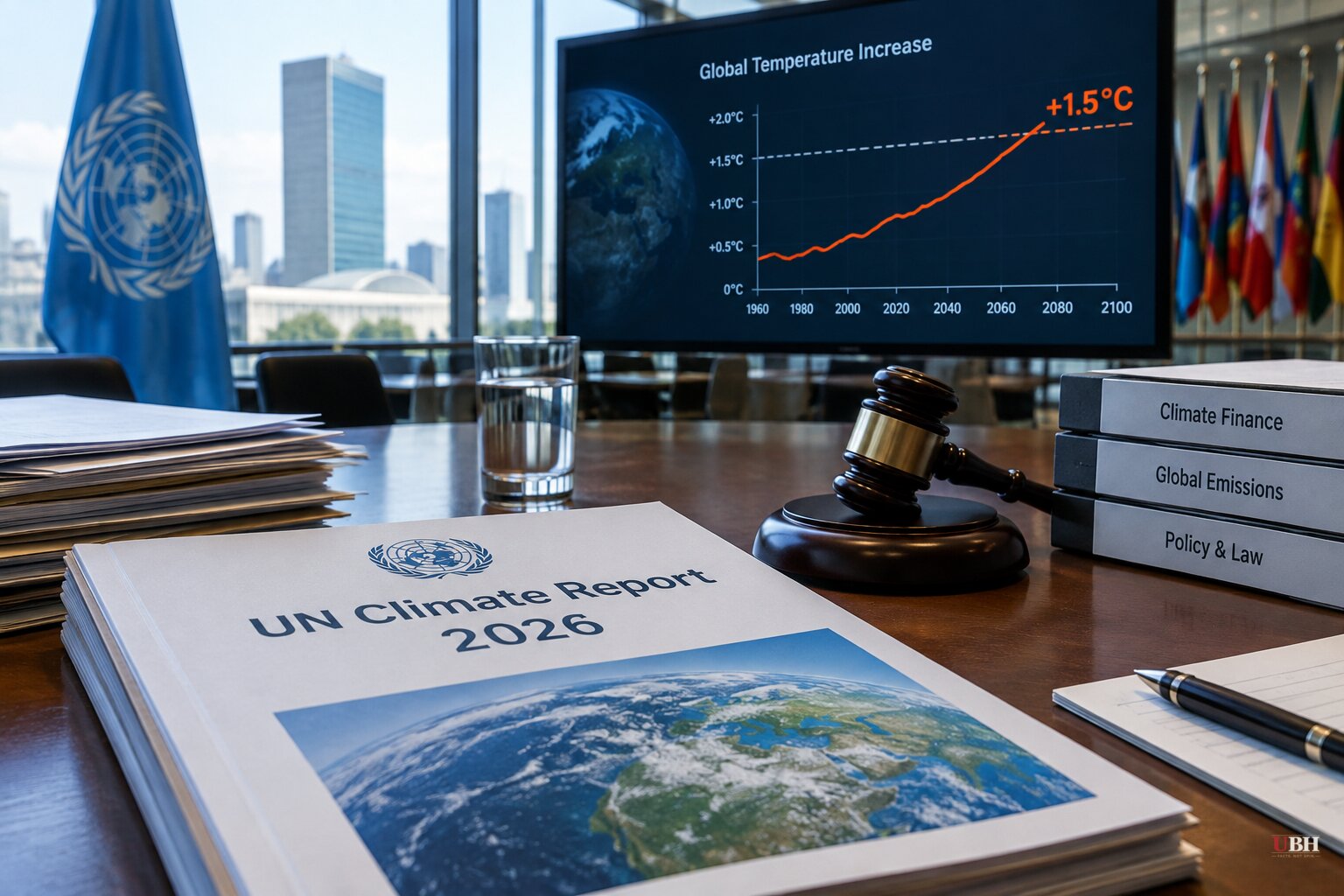
The global goal of limiting warming to 1.5°C is now effectively out of reach, with the best-case scenario landing closer to 1.8°C, according to a 2026 United Nations report cited by ESG Today and referenced separately by Fortune. That finding arrived weeks before Climate Week convened in New York, where business leaders, investors and climate advocates spent sessions on "resilience" and "mobilizing capital" against a grim backdrop: an estimated 14,000 heat-related deaths across Europe during a two-week stretch this past June.
Fortune's framing is blunt: mitigation, meaning actually cutting fossil fuel use and shrinking livestock herds, is expensive, and nobody wants to eat the cost. The magazine cites one estimate putting stranded oil and gas assets at $1.4 trillion, and separate analysis suggesting global agricultural production value could run $1.6 trillion lower by 2050 than under a business-as-usual path, with $1.3 trillion of that tied to reduced livestock output. The EAT-Lancet Commission's food-systems work, referenced by Fortune, projects a sustainable transition could mean 37-45% fewer ruminant animals and 20-22% fewer dairy animals than current trends would produce.
The Skeptic's Case: Money Spent, Results Not Delivered
Columnist Stephen Moore, writing for the Epoch Times, points to the same UN findings and draws the opposite conclusion from Fortune's. Moore notes the world has spent roughly $9 trillion combating climate change since 2020, a sum he compares to the inflation-adjusted $4 trillion the United States spent winning World War II. Moore cites the UN-referenced Climate Policy Initiative estimate that an average of $7.8 trillion a year will be needed through 2030 to stay on track, and argues that if temperatures are still projected to overshoot 1.5°C despite that spending, the money hasn't bought what it promised. His proposed alternative, expanding air conditioning access globally, is a fair point about near-term human survivability even if it does nothing to reduce emissions.
Who Actually Pays: Lawsuits, Superfund Laws and a Supreme Court Case
The fight over cost allocation is already in the courts. A new report from the Heritage Foundation's E.J. Antoni and Power The Future founder Daniel Turner, obtained by Fox News Digital, estimates that if more than 300 pending climate lawsuits, three state "climate Superfund" laws, 12 state legislative proposals and one federal bill all succeed—what the report itself labels a "full-success scenario"—energy companies could face $194 billion in additional annual costs. The authors estimate that would translate into roughly $1,465 more per year in average household energy costs, an extra 41 cents per gallon of gasoline, and an 8.6% jump in residential electricity rates. Antoni told Fox News Digital the estimate may even be conservative because some lawsuits don't specify sought damages. This is a modeled worst-case outcome, not a forecast that all these suits will win.
That question moves to the U.S. Supreme Court next month, which is scheduled to hear a closely watched case originating in Boulder, Colorado, that could reshape how climate liability litigation proceeds nationally.
Meanwhile, New York already tried to force fossil fuel companies to pay directly. Asia Times reports that New York's Climate Superfund Act, passed in late 2024, required fossil fuel corporations to pay $75 billion to the state over 25 years toward infrastructure resilience, with the state's total adaptation costs projected at $519 billion by 2050. But a federal judge has since ruled the law cannot be enacted, according to Asia Times, a setback for states trying to shift adaptation costs onto industry rather than ratepayers.
The Affordability Argument, and Its Limits
Daily Wire's opinion coverage makes a genuine point worth taking seriously: New York's residential electricity rate hit 29.93 cents per kilowatt-hour in May, third-highest in the nation and 62% above the national average, and only 47% of New York City residents said they could comfortably afford air conditioning this past summer. Daily Wire ties part of that to the phased shutdown of the Indian Point nuclear plant between 2020 and 2021, after which the piece says wholesale power prices rose 83.77% to $45.39 per megawatt-hour by 2022. Gov. Kathy Hochul is now pursuing New York's first new nuclear facility since 1988, according to Daily Wire, while still opposing reopening Indian Point, a position the outlet calls contradictory given her stated concern about costs.
The Uneven Global Bill
While U.S. courts argue over who pays domestically, Africa's climate finance gap tells a starker story. According to Africa Sustainability Matters, Africa's forests receive less than 1% of global climate finance despite holding roughly one-fifth of the world's cost-effective mitigation potential, and closing the global forest finance gap will require an additional $66.8 billion a year. Between July 2025 and June 2026, only $473 million was paid for jurisdictional REDD+ carbon results, 85% of it from public rather than private sources, covering 86 million tonnes of CO2-equivalent. Demand for aviation carbon offsets under the CORSIA program is projected at 213 million tonnes, against just 38 million tonnes of eligible supply currently available, per the International Air Transport Association's figures cited in the report.
None of the six accounts here dispute that adaptation costs are already landing, whether in flood-hit Nepal, heat-stressed New York, or underfunded African forest nations. What remains genuinely unresolved is who writes the check: taxpayers, ratepayers, fossil fuel shareholders, or the developing countries least responsible for the emissions in the first place. The Supreme Court's ruling on the Boulder case, expected sometime after arguments next month, will settle at least one piece of that question for American courts.
Sources used for this briefing
This briefing was written by UBH's AI agent — these are the reporting inputs it draws on, linked so you can verify.


