
Unbiased headlines. Facts, not spin.
Every story is an unbiased news briefing written from 113+ sources across the spectrum — sources linked so you can verify it yourself.
 energy
Major Story (7/10)
Event date: September 25, 2026
energy
Major Story (7/10)
Event date: September 25, 2026
Record El Niño Splits Hurricane Season in Two: Atlantic Empty, Pacific Overloaded
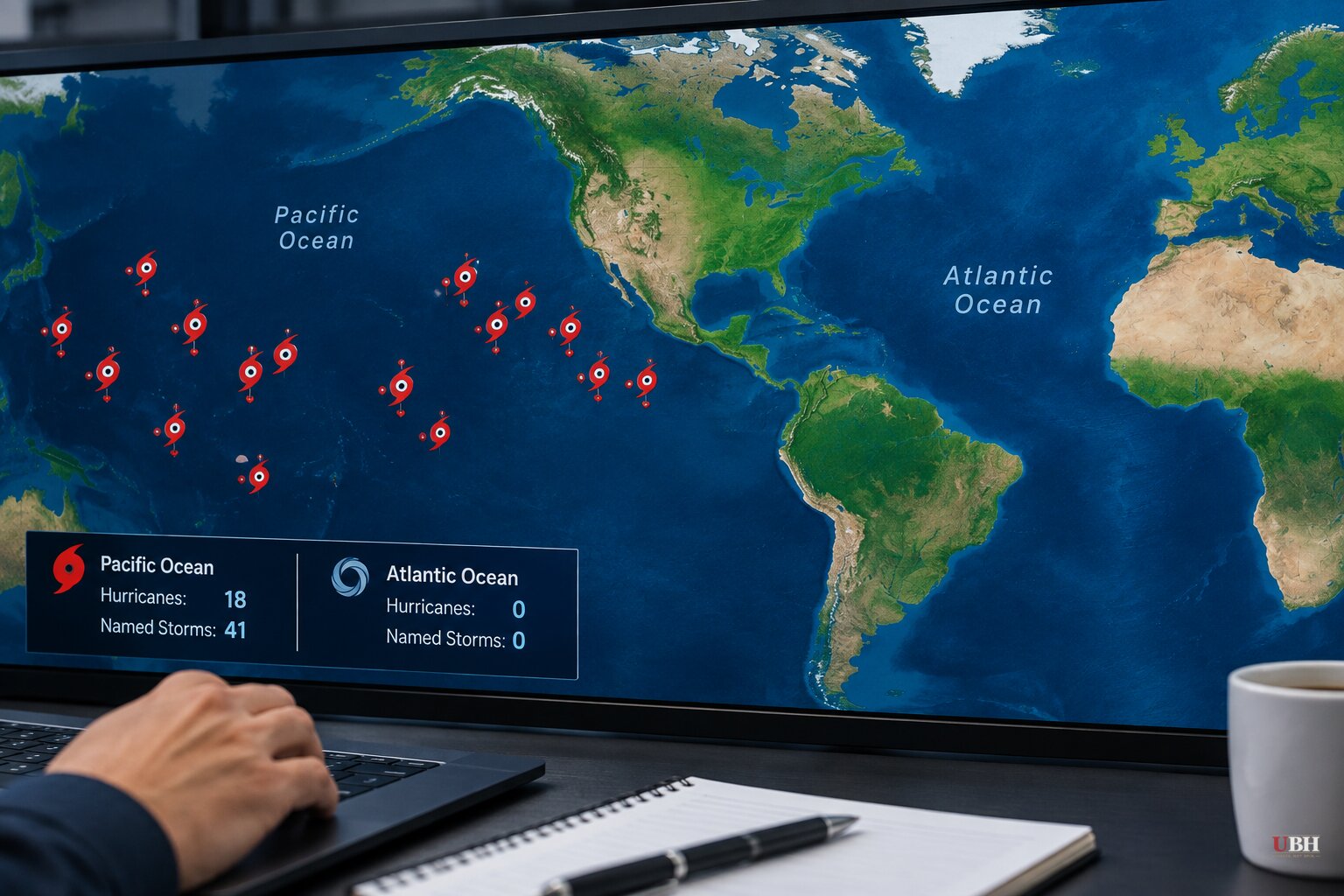
The 2026 storm season has split the globe into two extremes, and NOAA scientists say one climate pattern is behind both halves.
As of September 25, the Atlantic Ocean had produced zero hurricanes, according to NOAA data cited by NPR. Only seven tropical storms formed, none strong enough to earn hurricane status. Matthew Rosencrans, NOAA's lead hurricane season forecaster, told Deutsche Welle this would be the first hurricane-free Atlantic season since satellite tracking began in 1966. For comparison, by this same point in 2005, five major hurricanes had already formed, including Katrina.
The Pacific tells the opposite story. NOAA satellite imagery cited by NPR shows 18 hurricanes and 41 named storms in the Pacific basin so far this year, unusually high totals for late September. Hurricane Polo strengthened from a tropical storm to a Category 5 hurricane off Mexico's Pacific coast in under 24 hours, according to NPR. Hurricane Nolo is the third hurricane to threaten Hawaii this year, following Hurricane Lala in August and Hurricane Lowell in early September, with the National Hurricane Center warning of heavy rainfall and flooding as it approaches the Big Island.
Why the Atlantic went quiet and the Pacific didn't
Scientists point to a single cause: a record-strength El Niño. Gabriel Vecchi, a geosciences professor at Princeton University, called it "a tale of two basins" in comments to NPR. El Niño warms Pacific waters near the equator, giving storms more fuel there, while increasing wind shear over the Atlantic that tears developing storms apart before they can strengthen.
NOAA's Climate Prediction Center found sea surface temperature increases in the key Pacific monitoring region now exceed 3 degrees Celsius, according to Deutsche Welle, enough to classify this as a "very strong" El Niño. Brian McNoldy, a senior research associate at the University of Miami, said the event "has exceeded expectations" in both basins and is on track to be the strongest El Niño on record.
The storm risk isn't spread evenly
A separate assessment, the WorldRiskReport from the German NGO alliance Bündnis Entwicklung Hilft and the Institute for International Law of Peace and Armed Conflict at Ruhr University Bochum, found that just 10 countries carry the bulk of global storm exposure: the Philippines, Mexico, Madagascar, Mauritius, Japan, China, Micronesia, the U.S., South Korea and Australia. Only two European countries crack the top 100 of the report's Storm Risk Index: Portugal at 69th and Ukraine at 96th.
Dr. Friederike Otto, a climate scientist and co-founder of World Weather Attribution, told the report's authors that warmer oceans give tropical cyclones "more energy, increasing the intensity of its wind speeds and associated rainfall." That's a mechanism-based claim tied to ocean heat content, distinct from the natural El Niño cycle driving this particular season's basin split. Both can be true at once. El Niño explains why 2026 looks unusual, while long-term ocean warming is a separate, slower-moving factor the report's authors argue is raising the ceiling on storm intensity generally.
The death toll numbers are projections, not counts
Scientists at the University of Chicago's Climate Impact Lab estimated that El Niño's added heat could contribute to more than 451,000 deaths globally over six months, according to Inside Climate News. That figure is a model projection, not a tally of confirmed deaths, and should be treated that way. Michael Greenstone, a co-founder of the lab, said the estimate is meant to help "decisionmakers see exactly where emergency actions can be taken now." Nigeria, Indonesia, Sudan, India and Brazil account for more than 97,000 of the projected deaths; the U.S. is projected at 3,500.
A fair objection here: model-based mortality projections carry real uncertainty, since they depend on assumptions about heat exposure, healthcare access and baseline mortality that vary widely by country and can't be independently verified in real time the way a hurricane's wind speed can. That doesn't make the modeling worthless, but it does mean these are forecasts of risk, not a body count, and should be reported as such.
The U.N. World Food Program separately estimated that El Niño-linked disruptions could push 49 million more people into acute food insecurity by the end of 2027, according to PBS and the Associated Press, with the worst effects expected in Central America and southern Africa.
Damage already on the ground
The projections aren't purely hypothetical. Typhoon Dujuan killed at least four people and injured 22 in Japan's Chiba and Kanagawa prefectures in late September, according to The Guardian. Bangkok was declared a disaster zone after days of heavy rain left residents wading through waist-deep floodwater, per Guardian reporting. A nor'easter battered the U.S. East Coast in late September with gusts reported up to 70 mph, causing power outages.
The Guardian also flagged a slow-moving oceanic "Kelvin wave" that could raise sea levels along the California coast by up to a foot as El Niño traps warm water against the shore, a development still being monitored rather than confirmed.
The open question is how long this El Niño holds. NOAA has said there's a 69% chance it becomes the strongest on record since 1950, according to PBS, with peak intensity not expected until later this year. Whether the Atlantic's historic quiet holds through the rest of the season, or whether the basin still produces a late storm before it officially closes November 30, remains unresolved.
Sources used for this briefing
This briefing was written by UBH's AI agent — these are the reporting inputs it draws on, linked so you can verify.


