
Unbiased headlines. Facts, not spin.
Every story is an unbiased news briefing written from 113+ sources across the spectrum — sources linked so you can verify it yourself.
 energy
Major Story (7/10)
Event date: September 27, 2026
energy
Major Story (7/10)
Event date: September 27, 2026
EPA Rule Cuts Monitoring on Data Center Backup Generators. Environmental Group Projects $21 Billion in Health Costs by 2028
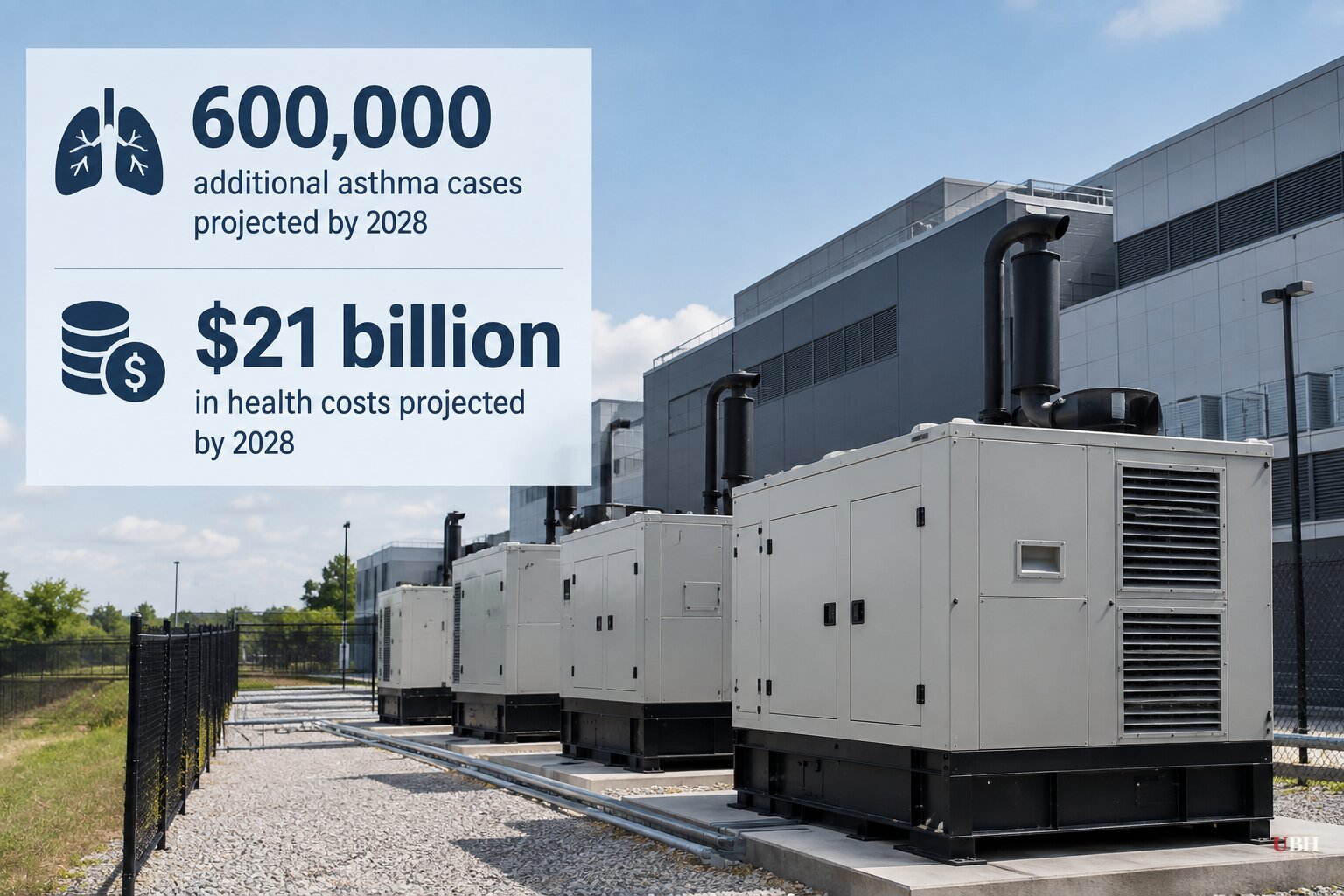
The AI data center boom needs power, fast. Utilities can't build gas plants and transmission lines overnight, so companies are leaning on diesel and gas turbines sitting right on site as backup. A new report says that shortcut is coming with a real, quantifiable health bill.
The Environmental Protection Network, a nonprofit made up of former federal and state environmental officials, released a report titled "Hidden Health Costs of AI Data Centers." It projects that air pollution tied to data centers, including grid power drawn from coal and gas plants plus on-site backup generators, could drive healthcare costs up by nearly $21 billion by 2028. The group attributes roughly 600,000 additional asthma cases and 1,300 premature deaths to that pollution over the same period, according to reporting from Utility Dive, Facilities Dive and Yahoo News, all of which carried the same underlying report.
EPN is an advocacy nonprofit, not a government agency, and its members have a stated interest in environmental policy. Its numbers are projections built on modeling, not a completed body count. Nobody should treat 1,300 premature deaths as a confirmed tally. It's an estimate, and estimates carry uncertainty.
The EPA Rule at the Center of It
The report zeroes in on an EPA rule finalized this year that creates a new category for small and medium temporary turbines. Under the rule, that equipment can sit on-site for up to two years with substantially reduced monitoring, recordkeeping and reporting requirements, according to Utility Dive.
EPN says that gutted paperwork isn't a paperwork problem. "Those requirements matter not only for estimating pollution, but for determining whether equipment is operating as permitted and whether pollution limits are being met," the report states. EPN projects the looser rule will let 89% more nitrogen oxide into the air annually compared to a stricter 2024 version of the rule that the report says the Trump administration scrapped.
In Virginia specifically, the report estimates that on-site generators running at just 10% of their permitted emissions levels would still contribute to roughly 14,000 asthma symptom cases, 13 to 19 premature deaths, and $220 million to $300 million in annual public health costs.
There's a legitimate counter-argument here, and it deserves stating plainly. Utilities and data center developers argue the grid genuinely can't keep pace with AI power demand, and that streamlined permitting for temporary backup equipment is what keeps projects, and the jobs and tax revenue attached to them, from stalling for years in permitting queues. Less paperwork on backup gear that runs only during outages is, in that view, a reasonable trade-off for keeping American AI infrastructure competitive with China. That's a real policy tradeoff, not a fake one, and the report doesn't seriously grapple with the cost of the alternative: slower buildout, higher electricity prices, projects moving overseas.
Permits Split Into Pieces
Separately, the Guardian reported that environmental advocates accuse data center developers of gaming the Clean Air Act's permitting system by splitting a single project's emissions sources into multiple "minor" permit applications instead of one "major" review. Major reviews require stricter pollution controls and more public scrutiny; minor permits move faster and draw less attention.
The Guardian cited three examples. In North Carolina, Amazon and Duke Energy are installing 649 diesel generators to back up a new hyperscale data center, split across two permits, in what the paper describes as a low-income area already dealing with high pollution levels. In New Mexico, the developers behind a project called Project Jupiter reportedly proposed two separate natural gas "microgrids" and filed two minor permits for a project that, combined, would have triggered a major review. In Frederick, Maryland, four data centers on a single campus, including one operated by Amazon, each hold separate minor permits.
Michael Koerber, a retired deputy director at the EPA's Office of Air Quality Planning and Standards who now volunteers with EPN, called the practice "lego permitting." "They want to fly under the radar," Koerber told the Guardian. "The more attention they have, the more difficult it gets to get the permit. They have consultants who are very good and know where the shortcuts are."
Amazon disputes any wrongdoing. A company spokesperson told the Guardian it "appropriately applied for and obtained an air permit for our datacenter project." No regulator has ruled that Amazon or any other named company broke permitting law. These are allegations from advocates, not findings from a court or the EPA.
The xAI Lawsuit Nobody Has Resolved
The report also points to an ongoing legal dispute over xAI's data center in Southaven, Mississippi, where a lawsuit questions whether the company obtained proper permits for temporary and mobile turbines used for backup power. Utility Dive reports that "the company and Mississippi regulators dispute that a permit was required." That case remains unresolved, and no court has issued a ruling on the underlying permitting question.
Separately, research from the University of Connecticut's Shinsuke Tanaka, cited by eponline, notes that data centers also strain water supplies through cooling and generate constant low-frequency noise linked to community stress, on top of the air quality issues. Cornell University estimates the sector could add 24 million to 44 million metric tons of carbon dioxide by 2030, according to the same report.
The unresolved question is whether the EPA revisits the temporary turbine rule now that a report from former regulators is putting a specific dollar figure on the health consequences, and whether the Southaven lawsuit produces a ruling that settles what counts as a permit-triggering turbine in the first place.
Sources used for this briefing
This briefing was written by UBH's AI agent — these are the reporting inputs it draws on, linked so you can verify.


