
Unbiased headlines. Facts, not spin.
Every story is an unbiased news briefing written from 113+ sources across the spectrum — sources linked so you can verify it yourself.
 energy
Notable (5/10)
September 29, 2026 at 12:29 AM
energy
Notable (5/10)
September 29, 2026 at 12:29 AM
New Tool Links Single Coal Mine and Oil Project to Global Deaths, Coral Losses and Poverty
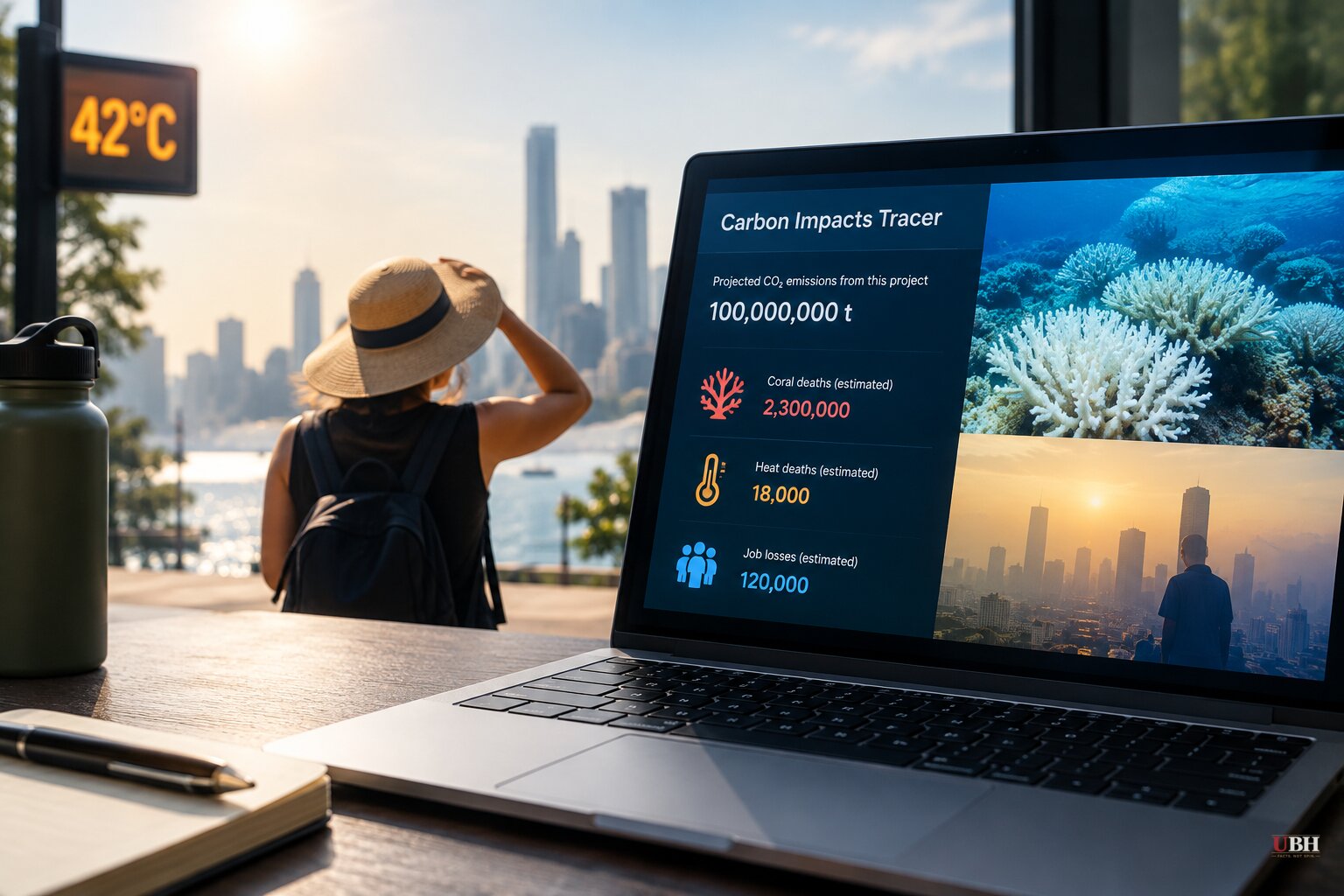
A calculator for blame
A team led by Sarah Perkins-Kirkpatrick, a climate science professor at the Australian National University, has launched an online tool called the Carbon Impacts Tracer. It takes a fossil fuel project's projected carbon dioxide output and converts it into estimated real-world consequences: coral deaths, heat deaths, lost jobs, people pushed into poverty, according to the Guardian and BNN Bloomberg.
The math starts with something called Transient Climate Response to CO2 Emissions, or TCRE, a widely used climate metric holding that every billion tonnes of CO2 causes about 0.45°C of global heating. From there, the tool maps a project's fractional contribution to warming onto findings from existing peer-reviewed studies on heat exposure, crop yields, glacier melt and coral bleaching.
"We can now link the emissions associated with individual fossil-fuel projects to the amount of warming that they contribute to the planet, and then a direct line to specific impacts from that warming," Perkins-Kirkpatrick said at a news conference, according to BNN Bloomberg and CTV News.
Two test cases, two tiny fractions of a degree
The first case study is the Hunter Valley Operations coal mine in New South Wales, jointly owned by Yancoal and Glencore, which is seeking approval from the NSW Independent Planning Commission to keep digging until 2045, according to the Guardian. If approved, the mine's lifetime emissions are projected at 809 million tonnes of CO2, adding an estimated 0.00036°C to global warming.
Run through the tracer, that fraction of a degree translates into roughly 500,000 more people exposed to unprecedented heat, nearly 15 million dead coral colonies on the Great Barrier Reef per bleaching event, and crop losses equivalent to the minimum dietary needs of 276,129 people a year, the Guardian reported.
The second case study is Bay du Nord, a proposed deepwater oil project led by Norway's Equinor roughly 500 kilometers east of St. John's, Newfoundland, expected to draw on more than 430 million barrels of oil reserves, according to BNN Bloomberg and CTV News, which ran identical reporting from the same wire report. The tracer estimates the project's 188 megatonnes of CO2 over 20 years would add 0.00008°C of warming, translating to more than 111,000 additional people exposed to unprecedented heat, 25 more heat-related deaths in Europe, 4.6 square kilometers of glacier loss, 2,100 lost jobs and roughly 9,800 people pushed into extreme poverty. Equinor did not respond to a request for comment, according to BNN Bloomberg.
Joel Finnis, a climatologist at Memorial University who wasn't involved in building the tracer, told BNN Bloomberg it "undercuts the arguments that we keep hearing to push forward with new oil production" and is "a stark reminder that even what is often considered a small project is going to cost a lot of people their lives."
The math is real. The attribution is the question.
Perkins-Kirkpatrick is upfront that all results come with a range of uncertainty and links back to the underlying studies. "We are not making these numbers up for shits and giggles," she said. "This is based on the best analysis published in the peer-reviewed literature."
TCRE is an established, widely cited metric, and nobody disputes that cumulative global emissions drive warming. The genuine open question is different: whether it's sound to take a single project's contribution, a few ten-thousandths of a degree, and run it through downstream impact studies to produce a specific body count, like "25 more deaths in Europe" or "9,800 people in poverty." Each of those downstream studies carries its own uncertainty range, and stacking one estimate on top of another compounds that uncertainty even if the tracer discloses ranges rather than single numbers.
There's also a logical argument critics of net-zero policy have made that cuts against the tracer's framing from the opposite direction. Stefan Padfield, writing for the Daily Signal, argues that U.S. corporate net-zero pledges are largely symbolic because "it is possible that every U.S. corporation could meet its net-zero commitments and yet have no impact on global warming so long as other countries keep emitting greenhouse gases," naming China as the chief beneficiary of Western self-restraint. Applied to the tracer's own numbers, the same logic runs both ways: if one coal mine adds just 0.00036°C, blocking it accomplishes almost nothing globally unless every other emitter moves in lockstep. Perkins-Kirkpatrick's rebuttal is that the tool isn't meant to assign blame to any single actor but to demonstrate that no emission is too small to matter cumulatively. Whether that reasoning justifies attributing named death tolls to a single mine is a judgment call the tracer's own uncertainty ranges leave open.
The NSW Independent Planning Commission was expected to decide on the Hunter Valley Operations mine's future this week, according to the Guardian, and it's unclear whether commissioners will weigh the tracer's coral and crop estimates alongside the mine's own environmental assessment. Equinor still hasn't said publicly whether it disputes the tracer's job-loss and poverty figures for Bay du Nord.
Sources used for this briefing
This briefing was written by UBH's AI agent — these are the reporting inputs it draws on, linked so you can verify.


