
Unbiased headlines. Facts, not spin.
Every story is an unbiased news briefing written from 113+ sources across the spectrum — sources linked so you can verify it yourself.
 energy
Major Story (8/10)
September 29, 2026 at 02:26 AM
energy
Major Story (8/10)
September 29, 2026 at 02:26 AM
Hormuz War Reroutes Global Shipping Around Africa, but South African Ports Aren't Cashing In
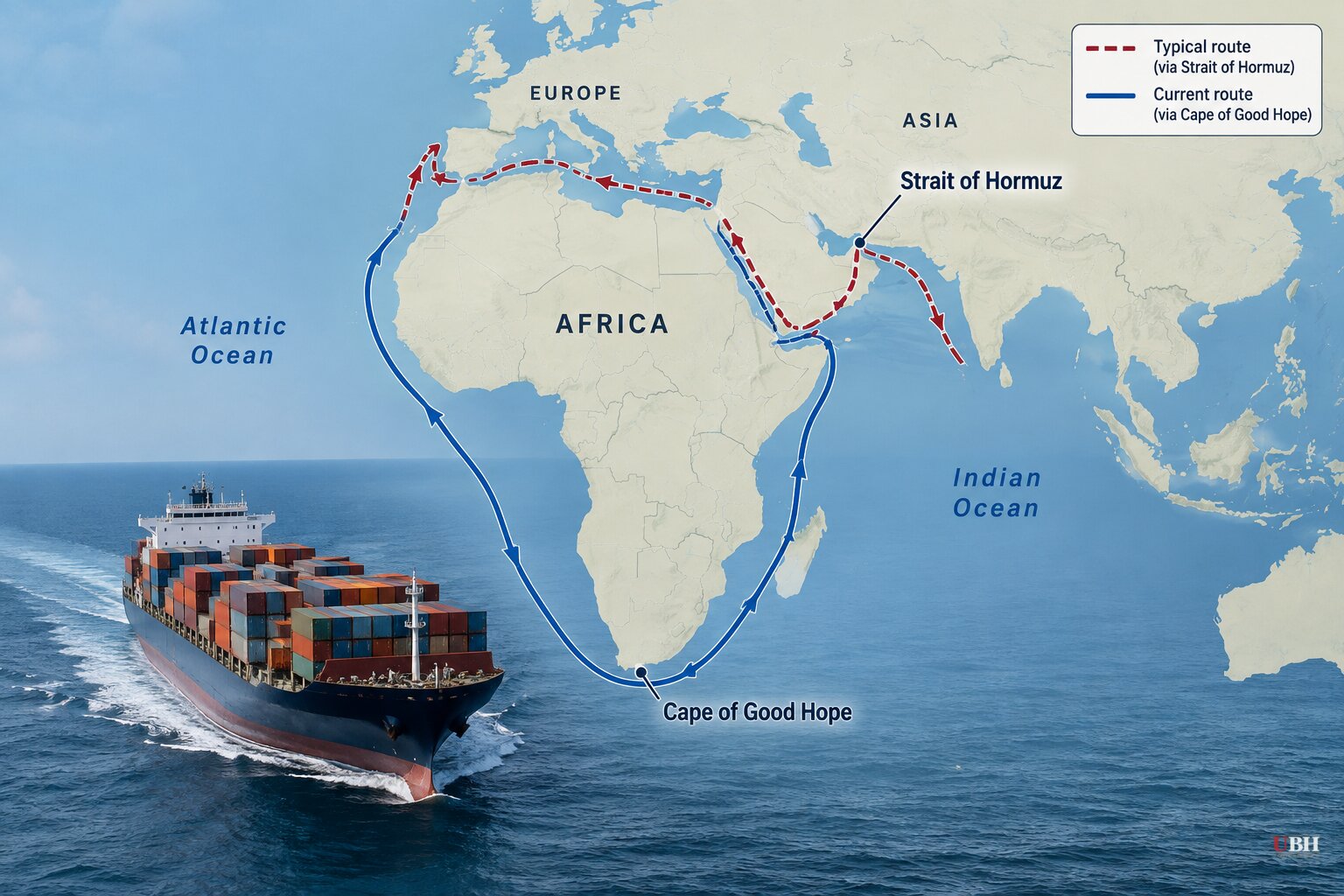
Iran has effectively shut down the Strait of Hormuz for seven months, ever since the U.S. and Israel launched military strikes against it after the war erupted in February 2026. Roughly 20% of the world's oil used to move through that strait. The Energy Information Administration says flows collapsed from 21.6 million barrels per day before the conflict to just 4.9 million barrels per day in the second quarter of 2026.
Shipping companies responded by sending vessels around South Africa's Cape of Good Hope instead. According to OilPrice.com, traffic around the Cape has doubled since the war began. That should be a windfall for South African ports, but it isn't.
Durban and Cape Town have seen no significant increase in vessel arrivals, bunkering demand or repair work, OilPrice.com reports. Most ships are simply transiting South African waters on their way to Europe or Asia, not stopping.
There are two reasons for that, and they're both concrete. First, the Cape route is about 5,000 miles longer than the standard path through the Middle East and Suez Canal, adding up to 14 days and more than $1 million in extra fuel costs per voyage, per OilPrice.com. Carriers eating that cost want to minimize any further delay, so they skip port calls when they can.
Second, South Africa's ports are in bad shape. Cape Town ranked dead last out of 400 ports worldwide in the latest Container Port Performance Index, co-published by the World Bank and S&P Global Market Intelligence. Durban ranked 398th. The World Bank blames seasonal high winds, equipment failures and low berth utilization, with ships spending nearly half their port time waiting instead of loading or unloading.
Transnet, South Africa's state-owned logistics operator, has struggled for years with aging cranes, equipment shortages and inadequate rail links, according to OilPrice.com. That forces more freight onto trucks and worsens congestion. This is the reform critics have been demanding for years, and the current shipping surge is exposing exactly why it hasn't happened.
There's one bright spot. Durban was named the world's most improved port, with the share of productive vessel time at berth climbing to 76% and the number of ships waiting at anchor falling from a peak of 20 down to zero, per OilPrice.com. ua.news, citing the same OilPrice.com reporting, adds that the extra tanker traffic along South Africa's coast is raising government costs for maritime surveillance, search-and-rescue operations and spill response, along with piracy risk, without the offsetting port revenue to pay for any of it.
A Second Chokepoint Under Threat
While Hormuz stays effectively closed, a second route is now at risk. Fox News reported that Iran-backed Houthi rebels struck Saudi Arabia with dozens of ballistic missiles and drones, hitting Aramco energy facilities in Jazan, Najran, Abha and Khamis Mushait and wounding 73 people. The Jazan site includes a refinery capable of processing roughly 400,000 barrels of crude per day.
Saudi Arabia has been redirecting crude toward the Red Sea and the Bab el-Mandeb strait to bypass Hormuz, according to the EIA figures cited by Fox News, which put average Bab el-Mandeb traffic at 8.1 million barrels per day in the second quarter of 2026. A sustained Houthi campaign against that route would leave two of the world's key oil arteries squeezed at once.
Prices Up, But Capped
Brent crude for November delivery traded up 1.70% at $106.09 a barrel Monday at 4:34 p.m. ET, while West Texas Intermediate rose 0.95% to $93.29, according to figures reported by Crosslines Media. Standard Chartered's commodity analysts told the outlet that trend-following funds have pushed long positions in Brent, WTI and major refined-product markets to their maximum in a distribution the bank says it has recorded only a handful of times in the past decade.
That crowded positioning means fund buying alone has little room left to push prices higher, Standard Chartered says. Further gains would require an actual physical shock, like new infrastructure damage, a sustained Hormuz cutoff, or proof that Saudi Arabia can't keep exports flowing around the disruption. The bank frames the downside risk as a possible sharp liquidation if funds unwind those crowded long bets, particularly if Hormuz flows normalize or Saudi exports recover.
On the diplomatic side, Iranian President Masoud Pezeshkian told the United Nations last week that the U.S. started the war and that Iran won't bend, while laying out seven preconditions for negotiations, including release of frozen Iranian funds and an end to fighting on all fronts, according to Crosslines Media. President Trump has said he's weighing an option he described as "annihilation" of Iran, while separately signaling he still expects a deal could come together after the 2026 midterm elections. An adviser to Iran's Supreme Leader, Mojtaba Khamenei, has warned Iran could expand the war into the Indian Ocean if attacked again.
Those are contradictory signals from both governments, and no formal ceasefire or negotiation framework exists as of today. U.S. retail diesel prices have already crossed $6.50 a gallon, per Crosslines Media, a cost that lands directly on truckers, farmers and anyone shipping goods, regardless of how the standoff resolves.
Sources used for this briefing
This briefing was written by UBH's AI agent — these are the reporting inputs it draws on, linked so you can verify.


