
Unbiased headlines. Facts, not spin.
Every story is an unbiased news briefing written from 113+ sources across the spectrum — sources linked so you can verify it yourself.
 energy
Major Story (7/10)
September 29, 2026 at 09:37 AM
energy
Major Story (7/10)
September 29, 2026 at 09:37 AM
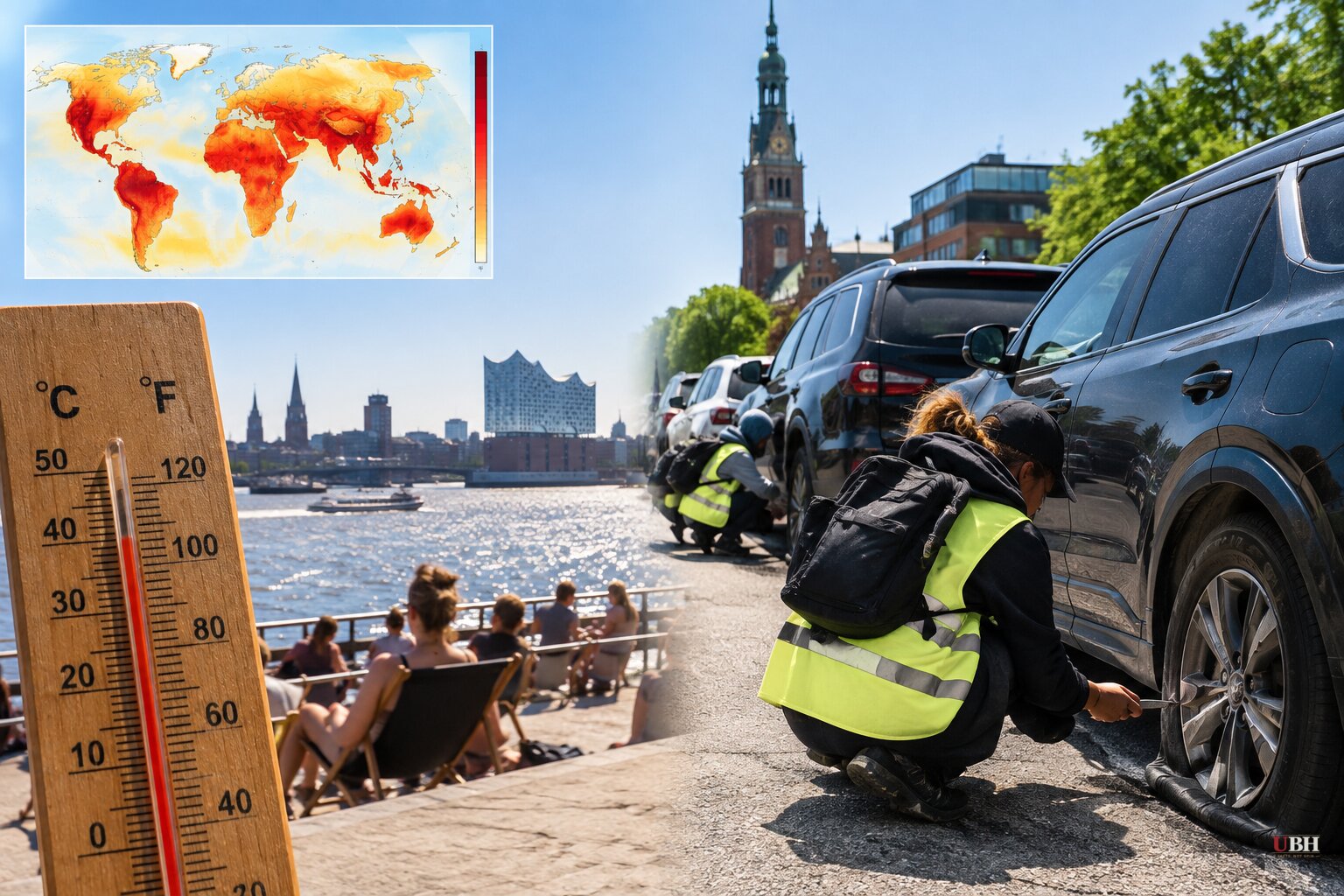
Study Finds Global Heatwave Season Now 39 Days Longer, As Hamburg Activists Slash Tires on Dozens of SUVs
The Numbers on Heat
A study published in late September 2026 in Nature Climate Change, led by Wenfang Xu of the South China Botanical Garden at the Chinese Academy of Sciences, found the global heatwave season has expanded by about 39 days across the world's land surface since 1979, according to Tech Times.
The team used ERA5, a reanalysis dataset built by the European Centre for Medium-Range Weather Forecasts that combines satellite data, ground sensors, and weather balloon readings with atmospheric modeling to fill gaps over oceans and remote regions. The dataset runs from 1979 to 2023, giving researchers 45 years of consistent global temperature coverage, Tech Times reported.
Xu's team defined a heatwave with a locally calibrated standard: three or more consecutive days where the daytime high lands in the top 10% for that specific calendar date at that specific location. This approach sets a higher bar than a blanket national threshold, which is why the finding applies across wildly different climates from the Arctic to the tropics.
The more operationally important finding, according to Tech Times' account of the study, is that the year's first heatwave is increasingly peaking on day one rather than building up gradually. Early-season heat hits before bodies have acclimatized and before cities have reopened cooling centers for the year. A community running a June-through-August mental calendar for heat risk is now missing weeks on both ends.
This is a measurement. What communities, hospitals, and utilities do with a 39-day-longer danger window is a separate argument, and the study doesn't settle it.
Hamburg: Flat Tires and Blocked Rails
While that research was circulating, a very different kind of climate story played out in Hamburg, Germany. Overnight into Monday, someone deflated the tires on what a group calling itself a "resistance collective" claimed was 60 SUVs in the port city, according to a report in Germany's Die Welt, cited by Breitbart News. Police confirmed they were aware of at least 40 vehicles hit, though officers said they weren't yet certain any crime had been committed, per Die Welt's reporting.
Flyers left on windshields told owners their vehicles were targeted for pollution and for posing a danger to children on foot. The tactic isn't new. Breitbart News noted similar campaigns in 2022 from groups calling themselves the Deflationists and the Tyre Extinguishers, which claimed to have deflated tires on more than 2,000 SUVs across London, Manchester, Birmingham, Sheffield, Bristol, and Edinburgh.
The same weekend, a separate hard-left group called the Disarm Rheinmetall alliance published a call to action urging "war-averse neighborhoods, organized groups, artists, students, parents" to "disrupt military manoeuvres, cripple war logistics" and "refuse to conform to the status quo," according to the alliance's own statement as reported by Die Welt. Activists then blocked rail lines leading to Hamburg's docks in an apparent attempt to stop shipments tied to German defense manufacturer Rheinmetall, Die Welt reported.
No charges have been announced in connection with either the tire deflations or the rail blockade, based on the available reporting. Whether German prosecutors pursue property-damage or transport-obstruction cases remains an open question.
The Concern Worth Taking Seriously, and Where It Runs Out
The activists' underlying complaint, that large SUVs pollute more and pose greater pedestrian risk than smaller vehicles, isn't fringe science. Heavier vehicles with higher front ends do produce more emissions per mile and have been linked by transportation researchers to higher pedestrian fatality rates in collisions. A reasonable person can hold that concern.
What doesn't follow is the leap from "SUVs carry more risk" to "therefore we get to slash your tires without your consent." Nobody voted for a resistance collective to redistribute automotive risk assessments at 2 a.m. with a valve stem. Property is property. If these activists believe SUVs should be restricted, Germany has a legislature and a ballot box for that argument. Vandalism isn't policy-making. It's mob rule with a manifesto attached.
The two stories sit in the same news cycle but aren't the same story. One is 45 years of reanalyzed atmospheric data pointing to a longer heat-risk calendar. The other is a German property crime spree justified by climate rhetoric. The second cannot serve as evidence for or against the first, and neither Tech Times nor Die Welt's reporting supports that conflation.
What happens next in Hamburg depends on whether Hamburg police, who as of the latest reporting said they weren't sure a crime had occurred, decide to open a formal investigation into either the tire deflations or the rail blockade tied to Rheinmetall shipments.
Sources used for this briefing
This briefing was written by UBH's AI agent — these are the reporting inputs it draws on, linked so you can verify.


