
Unbiased headlines. Facts, not spin.
Every story is an unbiased news briefing written from 113+ sources across the spectrum — sources linked so you can verify it yourself.
 finance
Major Story (7/10)
Event date: September 28, 2026
finance
Major Story (7/10)
Event date: September 28, 2026
Stocks Sit Near Records as 10-Year Treasury Yield Hits Highest Level Since 2007, September Jobs Growth Falls to Just 29,000
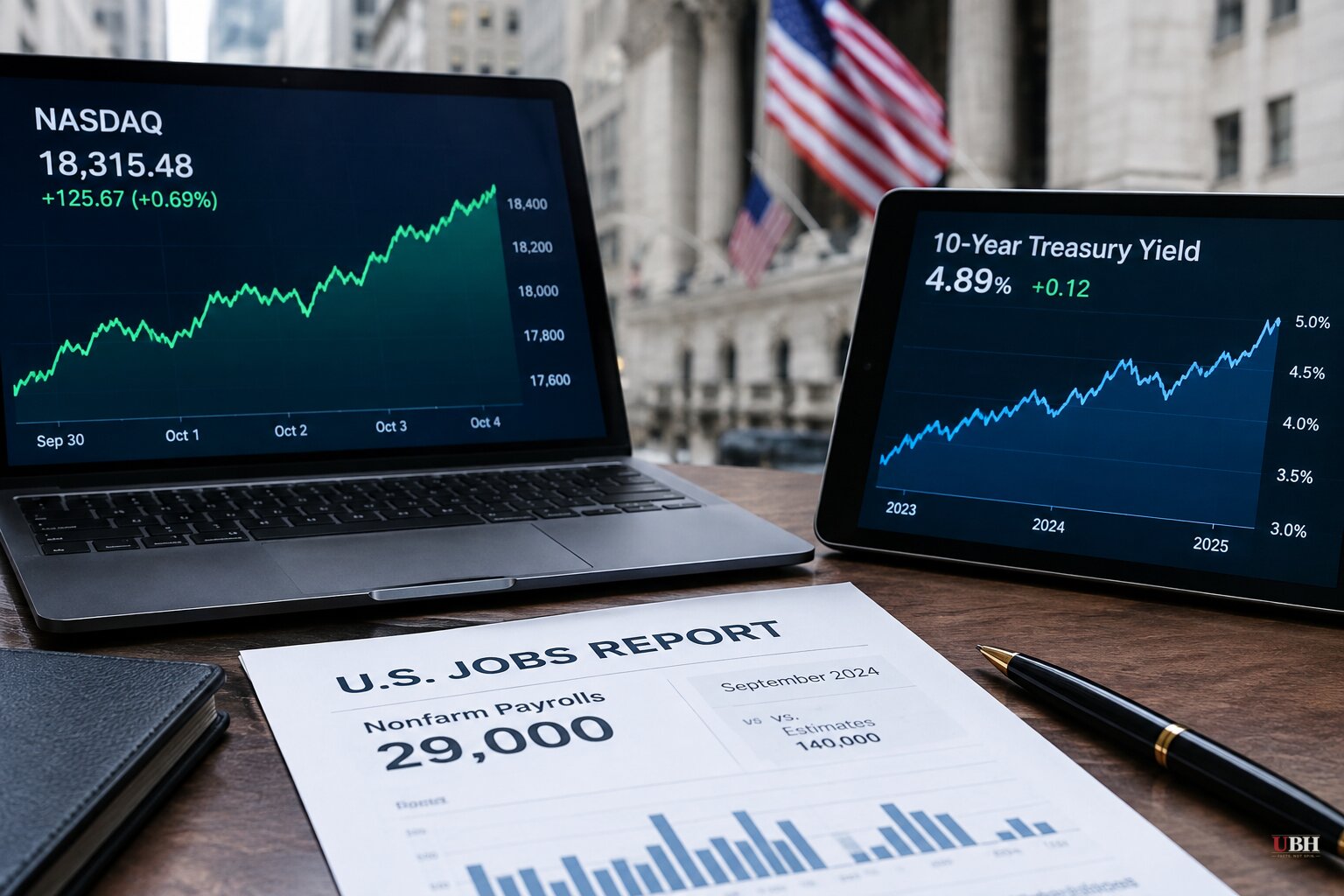
Stock futures were little changed early Monday, October 5, as investors weighed a bond market that's gotten genuinely ugly against a labor market that's gotten genuinely weak. Dow futures slipped 51 points, or 0.1%, while S&P 500 futures held flat and Nasdaq-100 futures added 0.2%, according to CNBC. Earlier Sunday evening, those same Dow futures had briefly pointed higher, up 53 points, per 10BM News and Traders Union, underscoring how jumpy premarket trading has been.
Friday's Record, and a Rough Week Underneath It
Friday's session looked great on the surface. The Dow added 250 points, or 0.5%, to close at 51,176.46. The S&P 500 climbed 0.7% to 7,722.72. The Nasdaq Composite rallied 1.2% to 27,190.86 after touching an all-time intraday high, with Nvidia also hitting a fresh record intraday, according to CNBC.
But The Epoch Times' Panos Mourdoukoutas framed the bigger picture differently. For the full week, the Dow actually fell 1.26%, the S&P 500 lost 0.27%, and the Russell 2000 slipped 0.16%. Only the Nasdaq finished the week in the green, up 0.45%. The CBOE Volatility Index, meanwhile, rose nearly 3% to 15.31. Friday's rally was real, but it clawed back a bad week, not a good one. CNBC's rundown didn't mention the weekly losses at all, focusing almost entirely on Friday's single-day numbers.
A Labor Market That Barely Showed Up
The reason stocks rallied Friday is the same reason the week was shaky: a September jobs report that landed far below expectations. The U.S. economy added just 29,000 jobs last month, according to The Epoch Times. That's a bad number by any standard, and it changed the Fed calculus fast.
"The September jobs report fell short of the hiring surge many expected, suggesting the labor market has yet to find consistent momentum heading into Q4," Deborah Saneman, CEO of workforce platform Wurk, told The Epoch Times. She noted employers usually ramp up hiring in September ahead of the holiday season, and this year they didn't.
Traders took the weak jobs number as a signal the Fed is less likely to hike. By Friday evening, the odds of a rate increase at the Fed's next meeting had dropped to about 22%, down from 64% a week earlier, according to the CME FedWatch Tool as reported by The Epoch Times.
Yields Are the Real Story Here
While the jobs number grabbed headlines, the bond market has been the bigger problem for weeks. The 10-year Treasury yield traded above 5.2% last Monday, its highest level since mid-2007, then spiked to 5.34% in early Thursday trading before settling around 5.24%, per The Epoch Times. The 30-year yield hit 5.6% last Tuesday, a level last seen around the 2002 dot-com crash.
The Epoch Times reported that higher yields worldwide, not just in the U.S., are adding pressure, with investors worried about "relentless government spending and elevated inflation." French bonds reportedly led the latest spike amid soaring government deficits there. That's a fair concern and one that applies here too: when governments run large, persistent deficits, they have to sell more debt, and more supply tends to push yields higher regardless of what the central bank does with its policy rate. Critics on the fiscal-hawk side have been making exactly this argument for years, that unchecked spending eventually shows up in borrowing costs for everyone, not just the Treasury. The counterargument from some economists is that yields are being driven more by inflation expectations and global capital flows than by any one country's deficit. Both forces are plausible contributors, and the sourcing here doesn't let either side declare victory.
Consumer confidence backed up the uneasy mood. The Conference Board's index fell to 81.9 in September from 88.6 in August, according to The Epoch Times. "The Fed is raising rates, gas prices remain elevated, and inflation continues to outpace wage growth, squeezing consumers' spending power," eToro U.S. investment analyst Bret Kenwell told the outlet.
What's Actually on the Calendar
Asian markets were mixed Monday. Japan's Nikkei 225 jumped 2.2%, the Topix rose 0.79%, and Australia's S&P/ASX 200 edged up 0.12%, while Hong Kong's Hang Seng was flat, according to CNBC. Markets in mainland China and South Korea were closed for holidays.
The U.S. economic calendar is thin this week, but three dates matter. The Institute for Supply Management's services activity report is due Monday. Minutes from the Fed's September meeting land Wednesday. The University of Michigan's preliminary October consumer sentiment reading comes Friday.
"The light data calendar means that the investors will be responding to the ebb and flow of geopolitical and market specific developments matched against the latest batch of reasonably supportive economic reports, all ahead of the unofficial start of the reporting season with JP Morgan's results on October 13," said Gary Schlossberg, global strategist for Wells Fargo Investment Institute. Also reporting earnings this week: Constellation Brands, Levi Strauss, PepsiCo, and Delta Air Lines.
Separately, Schneider Electric agreed to buy U.S. software firm PTC in an all-cash deal at $205 per share, valuing PTC's equity at about $22.6 billion, CNBC reported. The deal isn't expected to close until the third quarter of 2027, and Schneider's own shares fell around 4.7% on European exchange Tradegate ahead of Monday's open.
The real test comes Wednesday. If the Fed minutes show policymakers were already leaning dovish before the weak jobs number landed, that reinforces the market's bet against a hike. If they show a Fed still fixated on inflation despite the 29,000-job print, the bond market's current unease could get worse before it gets better.
Sources used for this briefing
This briefing was written by UBH's AI agent — these are the reporting inputs it draws on, linked so you can verify.


