
Unbiased headlines. Facts, not spin.
Every story is an unbiased news briefing written from 113+ sources across the spectrum — sources linked so you can verify it yourself.
 finance
Major Story (7/10)
Event date: September 28, 2026
finance
Major Story (7/10)
Event date: September 28, 2026
Euro Sinks to Fresh 17-Month Low as France's Bond Mess Deepens and Spain Joins the Political Risk List
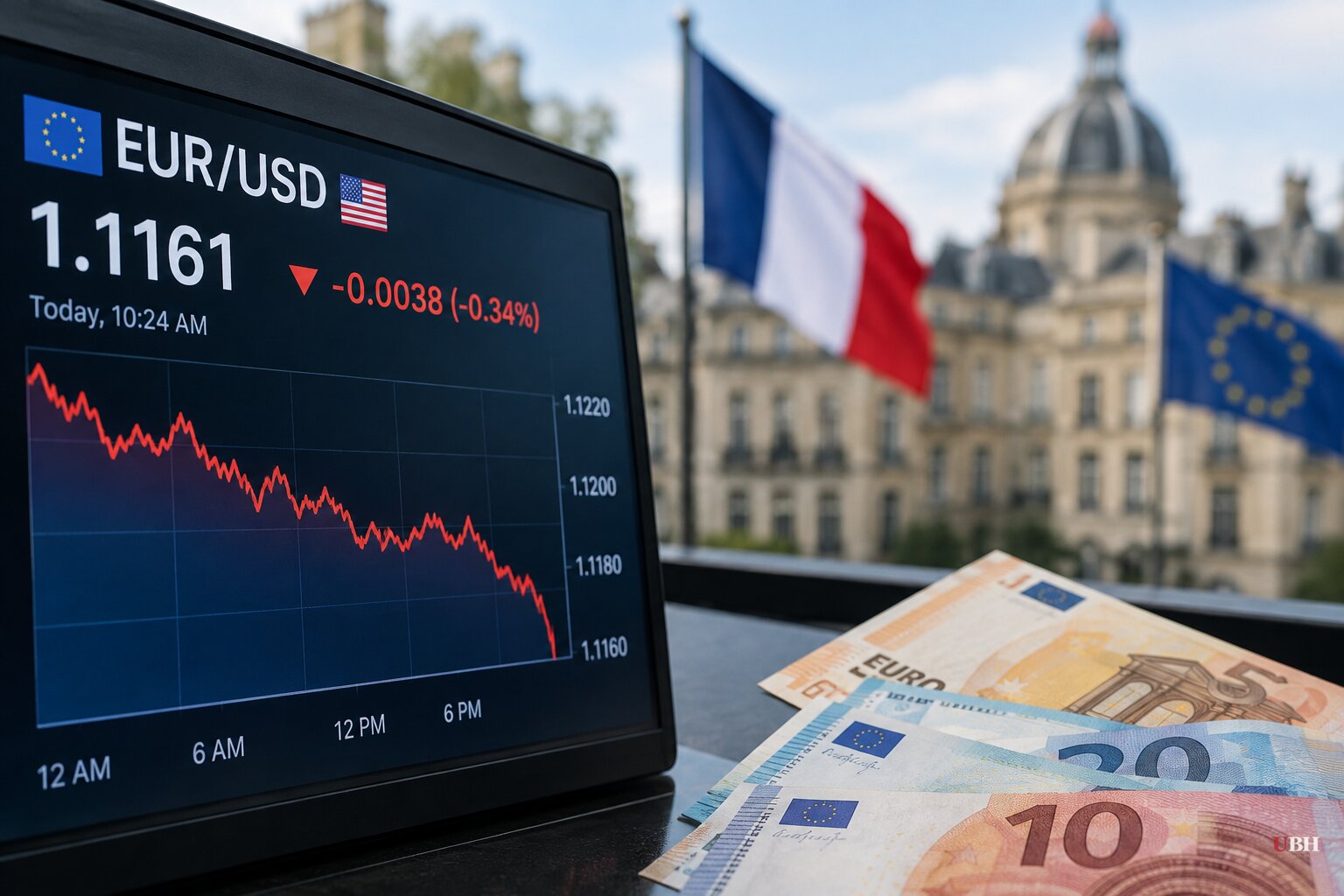
Since the France-Germany bond spread first blew out to levels unseen since 2011 on Friday, October 2, the selloff has only gotten worse. The euro fell as much as 0.8% Monday to touch $1.1161, according to Bloomberg, its weakest level since May 2025 and a fresh low below the $1.1291 mark it hit the previous Thursday, October 1, according to investingcube.
Two things are new today. First, Bloomberg reports that Spanish government officials are preparing for an early election, adding a second European political flashpoint on top of France. Second, the French bond rout has widened further rather than stabilizing after last week's budget announcement.
Fast Money Piles On
TradingView, citing Bloomberg, reported that hedge funds and other fast-money accounts sold the euro for dollars in Asian spot trading Monday, pushing prices through technical barrier levels and triggering options-related selling that compounded the drop. French bond futures slipped another 0.13%, hovering near the record lows they've held for weeks.
"The French politics trade that many expected would escalate this winter as April 2027 elections neared is here now," Brent Donnelly, president of foreign exchange trading at Spectra Markets, told Reuters. "It's not completely obvious what might fix things here as any budget promises made by the French government now are not super credible with a change of power coming soon."
The €43 Billion Budget That Isn't Enough
French Finance Minister Roland Lescure unveiled a budget for next year that includes €43 billion in spending cuts and tax increases, framing it as necessary to put France on a path toward deficit reduction, according to PrimeXBT, citing The Guardian.
The math doesn't impress bond markets. Even with the cuts, France's budget deficit would only fall to 5% of GDP, and analysts at ING warn that's still too high to stop French debt, already at 119% of GDP, from climbing further. ING did note the plan would at least keep the deficit from blowing out to 6.5% of GDP, a fair point in the government's favor even if it doesn't solve the underlying debt trajectory.
The bond market reaction has been ugly regardless. The gap between French and German 10-year borrowing costs widened to its broadest since 2012, and French 10-year yields briefly spiked to their highest level since 2002 before paring back, according to PrimeXBT. Deutsche Bank strategist Jim Reid flagged that the Franco-German spread widened by 13.9 basis points in a single day, the sharpest jump since March 2020.
Not Just France
Germany isn't immune either. Chancellor Friedrich Merz is facing mounting pressure after the far-right Alternative for Germany party posted gains in recent regional elections, a factor Rabobank's head of FX strategy Jane Foley says is weighing on the euro alongside Europe's exposure to high energy import costs and unwound long-euro positioning.
That combination of French fiscal rot, now Spanish political uncertainty, and German coalition strain is why the euro has struggled to hold any ground even as the European Central Bank has kept cutting rates, Foley said.
Dollar's Side of the Trade
The other half of the move is a stronger dollar. The Dollar Index rose 0.47% to 102.37 Monday, according to TradingView, with the greenback drawing support from still-elevated Treasury yields even after a weaker-than-expected US jobs report trimmed the odds of a Federal Reserve rate cut this month. Markets are now pricing less than a 20% chance of an October cut, though a December cut remains on the table, according to Global Banking and Finance. The 10-year Treasury yield sat at 5.262% Monday, down from last week's 24-year high of 5.342%, suggesting some of the bond-market panic has cooled on the US side even as it accelerates in Europe.
Sterling and the yen also lost ground against the dollar Monday, falling 0.24% to $1.32064 and trading at 157.92 per dollar respectively, per TradingView.
The OAT-Bund spread, while at its widest in over a decade, remains well below the levels Greece or Italy saw during the 2011-2012 euro crisis. But with France's presidential election still about 6 months away and no credible path to budget approval before a possible change in government, traders aren't waiting around to find out if this time is different.
Later Monday, markets get French and German services and composite PMI readings for September, plus eurozone producer price data for August, the next data points that could move the euro further, according to calendars published by Global Banking and Finance and WMBD Radio. Whether Spain actually calls an early election remains an open question Bloomberg has not yet confirmed.
Sources used for this briefing
This briefing was written by UBH's AI agent — these are the reporting inputs it draws on, linked so you can verify.


