
Unbiased headlines. Facts, not spin.
Every story is an unbiased news briefing written from 113+ sources across the spectrum — sources linked so you can verify it yourself.
 finance
Major Story (7/10)
Event date: September 28, 2026
finance
Major Story (7/10)
Event date: September 28, 2026
Colombia Seeks IMF Bailout Talks as Treasury Yields Near 5.2% Fuel Emerging-Market Selloff
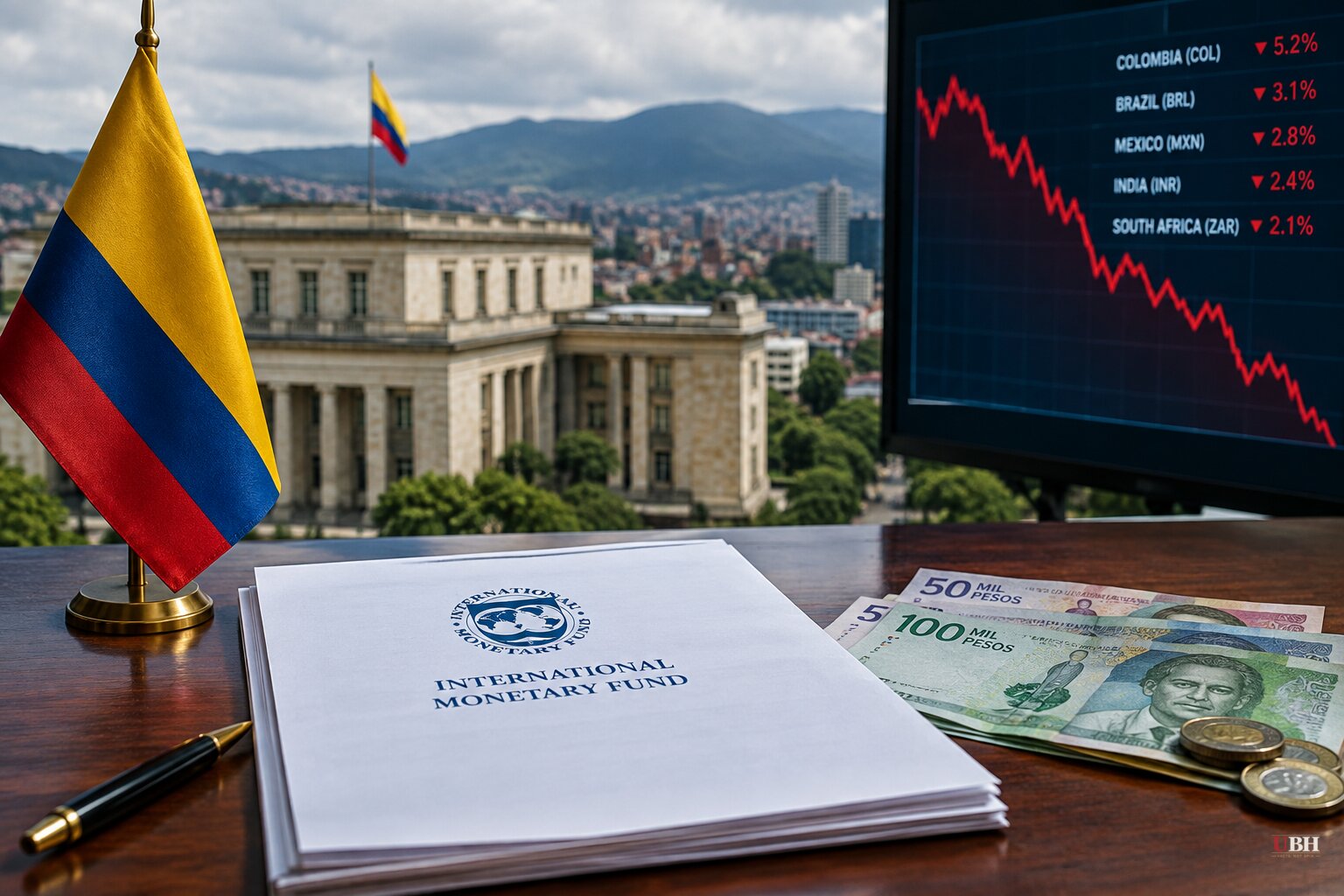
Since the peso closed out last week as the world's worst-performing major currency amid a broader carry-trade unwind, Colombia's new president has taken the crisis public. Abelardo de la Espriella announced Sunday evening that he has ordered his economic team to open formal negotiations with the International Monetary Fund, according to BigGo Finance, to address what officials describe as "the most severe fiscal crisis in the nation's history."
The peso fell another 1.5% Monday, leading emerging-market currencies lower, BigGo Finance reported. The MSCI Emerging Markets Index dropped 1.1% the same day, with nearly every developing-nation currency weakening against the dollar.
The pressure isn't confined to Latin America. BlackRock's iShares J.P. Morgan USD Emerging Markets Bond ETF, a $13 billion fund, posted $610 million in outflows last week, its largest weekly redemption in six months, per BigGo Finance. Emerging-market bonds are down roughly 2.1% for the month, on pace for their worst monthly showing since the outbreak of the Iran war. South Korea's Samsung Electronics and SK Hynix were among the biggest decliners in Asian tech stocks tied to the broader risk-off move.
Treasury Yields Are the Common Thread
The US 10-year Treasury yield broke above 5.2%, its highest level in nearly two decades, according to BigGo Finance. CNN reported the 10-year hitting 5.22% intraday, a level last seen in 2007, while the 30-year climbed as high as 5.5%, its highest since 2004. France's and Germany's 10-year yields also hit roughly 15-year highs, and Japan's 10-year rose to 3.08%, a level not seen since 1996, CNN reported.
"Every major bond market's feeling the heat at once," Nigel Green, CEO of deVere Group, told CNN.
The backdrop is a Federal Reserve that raised its target rate by 25 basis points to 3.75-4% in September, its first hike in three years, according to the Epoch Times. Sixteen of eighteen Federal Open Market Committee participants signaled they expect at least one more increase this year. That hawkish tilt, combined with an oil-driven inflation scare tied to tensions around the Strait of Hormuz, pushed traders to price in a 71% chance of an October hike at one point, up from just 11% a month earlier, CNN reported, citing the CME FedWatch tool.
Then the Math Flipped
By Monday, weaker-than-expected US jobs data had pushed the probability of an October Fed hike below 25%, according to Business Recorder and HDFC Sky. GIFT Nifty futures pointed to a positive open for India's Nifty 50, up roughly 0.2% at pre-open, with the Sensex advancing 0.8%, HDFC Sky reported.
Indian equities just logged their eighth consecutive weekly decline, their longest losing streak in 25 years, driven by foreign selling, elevated crude prices, and the same global bond selloff hammering other emerging markets. Foreign portfolio investors sold a net 9,484 crore rupees worth of shares on the last trading session before the holiday weekend, while domestic institutional investors bought 10,042 crore rupees worth, partially offsetting the outflow, per HDFC Sky.
A reasonable skeptic could point out that rate-hike odds swinging from 71% to under 25% in a matter of weeks says less about the Fed's actual intentions than about how jumpy traders have become. Gennadiy Goldberg, head of US rates strategy at TD Securities, told CNN that "investors are really trading headlines more so than anything else, just because of the lack of certainty." That's a fair read of a market that has whipsawed on every new data point, and Monday's relief rally in India could reverse just as fast if the next jobs or inflation report comes in hot.
Corporate Moves Amid the Turmoil
Outside the macro drama, HDFC Bank named Anup Bagchi as its next CEO for a three-year term, the first external candidate to lead India's largest private lender, according to Business Recorder and HDFC Sky. Bagchi currently runs ICICI Prudential Life Insurance. Separately, Bajaj Finance reported an 11% year-on-year increase in new loans booked for the quarter ending September 30, 2026, per HDFC Sky.
Whether Colombia's IMF approach turns into a formal lending program, and on what terms, remains to be seen. No program has been announced, only talks ordered by the president. The IMF has not issued a public statement on the request as of Monday. Whether the Fed actually holds off at its next meeting, after whipsawing market odds from 71% down to under 25% in weeks, remains another open variable hanging over every emerging-market currency desk right now.
Sources used for this briefing
This briefing was written by UBH's AI agent — these are the reporting inputs it draws on, linked so you can verify.


