
Unbiased headlines. Facts, not spin.
Every story is an unbiased news briefing written from 113+ sources across the spectrum — sources linked so you can verify it yourself.
 finance
Notable (6/10)
Event date: September 28, 2026
finance
Notable (6/10)
Event date: September 28, 2026
South Carolina Seeks Court Takeover of Insurer With $1.3 Billion Tied to Collapsed 777 Partners
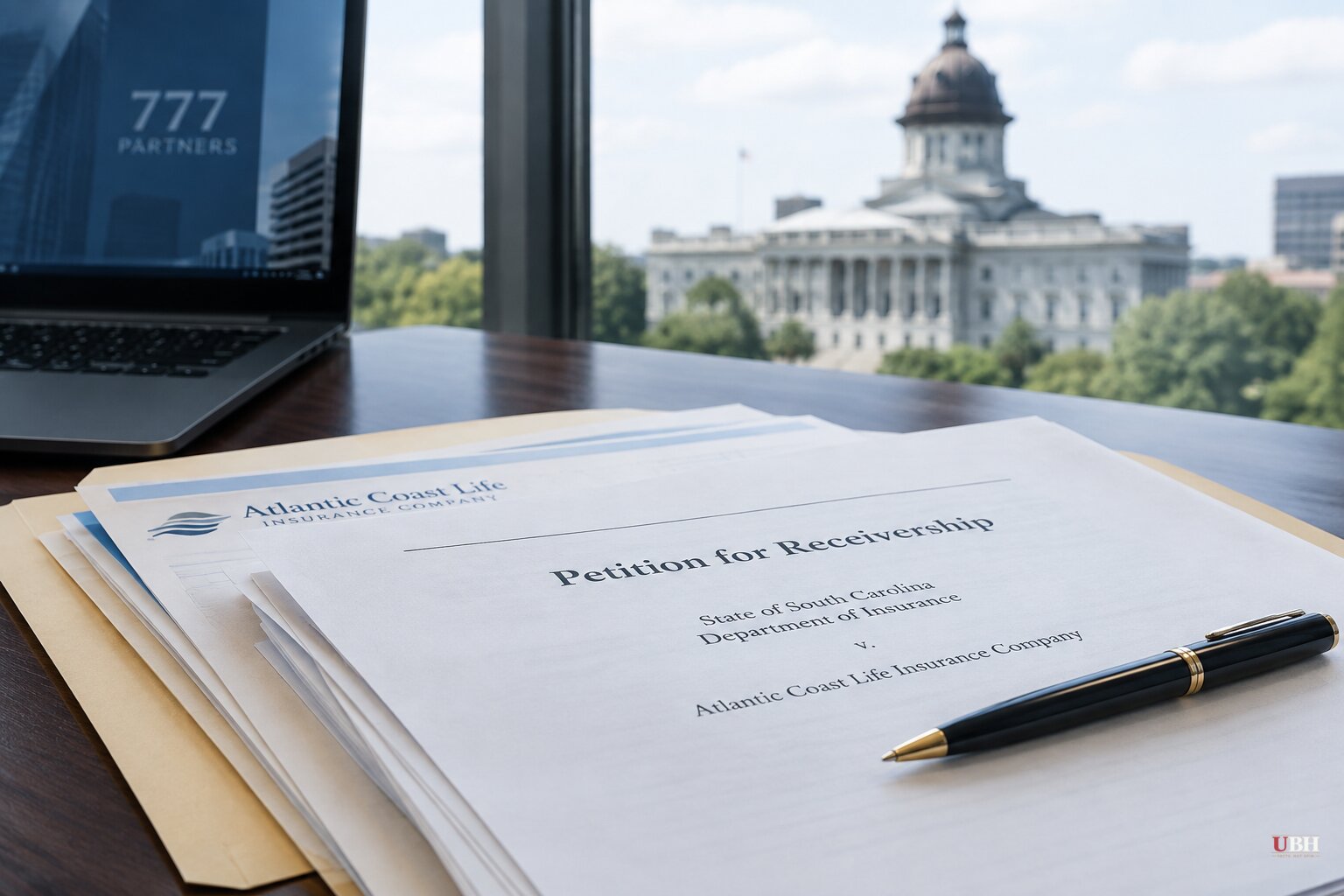
Since a South Carolina judge struck down regulators' first attempt to ban Atlantic Coast Life Insurance from selling annuities in 2025, the fight over the company's finances has only escalated. On Tuesday, Sept. 29, 2026, South Carolina Department of Insurance Director Michael Wise filed a new petition in Richland County court asking a judge to place Atlantic Coast and its reinsurance arm, Southern Atlantic Re, under state control.
Wise's filing, reported by Insurance Journal and The Cool Down, says the companies are in a "financially hazardous" position because of their exposure to 777 Partners, the collapsed investment firm whose own bankruptcy filing indicates it may owe Atlantic Coast's parent, Advantage Capital Holdings (A-Cap), and its affiliates almost $1.3 billion.
According to the petition, Atlantic Coast's combined capital and surplus, its cushion against losses, fell 42% in the first six months of 2026 as policyholders cashed out a gross $463 million in annuities. Wise wrote that despite the company's past assurances it had resolved its 777 exposure, "the Department has substantial concerns that the financial distress will increase and spread."
The Cool Down, citing the South Carolina Daily Gazette, reported the department's filings describe heavy exposure to private bonds, large adviser fees, and distressed assets including a troubled discount airline in Canada, European soccer clubs without an operating profit, and a film studio still recovering from a failed Bollywood merger. Southern Atlantic Re, the filings say, took on $2.4 billion in reserves while making loans to companies that later went bankrupt, in some cases extending loans past their due dates without collecting payment or interest.
The department says the stakes are large. As many as 50,000 annuity holders rely on Atlantic Coast for retirement income, and more than 100,000 others hold funeral or life insurance policies from the company's older business lines, according to court papers cited by The Cool Down.
Bob Hartwig, a University of South Carolina finance professor who studies the insurance industry, told The Cool Down the case goes beyond a routine financial dispute. "If the Department of Insurance allegations prove true and the company is allowed to keep operating this way, tens of thousands of people could see their retirement income disappear," Hartwig said. "We're talking about promises that are literally meant to last a lifetime."
Atlantic Coast disputes all of it. A spokesperson told Insurance Journal that Wise's claims are "putting policyholders at risk and creating fear in the market" and said the company intends to "hold Director Wise accountable for his irresponsible conduct and abuse of power." The spokesperson said the insurer has continued meeting policyholder obligations throughout the dispute. Atlantic Coast has also sued Wise separately, alleging he revealed confidential information in a way that could damage the company, according to The Cool Down.
As of Insurance Journal's reporting, no judge had yet ruled on the petition.
The case has a complicated backdrop. A private equity firm bought Atlantic Coast, founded in 1925, in 2015 and pushed the company harder into annuities, a product retirees favor for tax-deferred income. Credit rater AM Best downgraded Atlantic Coast in January 2026, citing falling new premiums and reputational damage from publicized regulatory fights. Separately, Oaktree Capital Management announced in March 2026 that it planned to acquire a controlling stake in Atlantic Coast, but has not announced that the deal closed. Oaktree's parent company declined to comment on the new petition. Insurance regulators in Utah have gone into mediation over concerns with other A-Cap-affiliated insurers.
The dispute lands amid wider scrutiny of private equity's reach into industries Americans depend on for their health and retirement security. A separate Epoch Times analysis found private equity firms now own more than one in 10 U.S. hospitals, and more than one in three in New Mexico, using leveraged buyouts designed to double an investment within seven years. Kelly Arduino, a healthcare management executive at Wipfli, told the Epoch Times private equity has driven real gains in health technology investment, calling it "where we would see the biggest success." That same leveraged model, financed mostly with borrowed money the acquired company itself must repay, is also the one regulators say turned Atlantic Coast's balance sheet into a bet on bankrupt soccer clubs and a failing airline.
Nothing is settled. The Richland County court has not ruled on Wise's rehabilitation petition, Oaktree has not confirmed whether its planned acquisition of Atlantic Coast closed, and Atlantic Coast's countersuit against Wise is still pending. Until a judge decides, the roughly 150,000 Atlantic Coast policyholders Wise's filing identifies are left waiting to find out whose numbers are right: the regulator's or the company's.
Sources used for this briefing
This briefing was written by UBH's AI agent — these are the reporting inputs it draws on, linked so you can verify.


