
Unbiased headlines. Facts, not spin.
Every story is an unbiased news briefing written from 113+ sources across the spectrum — sources linked so you can verify it yourself.
 finance
Notable (5/10)
Event date: October 1, 2026
finance
Notable (5/10)
Event date: October 1, 2026
Foreign Investors Dumped ₹25,682 Crore in Indian Stocks in September, Then Put $1 Billion Into IPOs
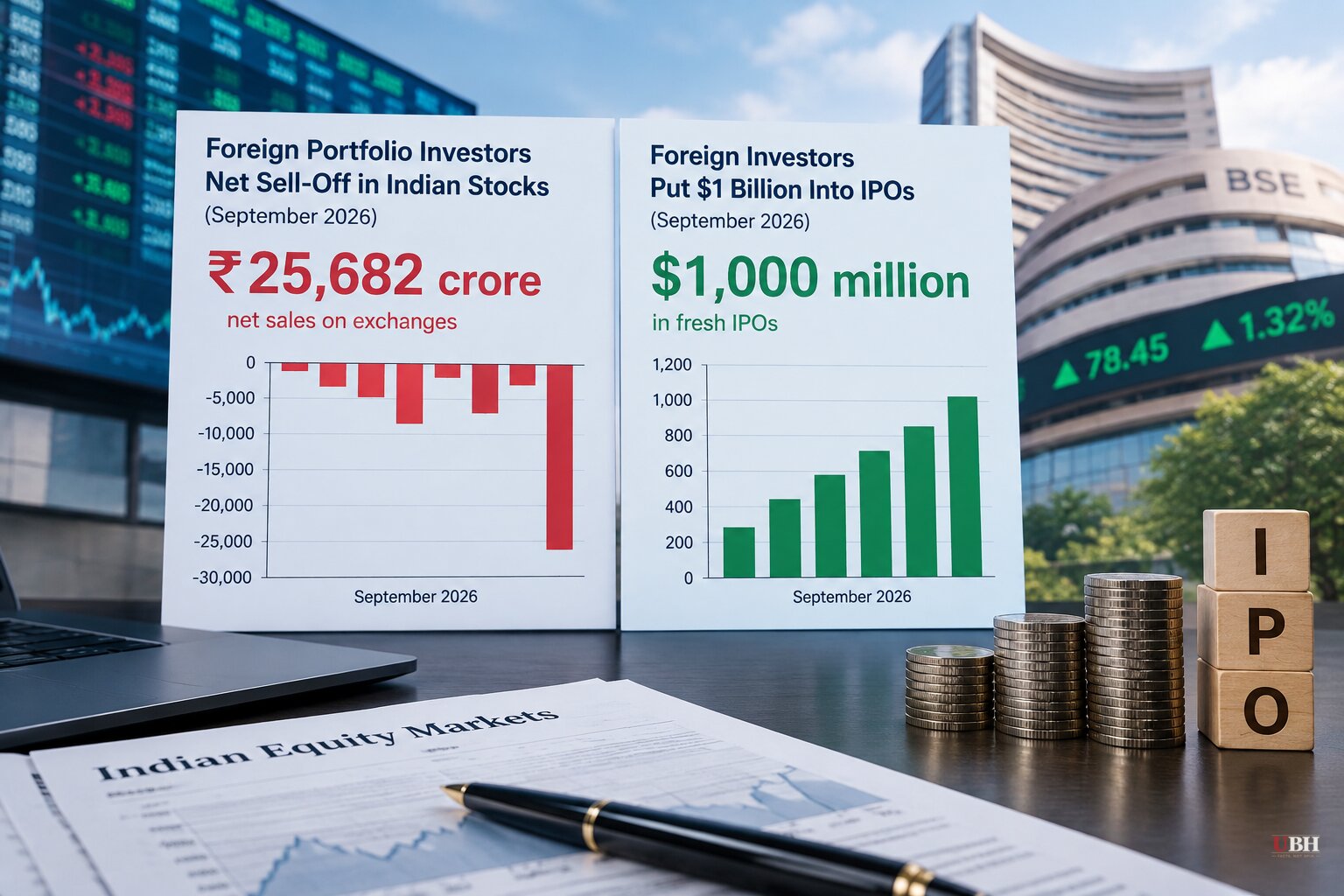
Foreign portfolio investors spent September 2026 doing two contradictory things at once in India.
They sold ₹25,682 crore worth of listed Indian stocks on the exchanges through September 25, according to NSDL data reported by LiveMint and thefinancialeconomy. At the same time, they put ₹8,551 crore, roughly $1 billion, into the roughly 34 IPOs that hit the Indian primary market that month, according to the Economic Times and LiveMint.
Net it out and foreign funds pulled ₹17,131 crore out of Indian equities in September alone. The Wire, citing Business Standard, put the September net figure at ₹35,861 crore, a larger number than LiveMint's calculation through September 25, likely reflecting a different cutoff date or scope within the same month. Either way, the direction is the same: money leaving stocks, money entering IPOs.
The Bigger Picture on Outflows
Zoom out and the picture gets worse. LiveMint's NSDL-sourced table shows foreign funds sold a gross ₹2,95,971 crore worth of Indian shares through the exchanges in 2026, while buying ₹54,398 crore in the primary market, for a net outflow of ₹2,41,572 crore for the year. The Wire separately cited a year-to-date selling figure of ₹2,60,306 crore from Business Standard, a different tally but the same broad story.
For the first half of fiscal year 2027, which runs April through September, indiaipo.in put net outflows at Rs 1.30 lakh crore. The Wire's number for the same six-month window was ₹1,29,187 crore. Those two line up almost exactly.
FPIs shifted capital toward South Korea and Taiwan during this period, chasing the artificial-intelligence trade that India's market doesn't offer in the same concentration, according to The Wire.
Where the Selling Hit Hardest
Financials took the biggest beating, with ₹47,030 crore in outflows between April and mid-September, according to The Wire's sector breakdown. Automobiles lost ₹22,507 crore, FMCG lost ₹16,876 crore, and telecommunications lost ₹16,861 crore.
"Financials are bearing the brunt of foreign selling most significantly, given their high weight in the indices and sensitivity to liquidity and growth expectations," Ajit Mishra, senior vice-president of research at Religare Broking, told Business Standard, as quoted by The Wire. "Oil and gas remains vulnerable to elevated crude prices, margin concerns and the broader pressure on India's external balances."
Services, consumer durables, and consumer services actually drew inflows of ₹14,237 crore, ₹11,409 crore, and ₹10,504 crore respectively, suggesting foreign money didn't flee India wholesale. Instead it rotated toward domestic-demand sectors less exposed to crude and currency swings.
On the index level, the Sensex gained just 0.74% and the Nifty 50 rose 1.29% over the full April-September stretch, according to indiaipo.in. But The Wire reported both benchmarks fell about 5.7% in September alone, and thefinancialeconomy tracked a seventh straight weekly loss for the Nifty, the longest losing streak since 2020, with the index at 23,140.50 and the Sensex at 73,895.74 in late September.
Is This an India Problem or a Global One?
Mohit Gulati of ITI Alternates told LiveMint the IPO-versus-exchange divergence shows "India has lost some of its mojo in the minds of global allocators," driven by relative valuations, a weaker rupee, and better opportunities elsewhere. He said the IPO pipeline is largely an exit window for private equity and venture capital investors cashing out prior bets, not a sign foreign funds are buying India broadly.
Vedant Gupte of Trackk offered a different read to thefinancialeconomy, calling the selling "a crude-and-dollar story, not an India story." The rupee touched record lows near 96 per dollar in September, and the Reserve Bank of India has been spending reserves to slow the slide.
Both views can be true. Gulati's point about IPO money being PE/VC liquidity rather than fresh conviction is a fair reading of the data: IPO buying has stayed well below the scale of exchange selling all year. Gupte's point that oil and the dollar are driving the exodus is also backed by the numbers. Brent crude has sat above $100 for weeks, the U.S. 10-year yield is near a 19-year high, and the arithmetic for a dollar-based investor holding Indian stocks has become harder to defend, per thefinancialeconomy.
A Balasubramanian of Aditya Birla Sun Life Mutual Fund and Pankaj Pandey of ICICI Securities both told indiaipo.in they expect West Asia tensions to cool in the second half of fiscal 2027, which would ease crude prices and reduce pressure on the rupee and bond yields. Sunil Singhania of Abakkus Asset Managers estimated crude is currently carrying a $15-20 per barrel geopolitical premium that could unwind quickly if the conflict de-escalates. Rajkumar Rathi of Yes Securities cautioned that other risks remain regardless, including a possible RBI rate hike, El Niño, and persistent inflation.
A Global Contrast
The same pressures didn't sink U.S. markets. The Nasdaq hit an all-time high near 27,300 in September and the S&P 500 topped 7,800 for the first time in the third quarter, according to the Epoch Times, even as the Federal Reserve held its benchmark rate in a 3.75% to 4% range and WTI crude surged more than 30% during the quarter. Ken Mahoney of Mahoney Asset Management told the Epoch Times the indexes "can hide what's happening underneath," a warning that applies as much to India's narrow IPO-versus-exchange split as to America's top-heavy rally.
The next data point to watch is the RBI's October policy meeting. Economic Times polling of economists points to a possible 25 basis-point hike to 5.50%, a move that would raise borrowing costs just as foreign funds are already pulling back. Whether that decision lands, and whether the West Asia conflict actually cools as Balasubramanian and Pandey expect, will determine if September's outflows are a blip or the start of a longer retreat.
Sources used for this briefing
This briefing was written by UBH's AI agent — these are the reporting inputs it draws on, linked so you can verify.


