
Unbiased headlines. Facts, not spin.
Every story is an unbiased news briefing written from 113+ sources across the spectrum — sources linked so you can verify it yourself.
 finance
Notable (6/10)
Event date: October 2, 2026
finance
Notable (6/10)
Event date: October 2, 2026
Steve Eisman Hedges AI Bets as BlackRock, Amundi and Morningstar Push Clients to Diversify Away From Concentration Risk
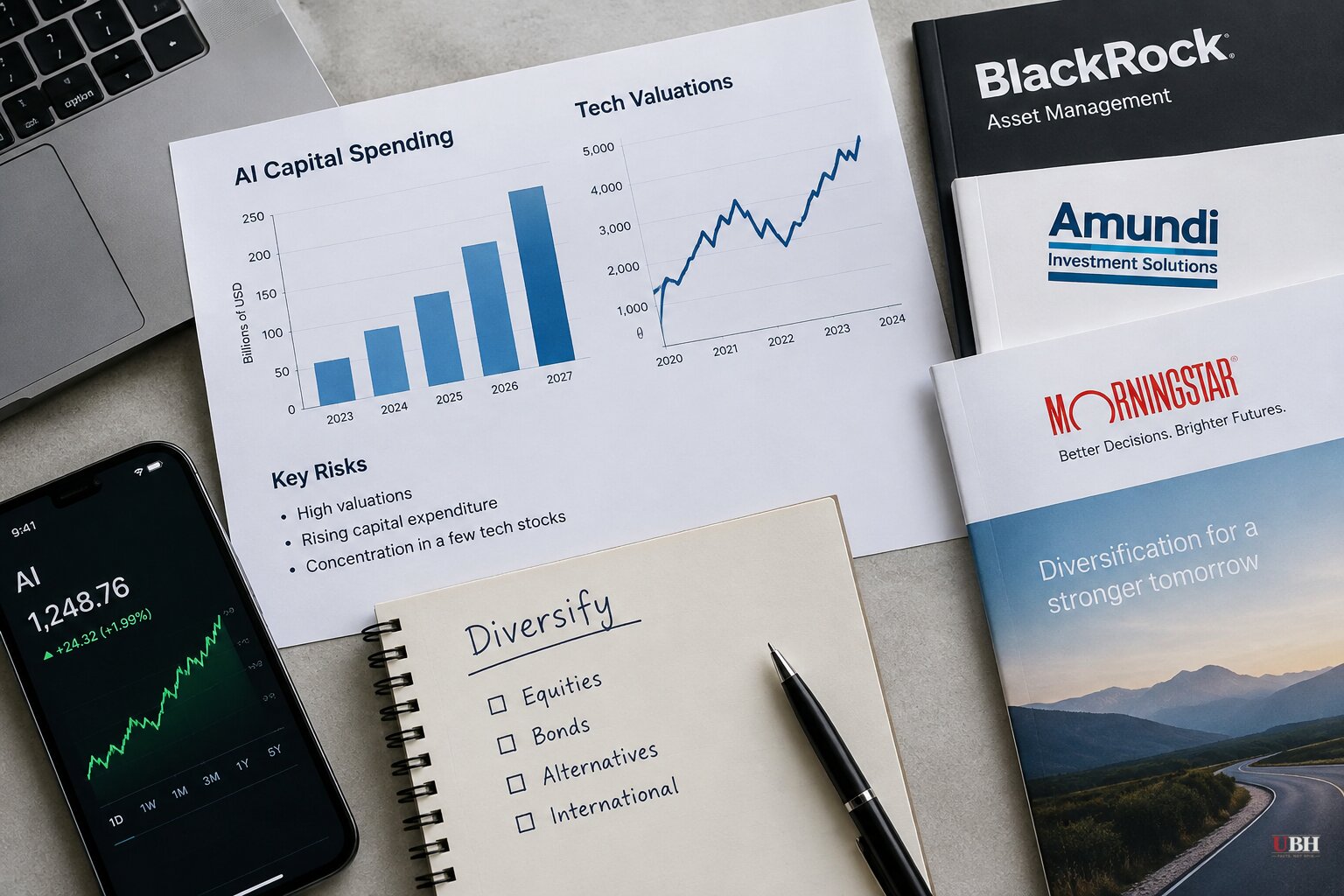
Since Michael Burry began warning in late 2025 that AI capital spending was tracking the dot-com bubble, the investor famous for predicting the 2008 subprime collapse has sharpened that case with specific dollar figures. Other Wall Street names are now backing their concerns with actual portfolio moves rather than just talk.
Steve Eisman, the investor whose bet against mortgage bonds was chronicled alongside Burry's in "The Big Short," told Prof G Markets he has started partially hedging four AI-related holdings. He called the move a shift from August, when he said he wasn't shorting the trade at all.
"I've played ball too. I've invested in these companies," Eisman said, describing the hedges as positions taken "against the box" — shorting part of stocks he still owns rather than selling outright. He wouldn't name the four holdings and said he isn't recommending the strategy to anyone else.
Eisman's worry isn't valuation. It's concentration. He estimates roughly 70% of AI-related revenue at Microsoft, Amazon, Alphabet and Oracle traces back to just two customers: OpenAI and Anthropic. "If anything bad happens to one of those two companies within the next year, everybody's in trouble," he said.
That estimate lines up with numbers from Anthropic's own paperwork. A prospectus reviewed by Reuters this week showed the company generated nearly $4.6 billion in 2025 revenue while losing more than $8 billion from operations, and disclosed $518 billion in future infrastructure obligations.
Eisman isn't predicting collapse. He called a bet that the AI story implodes "premature," and said he remains "mostly long." A Polymarket contract currently prices an 18% chance of an AI industry downturn by June 30, 2027, defined by at least three severe conditions, including Nvidia closing 50% below its all-time high, a 40% drop in a major semiconductor ETF, and a bankruptcy filing by OpenAI or Anthropic.
Burry's Numbers Get More Specific
Burry, writing in his Substack newsletter Cassandra Unchained, has moved from general bubble warnings to a detailed accounting of what five hyperscalers — Microsoft, Amazon, Alphabet, Meta and Oracle — have actually committed to spend.
He puts the aggregate figure, combining purchases, leases and third-party debt, at roughly $3 trillion. He adds that the group has made more than $1.5 trillion in supply-chain purchase commitments that don't show up on balance sheets but are disclosed in regulatory filings. That combination could push total spend to $5 trillion by 2028.
For context, Burry notes the combined earnings of those five companies came in under $400 billion over the past year. He also argues some of this spending is structured to stay off the books entirely. "A company can sign a non-cancellable 20-year data centre lease, disclose it in a footnote, and carry nothing on the balance sheet until the keys turn and the data centre boots up," he wrote.
Burry calculates current net investment as a share of U.S. GDP at 2.07%, a level he says hasn't been matched since the dot-com bubble of the late 1990s, and he expects the ratio to climb further in coming quarters. He separately points to Oracle's recent move to invoke a force majeure clause tied to a New Mexico data center project as evidence that even hyperscalers are looking for contractual exits.
Asset Managers Are Already Repositioning
BlackRock and Amundi are both telling clients the AI exposure problem has outgrown the obvious mega-cap tech names, according to Finance Monthly. BlackRock says AI-related concentration now runs through U.S. equities, emerging markets, and even euro investment-grade credit, meaning investors may carry more AI risk than standard asset-allocation labels would suggest.
BlackRock isn't advising clients to dump the sector. Its approach is to stay selective while diversifying into AI infrastructure, power and commodities alongside healthcare, emerging markets, income strategies and liquid alternatives, drawing a distinction between cutting concentration and cutting conviction.
Amundi's mid-year outlook, published June 29, makes a similar case, describing AI as a continuing structural driver of equity returns while warning that avoiding concentration will matter as the theme broadens across infrastructure providers and adopters. Its July hedge fund outlook goes further, arguing that traditional diversification is becoming less reliable because narrow leadership and common structural drivers — AI, power demand, infrastructure — are quietly linking assets that look different on paper.
Morningstar is making the same argument from the fund-selection side. Its latest "Best of Breed Asia" report highlights five actively managed global equity funds available in Hong Kong or Singapore that the firm says offer exposure beyond the dominant AI theme. Among them: the $15.7 billion BGF Systematic Global Equity High Income fund, run by Robert Fisher since 2014, which targets a 7% yield with a 0.8 beta relative to global equities; the $22 billion Fidelity Global Dividend fund, led by Dan Roberts since its 2012 launch; and the $6.9 billion JPM Global Select Equity fund, managed by Helge Skibeli since 2015.
"Broadly diversified portfolios generally achieve greater success than thematic ones over the long term," Morningstar associate analyst Yutong Cheng said, while acknowledging AI beneficiaries can still be held within a wider global portfolio.
The Counterargument on the Table
Not everyone treats the warnings as settled fact. Nvidia CEO Jensen Huang has publicly dismissed AI-safety predictions from computer scientist Geoffrey Hinton, who has said a roughly 10% chance of AI-driven catastrophe isn't an unreasonable estimate. Huang called Hinton's record of predictions wrong, pointing to a 2016 forecast that radiologists would be displaced by AI within years. A decade later, Huang said, they're still in demand. Huang argued dire predictions aren't automatically a social good and could discourage people from pursuing careers in the field. Hinton has said the risk is difficult to calculate precisely, which is itself part of the disagreement: critics of the AI buildout and defenders of it are both working from estimates, not hard data on what happens if a major lab stumbles.
That unresolved tension between an industry still generating losses in the billions and a spending commitment running into the trillions is exactly what Eisman, Burry, BlackRock and Amundi are now positioning around rather than waiting to see resolved. None of them are calling the top. They're all buying insurance.
Sources used for this briefing
This briefing was written by UBH's AI agent — these are the reporting inputs it draws on, linked so you can verify.


