
Unbiased headlines. Facts, not spin.
Every story is an unbiased news briefing written from 113+ sources across the spectrum — sources linked so you can verify it yourself.
 finance
Low Interest (4/10)
October 4, 2026 at 07:23 PM
finance
Low Interest (4/10)
October 4, 2026 at 07:23 PM
Buffett's First Tax Bill Was $7 in 1944. Berkshire's 2024 Bill Was $26.8 Billion. He Still Says It's Not Enough.
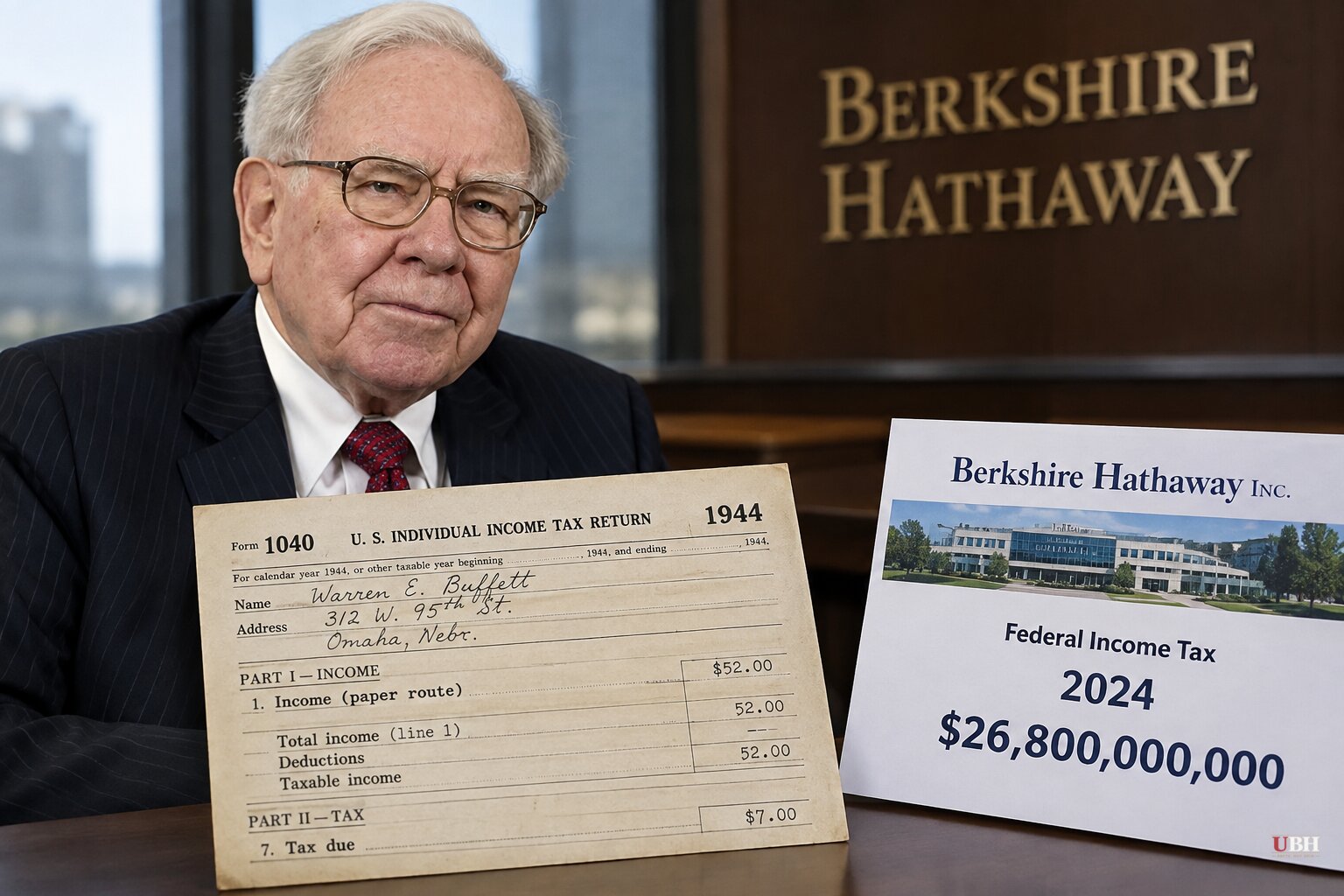
Warren Buffett filed his first federal tax return in 1944 at age 14. He owed $7.
That's according to the two-page filing Buffett shared with PBS NewsHour in 2017. The money came from delivering the Washington Post and the now-defunct Washington Times-Herald on a route that passed the homes of six U.S. senators and a Supreme Court justice, Buffett told PBS.
His total 1944 income was $592.50: $364 from the paper route and $228 in interest and dividends from three shares of Cities Service Preferred stock he'd bought at age 11. Under IRS rules at the time, anyone earning $500 or more had to file, minor or not.
Buffett even itemized deductions, attaching a handwritten note for $10 in watch repair and $35 in bicycle upkeep, both tools of his paper route. Adjusted for inflation, that $592.50 income would be worth $11,406.65 today, and the $7 tax bill would be $134.76.
From $7 to $26.8 Billion
Fast forward to 2024. Berkshire Hathaway, the conglomerate Buffett ran as CEO from 1965 until stepping down at the end of 2025 (he remains chairman, with Greg Abel now serving as CEO), paid $26.8 billion in federal taxes, according to Buffett's annual shareholder letter. Buffett described it as the largest tax payment ever made to the U.S. government.
Buffett, worth $142 billion according to Fortune, has never framed his taxes as a burden. He's said the opposite for decades: that he and people like him don't pay enough.
He's also been candid about Berkshire's own history. Before he took control of the company in 1965, Buffett wrote in his shareholder letter, Berkshire "did not pay a dime of income tax," something he called "an embarrassment." He added that kind of tax avoidance "may be understandable for glamorous startups, but it's a blinking yellow light when it happens at a venerable pillar of American industry."
"I have paid federal income tax every year since 1944," Buffett said in a 2016 statement responding to questions about his returns.
The Counterargument Buffett Rarely Addresses Directly
Buffett's core argument, repeated since at least his 2011 New York Times op-ed, is that his effective tax rate is lower than his secretary's because most of his income comes from capital gains and dividends, taxed at lower rates than wages. That argument became the basis for the "Buffett Rule," a proposed minimum tax on millionaires that President Obama championed in 2012. It failed in the Senate.
Critics, including Republican lawmakers and conservative commentators at the time, pushed back on the comparison itself, arguing that stacking payroll taxes and income taxes for a secretary against a capital-gains rate for an investor compares two different tax bases, not apples to apples.
There's a second, more pointed critique: Buffett doesn't take a large salary, Berkshire doesn't pay a dividend, and Buffett's wealth sits almost entirely in unrealized stock gains that go untaxed until sold. That's a legal and common strategy for the wealthy, but it means Buffett's own tax exposure stays low by design, the same design he says the tax code should close.
Buffett has also pledged to give away more than 99% of his fortune, mostly to the Gates Foundation and family charities, rather than to the U.S. Treasury directly. The federal government does accept voluntary extra payments through a program for gifts to reduce the public debt, an option that exists but that Buffett has not publicized using in any significant way. Supporters of Buffett's position would note that one billionaire's voluntary check doesn't fix a tax code he believes is structurally tilted, and that charitable giving and tax policy reform aren't mutually exclusive goals.
Both things are true at once: Berkshire Hathaway wrote the largest tax check in U.S. history in 2024, and Buffett still says the system lets rich people like him off easy. Congress hasn't revived the Buffett Rule since it died in the Senate in 2012, and no new version is currently pending. Whether that changes likely depends less on Buffett's shareholder letters than on which party controls Washington after the 2026 midterms.
Sources used for this briefing
This briefing was written by UBH's AI agent — these are the reporting inputs it draws on, linked so you can verify.


