
Unbiased headlines. Facts, not spin.
Unbiased Headlines is an independently owned news organization. We bring you the facts, not opinions, written fresh from 110+ named sources. Sources linked so you can verify it yourself.
 health
Notable (5/10)
Event date: October 26, 2026 ·
South Korean Study: Young Adults With Obesity Had Higher 10-Year Cancer Rates, With Modest Absolute Risk
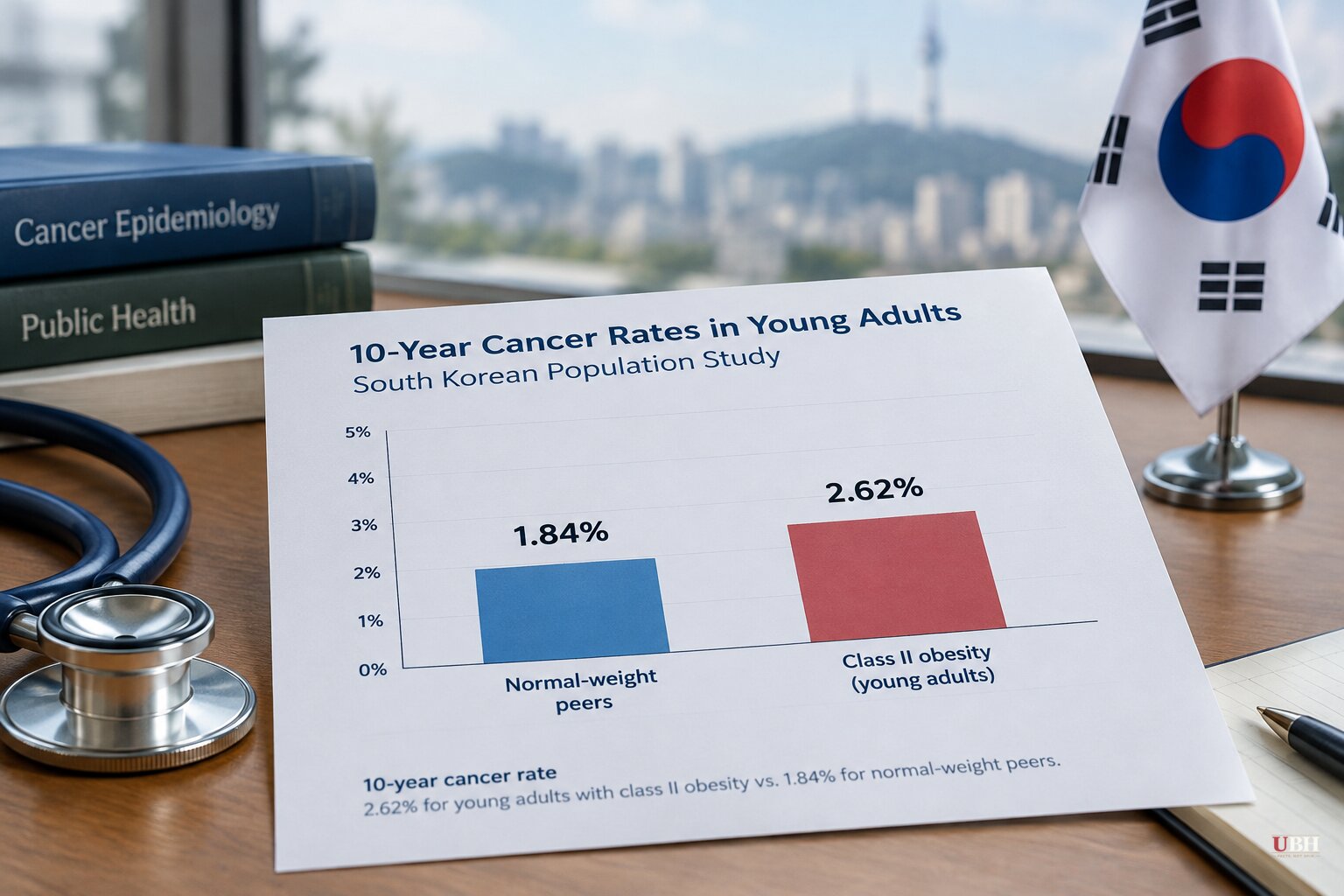
Young adults with obesity developed cancer at higher rates over the next decade than normal-weight peers, according to a large population-based study from South Korea published in the Annals of Internal Medicine.
The 10-year cumulative incidence of any cancer ranged from 1.84% in normal-weight people to 2.62% in people with class II obesity. Class II obesity was defined as a body mass index of 30 or above, using Asian-specific categories.
The study drew on a national health insurance database for 2009-2021 and identified 6.3 million adults in the studied age range who underwent at least one national health examination during 2009-2012. The authors defined young adults as ages 20-39. Over a mean follow-up of 11.2 years, 151,893 cancers were documented. The risk persisted into middle age, the authors found.
Which cancers, and who
The researchers, led by Kyungdo Han, PhD, of Soongsil University in Seoul, broke results out by cancer type. The highest 10-year rates were for thyroid, endometrial and ovarian cancer. Colorectal, kidney, liver and pancreatic cancers followed.
Breast cancer ran the other way. Ten-year rates were lower in people with obesity than in normal-weight young adults.
The obesity-cancer link was stronger in men. Cancer hazards were higher for men (1.13, 1.29, and 1.58 across the BMI categories) than for women (1.08, 1.15, and 1.28). Abdominal and visceral fat added to the risk beyond what BMI alone showed.
Small numbers, consistent pattern
The authors did not oversell it. "Although the absolute risk differences were modest, the consistency of associations across multiple cancer types and the young age of the population underscore the potential importance of early-life weight management," they wrote.
Alpa Patel, PhD, of the American Cancer Society in Atlanta, who was not involved in the study, said the low absolute rates reflect the age group. People between 19 and 39 have a low overall cancer risk to begin with.
Patel said the findings reinforce existing evidence. "This study provides additional insights into early-onset cancers, which are not as well represented in older studies," she told MedPage Today.
She also pointed to the timing of the data. "This is also a more contemporary study population, with the start of the follow-up period occurring between 2009 and 2012, so the trends reflect more of the current landscape."
The smoking complication
Patel flagged a shift in who smokes. The authors report that people in higher BMI categories are more likely to be current smokers. Historically, smoking was more common among people with lower BMI.
That matters because smoking independently raises cancer risk. The study reported smoking status but not intensity or duration, which Patel called a notable limitation. The investigators accounted for multiple covariates, including smoking status, alcohol intake, physical activity, residential area, income level and comorbid conditions.
Why young adults
Obesity is already tied to more than a dozen cancers. One recent study suggested that up to 10% of the global cancer burden might be attributable to overweight and obesity. Multiple studies have also shown recent increases in early-onset cancers amid a global rise in obesity prevalence.
Yet most obesity-cancer research has included limited information on young adults. Han and colleagues noted that cancer prevention strategies have mostly targeted middle-aged and older people.
The study shows an association, not proof that obesity caused these cancers. The authors do not claim that losing weight in early adulthood reduces later cancer risk. They frame that as a question for future research.
What comes next
The authors called for prospective studies to determine whether intentional weight loss in early adulthood lowers subsequent cancer risk. They also want research to identify clinical settings where early cancer screening for young adults with obesity might be warranted.
Sources used for this briefing
1 link from 1 independent newsroom (syndicated copies of the same report count once)
These are the sources it draws on, linked so you can verify.


