
Unbiased headlines. Facts, not spin.
Unbiased Headlines is an independently owned news organization. We bring you the facts, not opinions, written fresh from 110+ named sources. Sources linked so you can verify it yourself.
 health
Notable (5/10)
Event date: October 26, 2026 ·
Kidney Week 2026: Strict Low-Protein Diets Tied to Higher Dialysis and Death Risk in Korean Study
Decades of advice to kidney patients to cut protein hard just took a hit.
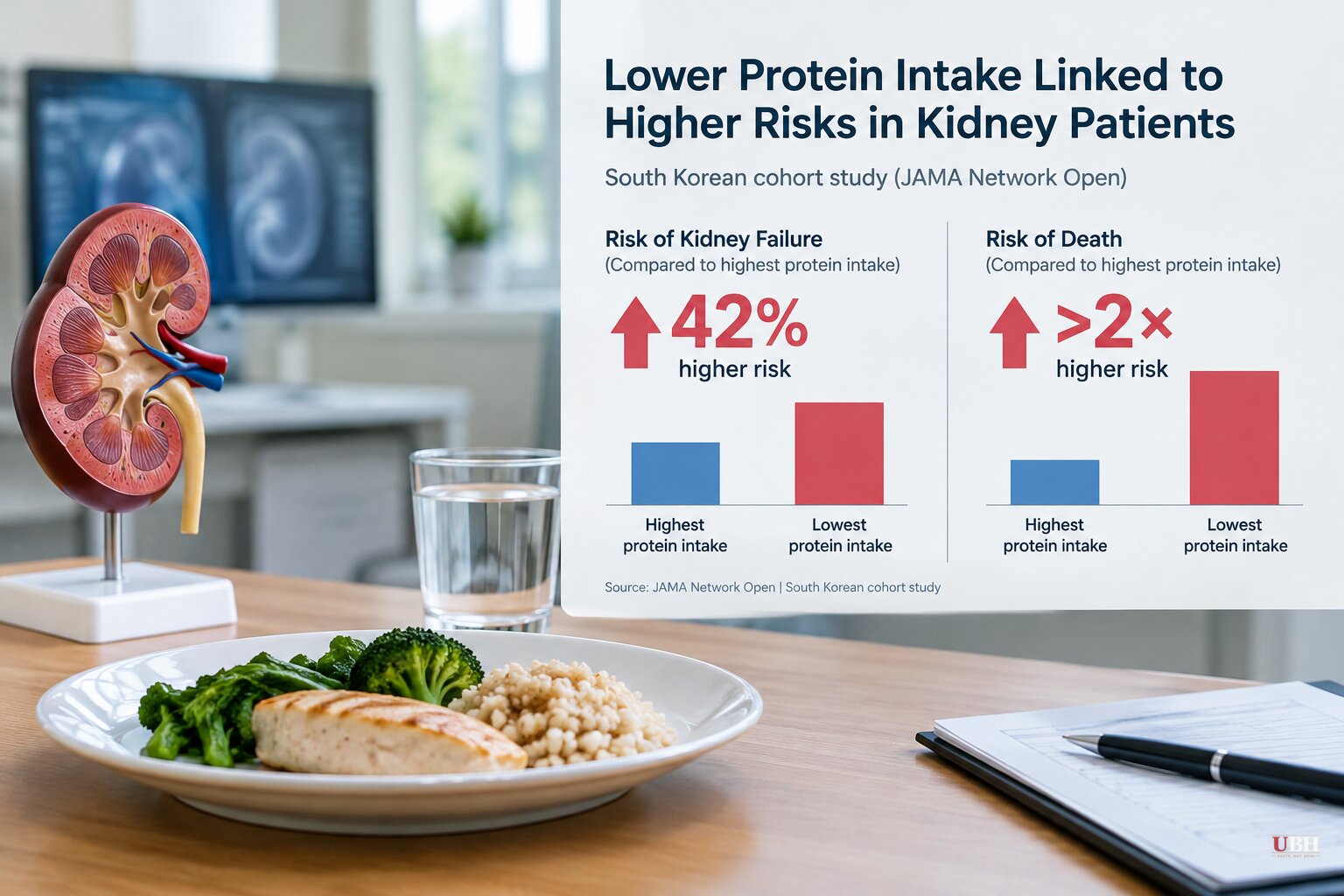
A prospective cohort study from South Korea, published in JAMA Network Open and presented at the American Society of Nephrology Kidney Week meeting in Denver, found that strict protein restriction was associated with worse outcomes in chronic kidney disease (CKD) patients not on dialysis.
The protein numbers
Patients who ate the least protein (under 0.6 g/kg of body weight per day) were compared with those who ate the most (1.2 g/kg or more).
The low-protein group had a 42% greater risk of kidney failure requiring dialysis or a transplant (subdistribution hazard ratio 1.42, 95% CI 1.09-1.85).
They also had more than double the risk of death from any cause (sHR 2.17, 95% CI 1.17-4.03). Major adverse cardiovascular events were not higher.
The lead author is Soo Wan Kim, MD, PhD, of Chonnam National University Medical School in Gwangju. His team wrote that "maintaining adequate nutritional status and preventing protein-energy wasting may be as critical as reducing the kidney workload."
The study is observational. It shows an association, not proof that the diet caused the outcomes.
Why restriction became standard
The old logic is straightforward. Kim's team described the premise this way: protein intake is "a primary source of uremic toxins and metabolic acidosis, which together drive intraglomerular hypertension and accelerate the progression of kidney injury."
Less protein, less workload for failing kidneys. That reasoning drove guidance near 0.6 g/kg per day for years.
The guidelines have already moved. In 2024, KDIGO shifted toward about 0.8 g/kg a day for CKD stages 3-5. The study authors note that figure matches the recommended daily allowance for the general population.
Kim's team said the findings "provide robust longitudinal evidence to support this normalization," and that the risks of the 0.6 threshold "may outweigh the marginal benefits of kidney workload reduction."
George Bonifant, MD, nephrology fellowship program director at Northwell Staten Island University Hospital, was not involved in the study. He said low-protein diets have been prescribed for decades but "this strict advice has been debated." He warned that patients staying under 0.6 g/kg face substantial risks of protein-energy wasting.
Sparsentan versus irbesartan in FSGS
A separate meta-analysis, presented Oct. 23 by Z. Ahmed and colleagues, pooled two randomized trials of sparsentan in focal segmental glomerulosclerosis (FSGS), a rare scarring disease of the kidney's filters.
The trials were DUET (8 weeks) and DUPLEX (12 weeks). Together they enrolled 480 patients with biopsy-proven FSGS. Sparsentan was compared with irbesartan, an angiotensin II receptor blocker.
Partial proteinuria remission was more likely with sparsentan (risk ratio 1.77, 95% CI 1.22-2.58). So was complete remission (RR 2.67, 95% CI 1.34-5.30).
Blood pressure also fell further at week 8, by a mean difference of 7.2 mmHg systolic and 5.6 mmHg diastolic.
Kidney function was less clear-cut. The eGFR difference of -4.2 mL/min/1.73 m2 favored irbesartan but was not statistically significant (P=.28). The authors noted early eGFR decline was numerically greater with sparsentan.
The authors called the safety profile acceptable. They also acknowledged the analysis rests on only two trials of different lengths, which limits how far the results generalize.
Fruits and vegetables for acid buildup
The third study, led by corresponding author Nimrit Goraya, MD, of Baylor Scott and White Health, is a 10-year randomized trial of 108 adults with stage 3 CKD and metabolic acidosis. It was slated for presentation at Kidney Week, which ran Oct. 22-25.
Participants were split into three groups of 36: fruits and vegetables, oral sodium bicarbonate, or usual care. Both active treatments aimed to cut dietary acid by half.
Over 10 years, the fruit-and-vegetable group had 14 hospitalizations and 20 emergency visits. The usual-care group had 64 and 88.
Only four patients in the diet group needed dialysis, versus 16 in usual care. Sodium bicarbonate showed no difference from usual care on any of those measures.
Goraya said the dietary approach was associated with "more favorable long-term clinical outcomes and health care utilization" than bicarbonate or usual care, "without increasing overall health-system or societal costs."
The sample is small, with 36 patients per arm. The authors want dietary interventions evaluated at the population level, which this trial was not designed to do.
What comes next
None of these findings changes a prescription on its own. The protein study already lines up with KDIGO's 2024 shift to 0.8 g/kg, so the open question is how quickly clinicians who still prescribe the strict 0.6 target will adjust.
The sparsentan and fruit-and-vegetable results come from limited trials. Larger studies would have to confirm them, including whether sparsentan's early eGFR dip matters over time.
Sources used for this briefing
3 links from 3 independent newsrooms (syndicated copies of the same report count once)
These are the sources it draws on, linked so you can verify.


