
Unbiased headlines. Facts, not spin.
Unbiased Headlines is an independently owned news organization. We bring you the facts, not opinions, written fresh from 110+ named sources. Sources linked so you can verify it yourself.
 health
Notable (5/10)
Event date: October 25, 2026 ·
High-Dose Vitamin D Did Not Improve Survival in 3,866 Dialysis Patients, UK Trial Finds
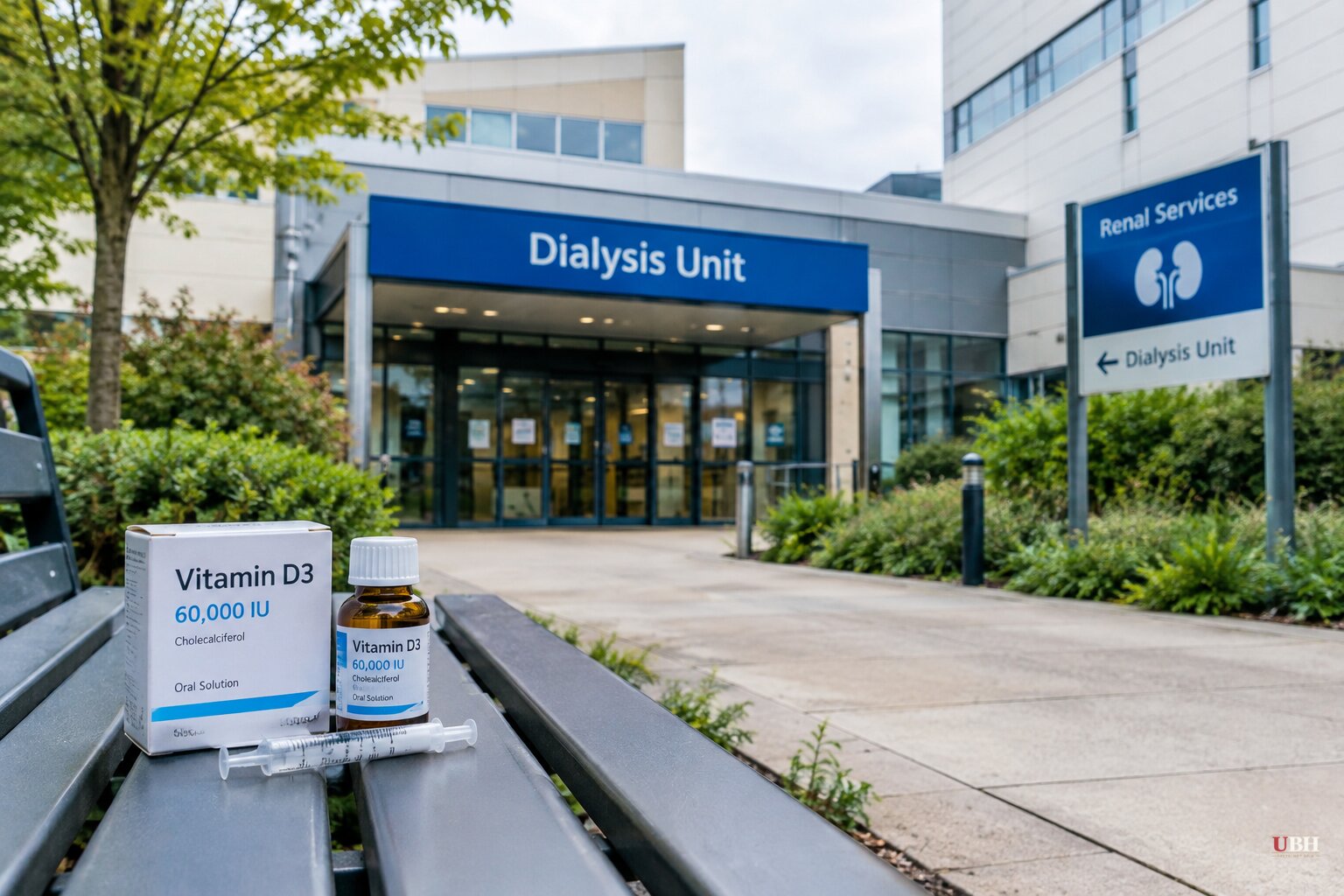
A large UK trial has found that high-dose vitamin D does not help dialysis patients live longer.
The SIMPLIFIED trial randomized 3,866 adults with end-stage kidney disease at 55 renal units in England, Scotland and Wales. Half received 60,000 IU of cholecalciferol (vitamin D3) every two weeks. The other half got standard care with no supplementation.
Rona Smith, MD, of the University of Cambridge and Addenbrooke's Hospital, presented the results at Kidney Week, which ran Oct. 22 to 25.
The numbers
Over a median follow-up of 7.5 years, 883 of 1,940 patients in the vitamin D group died (45.5%). In the standard-care group, 934 of 1,926 died (48.5%). The hazard ratio was 0.95, and the 95% confidence interval of 0.86 to 1.04 includes no effect at all.
The trial recorded 1,817 deaths in total.
Secondary outcomes did not move either. There were no significant differences in fatal and nonfatal cardiovascular events, infections, fractures or malignancy. The composite of first hospitalization for cardiovascular causes had a hazard ratio of 0.96.
The vitamin did raise blood levels. In an early subgroup of about 200 participants, median 25-hydroxyvitamin D reached 141 nmol/L after four months on supplements, against 36.5 nmol/L in the control group. The drug got into the bloodstream. It just did not change outcomes.
"The findings don't support routine supplementation of high-dose cholecalciferol," Smith said.
Why the trial was run
Dialysis patients do badly. Smith noted that by five years, half of those who start dialysis are dead, and most deaths come from cardiovascular disease. Vitamin D deficiency is very common in this group, and observational data link low levels to higher mortality.
The international KDIGO guidelines suggest measuring 25-hydroxyvitamin D in patients with stage 3 to 5 chronic kidney disease, dialysis patients included, and correcting deficiency. Smith said the guidelines "recognize that the grade of evidence for this is low," and SIMPLIFIED was designed to fill that gap.
The trial was pragmatic by design. After a baseline in-person visit, follow-up was remote, and outcomes were pulled from routinely collected electronic health records. Smith called it one of the largest dialysis trials ever conducted.
The National Institute for Health and Care Research (NIHR) funded the study, which began in 2017 and was led by Cambridge University Hospitals NHS Foundation Trust and the University of Cambridge. Follow-up finished in October 2025.
Who was enrolled
Median age was 65. About 68% of participants were men, 80% were white, roughly 10% Black and 8% Asian. About 40% had diabetes, and 94% were on in-center hemodialysis, with a median of 2.25 years on dialysis.
Patients were excluded for a life expectancy under six months, persistent hypercalcemia, or more than 1,000 IU of daily vitamin D3 in the prior 30 days. The trial was open-label, meaning patients and clinicians knew who was getting the supplement.
The call for more research
Kidney Care UK, a patient charity, said the overall result showed no benefit but that there were "possible interesting findings for non-white patients and men." The charity is urging further research. Those are subgroup signals. The trial's headline result was neutral, and nothing in the presented data shows the subgroup patterns would hold up in a dedicated study.
Fiona Loud, the charity's policy director, said treatments for kidney failure "have barely changed in the last couple of decades." She argued the trial points to where vitamin D "may potentially be effective, for those in under-represented groups," and said "we now need more investment to develop these initial research findings further."
The charity says about 30,000 people in the UK rely on dialysis and that survival has not improved in decades.
Sameer Solomon, 31, a trial participant and member of the charity's patient advisory group, has been on dialysis for more than three years and spends over 70 hours a week on treatment. He said people of colour are often underrepresented in research and that the results show why that matters.
What comes next
Guidance is the most immediate concern. KDIGO's recommendation to correct vitamin D deficiency in dialysis patients rests on what its own authors call low-grade evidence, and this trial is now the largest randomized test of the practice. KDIGO has not said whether it will revise that recommendation.
SIMPLIFIED tested one high-dose regimen in an unselected dialysis population. Whether the subgroup differences in men and non-white patients reflect anything real remains for follow-up research to answer.
Sources used for this briefing
4 links from 4 independent newsrooms (syndicated copies of the same report count once)
These are the sources it draws on, linked so you can verify.


