
Unbiased headlines. Facts, not spin.
Unbiased Headlines is an independently owned news organization. We bring you the facts, not opinions, written fresh from 110+ named sources. Sources linked so you can verify it yourself.
 health
Notable (6/10)
Event date: October 23, 2026 ·
Canada Plans Advance Euthanasia Requests for Dementia Patients; Ministers Brief Press Oct. 27
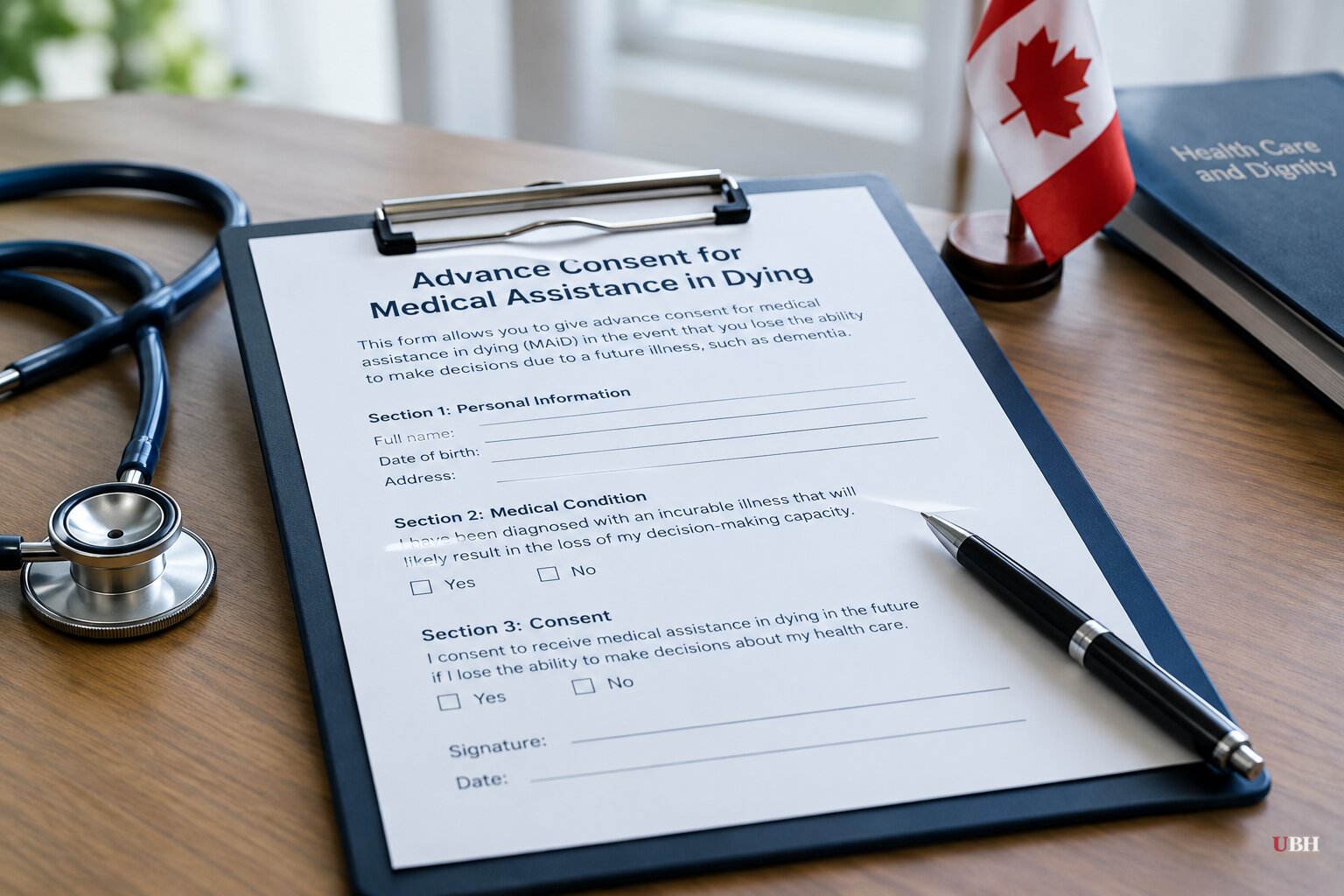
Canada is moving to let people decide, while still competent, that they want to die later, after dementia has taken away their ability to decide anything.
The federal government announced on Oct. 7 that it would introduce legislation to decriminalize and permit advance requests for medical assistance in dying, known as MAID. The Department of Justice followed on Oct. 23 with a media advisory. Justice Minister Sean Fraser and Health Minister Marjorie Michel will hold a media availability Tuesday, Oct. 27, at 1:00 p.m. ET at the National Press Theatre in Ottawa. A technical briefing for accredited press gallery members comes first, at 11:45 a.m., held virtually.
What the government says it will do
The advisory describes updates that "would also allow adults to consent in advance to receive MAID later with rigorous safeguards, following a diagnosis of an incurable illness expected to take away their ability to make this decision."
Fraser said the government will "grant access to medical assistance in dying to people who have provided consent at a time when they still have capacity but know that they have been diagnosed with an illness that will take that capacity from them subsequently."
The changes include Criminal Code amendments. They are meant to ensure a doctor who provides MAID to an eligible person on the basis of an advance directive "will not be treated as a criminal in Canada going forward," according to the government's description.
The same package drops a separate plan. MAID for people whose only underlying condition is mental illness had been scheduled to begin in March 2027. The government has said it will not proceed. Fraser said: "While there is not a perfect consensus on this issue, we believe this is the correct approach at this particular time."
Quebec already did it
Quebec became the first province to allow advance requests in 2024. It remains the only one.
Under the Quebec model, only a person diagnosed with a serious and incurable illness leading to incapacity to consent to care may make an advance request. The person must also name a physician or specialized nurse practitioner willing to carry it out.
Nothing federal becomes law until the bill passes the House of Commons and the Senate and receives approval from the governor general. Parliamentary committees can hear testimony and amend it along the way.
The liberty argument
Supporters frame this as a question of individual autonomy. Writing in Reason, a libertarian-leaning magazine, one author argues that a competent adult's decision about how much suffering to endure deserves respect, and that losing capacity should not "automatically grant the government authority to override instructions given while the patient was competent."
The same piece notes that U.S. laws, which exist in 13 states and Washington, D.C., generally follow the Oregon model. That model requires decision-making capacity, a terminal diagnosis with six months or less to live, and self-administration of the drug. Patients with progressive dementia may lose capacity before they would qualify.
Dying With Dignity Canada, which has long pushed for advance requests, is critical of the government's design. The group calls the approach "fundamentally flawed" because it hands implementation to the provinces and territories. It warns the result will be a patchwork that increases inequity in access rather than a single federal framework.
The objections
Dementia Justice Canada, chaired by lawyer Heather Campbell Pope, wants Parliament to test whether safeguards can catch coercion, undue influence and elder abuse. Pope said: "A court can undo a will that was unduly influenced. But once MAID is provided, there is no meaningful remedy if we later find that the person was pressured to make the advance request, that they had changed their mind, or that they are going along with it because of pressure or coercion. It is simply too late."
The group also notes that the UN Committee on the Rights of Persons with Disabilities urged Canada in March 2025 not to expand MAID to advance requests.
University of Toronto bioethicist Kerry Bowman said he is not necessarily opposed. He called the principle "profoundly ethically complex," noting the difficulty of predicting how a disease will progress. "The concern is you've almost got a stranger making a decision for a stranger," he said. He also flagged that withdrawing consent becomes complicated for patients with "no capacity to withdraw." Quebec's law lets a patient withdraw or modify a request.
University of Toronto health law professor Trudo Lemmens has argued that advance requests cross "the line between clear consent and no consent."
Opponents also point to the Netherlands, where euthanasia of dementia patients on the basis of prior written consent has been legally shielded from prosecution since an April 2020 ruling. Critics describe a Dutch case in which a woman with dementia who had made an advance request was reported to be confused and wanting to live at the time of her death, and in which family members held her down. Prosecutors argued the doctor had not properly consulted the 74-year-old patient. A Dutch court acquitted the doctor, ruling that all requirements of the euthanasia law had been met.
The mental-illness reversal
Right To Life welcomed the decision to indefinitely exclude mental illness as a sole condition. Some opponents of MAID expansion say that is not enough. One commentator at the Discovery Institute's Science and Culture site noted that "indefinite" could mean years, and that the government has not committed to a permanent legal bar.
What happens next
The Oct. 27 briefing is the first chance to see the bill's text and the safeguards the government calls "rigorous." Key questions are who assesses a request, how often it must be reaffirmed, and what happens if a patient who has lost capacity appears to resist. Committee hearings will follow, with Dementia Justice Canada saying it will keep pressing Parliament on coercion and elder abuse.
Sources used for this briefing
7 links from 7 independent newsrooms (syndicated copies of the same report count once)
These are the sources it draws on, linked so you can verify.


