
Unbiased headlines. Facts, not spin.
Unbiased Headlines is an independently owned news organization. We bring you the facts, not opinions, written fresh from 110+ named sources. Sources linked so you can verify it yourself.
 health
Notable (5/10)
Event date: October 17, 2026 ·
MS Patients on GLP-1 Drugs Had Fewer Relapses in 12-Year U.S. Study, Researchers Report
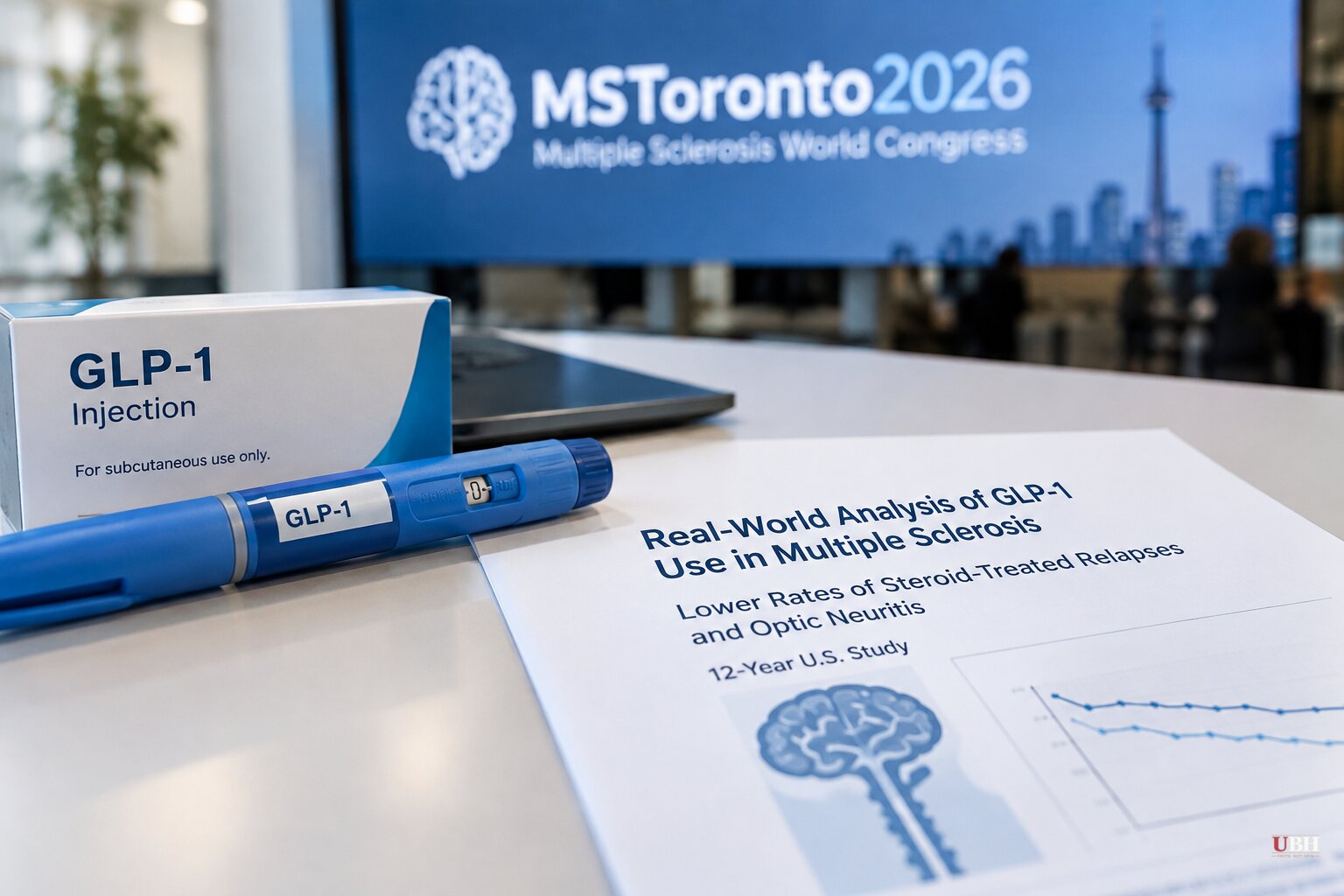
Multiple sclerosis patients who took GLP-1 drugs had fewer relapses than those who didn't, according to a 12-year analysis of U.S. patient data presented at MSToronto2026, the joint meeting of ECTRIMS and ACTRIMS.
The numbers are large. The study doesn't show the drugs caused them.
What the MS data show
Mahsa Khayat-Khoei, MD, of the University of California Riverside, presented the results. Over 12 years, 1.85% of GLP-1 users had an acute steroid-treated relapse, versus 4.84% of non-users.
Optic neuritis, an inflammation of the optic nerve, occurred in 1.46% of users and 2.56% of non-users. Demyelinating events, where the protective coating around nerves is damaged, hit 3.48% of users and 7.01% of non-users.
Gait abnormalities, fatigue and depression were also less common among users:
- Gait abnormalities: 10.46% vs 16.15%
- Fatigue: 11.87% vs 17.55%
- Depression: 19.34% vs 26.38%
All of those differences were reported as statistically significant (P <0.00001).
The reported relative risks are framed from the non-user side. The 2.62 figure for steroid-treated relapses, for example, means non-users had roughly 2.6 times the rate of users.
A subgroup of patients on the B-cell therapy ocrelizumab (Ocrevus) showed a similar pattern, with the biggest gap in steroid-treated relapses (relative risk 5.52) and optic neuritis (2.37). That analysis covered 10 years, since ocrelizumab has only been available since 2017.
The analysis used the TriNetX research network and covered 339,092 MS patients, 14,300 of whom were exposed to GLP-1 drugs. The exposed group had higher mean body mass index (36.7 vs 29.0) and higher rates of type 2 diabetes (49% vs 4%) and obesity (58% vs 6%). Outcomes were assessed after propensity-score matching for age, sex and comorbidities.
Why researchers think it could be real
Khayat-Khoei said GLP-1 drugs, approved for diabetes, obesity and other uses, may influence neuroinflammation and neuronal survival through the gut-brain axis. She pointed to animal-model studies in Alzheimer's, Parkinson's, MS and stroke suggesting reduced neuroinflammation.
She was careful about what that means for patients. Their role in MS and other neurodegenerative diseases, she said, is unclear. She said prospective studies are needed to determine whether GLP-1 drugs have disease-modifying or neuroprotective effects in MS.
Paul Edison, MD, PhD, of Imperial College London, who wasn't involved in the work, called the data "encouraging." He told MedPage Today that GLP-1 drugs influence insulin signaling, mitochondrial resilience, vascular function and neuroinflammation, "providing a credible biological basis for neurological investigation."
Edison also cautioned against over-reading the field's failures. Oral semaglutide did not slow Alzheimer's progression in the EVOKE trials, but he said that "should not close the field," because different GLP-1 drugs vary in structure, distribution and receptor engagement.
Obesity and MS are already linked
A new narrative review in Annals of Clinical and Translational Neurology lays out why neurologists are looking at these drugs at all. In the multi-center MS PATHS cohort, 42% of newly diagnosed U.S. MS patients were obese.
A Swedish MS registry study of 3,249 people found that obesity at baseline was associated with faster disability progression, more frequent MRI lesions, worse quality of life and a higher risk of cognitive worsening. The review says German registry data corroborated many of those findings. Norwegian data showed that high body mass index between ages 14 and 24 increased MS susceptibility later in life.
That overlap means a drug that treats obesity, sleep apnea and diabetes could help MS patients through several routes at once. Tirzepatide became the first FDA-approved medication for obstructive sleep apnea in 2024, and the review notes that condition shares fatigue and cognitive deficits with MS.
The review describes its findings as a mixture of early reassurance, biological intrigue and unresolved safety questions. It estimates one in eight Americans has now tried a GLP-1 drug.
Anti-aging claims
Interest is spreading beyond MS. Researchers are now testing whether GLP-1 drugs slow biological aging, measured through epigenetic markers and protein levels in the blood.
Dr. Kevin Duffin, vice president of aging research at Eli Lilly, which makes tirzepatide (Zepbound, Mounjaro), said the company is seeing "a reduction in age" of somewhere around three to six years. "It's not the panacea," he said. Lilly sells these drugs, so it has a direct commercial interest in the finding.
Duffin presented data from Lilly's Surmount V clinical trial, which randomly assigned more than 700 adults who were overweight but did not have diabetes to use either tirzepatide or semaglutide for 72 weeks. The aging analysis looked at 71 participants on tirzepatide who were over 50. Duffin acknowledged limitations: there was no placebo group not using weight-loss drugs, and follow-up was relatively brief.
Outside researchers urged restraint. Dr. James Kirkland, who directs the Center for Advanced Gerotherapeutics at Cedars-Sinai Medical Center in Los Angeles, said some people are "biohacking" with these agents without being diabetic or obese. "My concern is that people could overread some of this stuff," he said.
Kirkland added that the aging metrics are still in development. They are useful for studies in larger groups but not very informative for individuals, he said, and they "can vary tremendously from day to day within a person." Many companies have begun marketing such tests to consumers.
Dr. Danica Chen of UC Berkeley, who studies calorie restriction and aging, said that targeting aging itself could potentially treat many age-related diseases at once. The research so far, in mice and people, is early. Scientists don't yet know whether the benefits extend to normal-weight, otherwise healthy people, or whether the slowing of biological aging is due to weight loss or to the drugs themselves.
What remains open
The MS analysis compares people who used the drugs with people who didn't. It does not establish that the drugs reduced relapses.
What happens to lean, younger, non-diabetic people on these drugs over the long term is the question Kirkland raised, and no one has answered it yet. The next test for MS is whether the association holds up in prospective studies, the step Khayat-Khoei herself called for.
For now, the drugs are approved for diabetes, obesity and other conditions, not for MS or aging.
Sources used for this briefing
3 links from 3 independent newsrooms (syndicated copies of the same report count once)
These are the sources it draws on, linked so you can verify.


