
Unbiased headlines. Facts, not spin.
Unbiased Headlines is an independently owned news organization. We bring you the facts, not opinions, written fresh from 110+ named sources. Sources linked so you can verify it yourself.
 energy
Notable (6/10)
Senate Eyes Nov. 9 Vote on Bipartisan Permitting Bill as Analysts Cut Odds After Democratic Midterm Wins
A permitting bill years in the making gets its first real test on Monday, Nov. 9. The midterm results have made its path harder.
The Bipartisan American Affordability and Jobs Act, or BAAJA, was introduced Sept. 30 by Republican Sens. Shelley Moore Capito of West Virginia and Mike Lee of Utah and Democratic Sens. Sheldon Whitehouse of Rhode Island and Martin Heinrich of New Mexico. The four call themselves the "four corners."
The bill would overhaul federal permitting for energy and infrastructure projects, including transmission lines, mines, and both renewable and fossil fuel development.
The vote and the math
Star Parker, a free-market advocate who joined a coalition letter organized by Americans for Tax Reform's Grover Norquist, writes that the Senate will vote Nov. 9 on whether to proceed. The Bipartisan Policy Center says a vote to move the bill forward could come as early as next week, setting up passage before year's end.
Proceeding requires 60 votes under Senate rules. Republicans hold the committee chairmanships behind the bill, and Democrats hold the ranking seats. That is not the same as having 60 senators. Parker acknowledges it is "not certain" enough Democrats will sign on.
Odds drop after the election
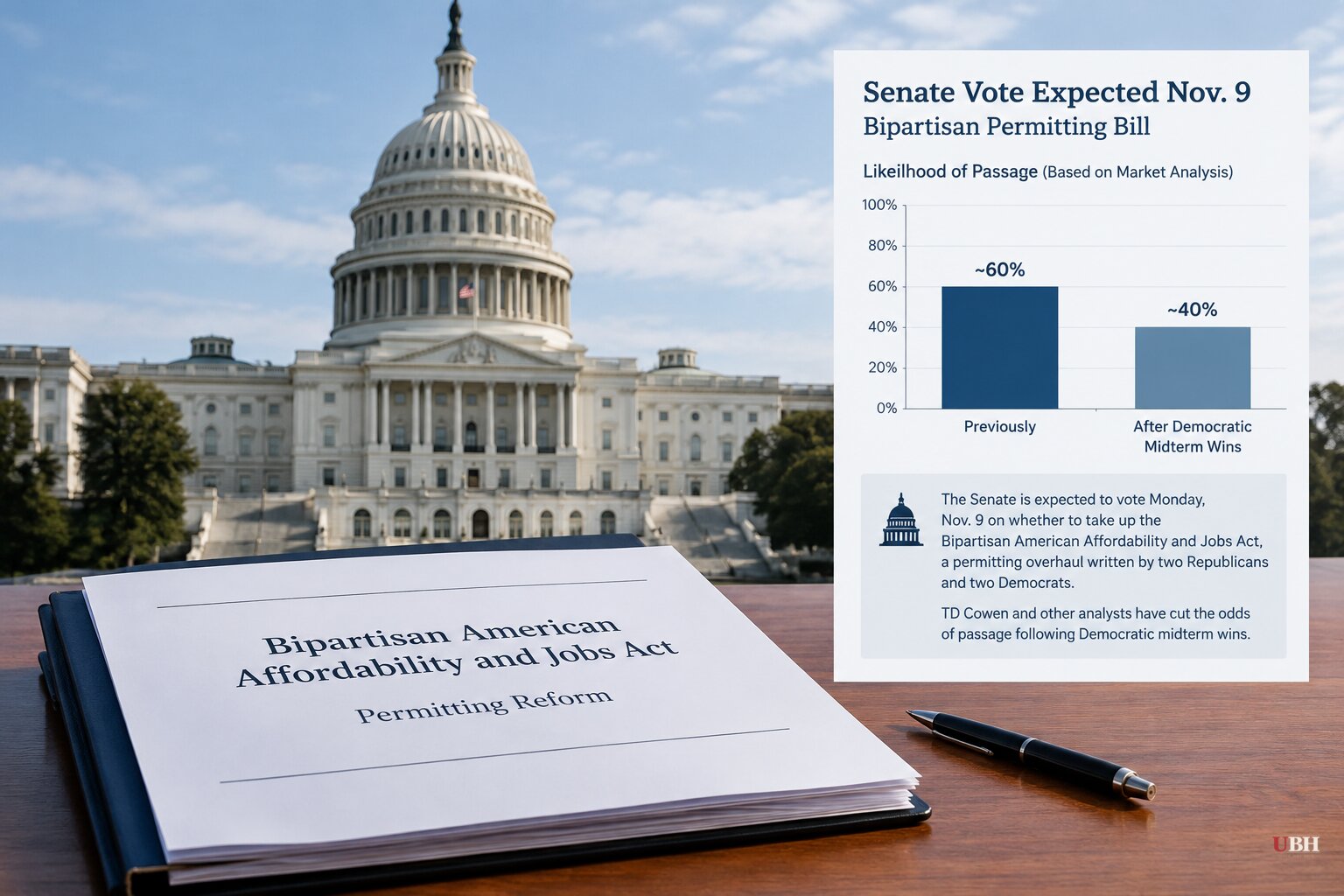
The market's read is cooler than it was a week ago. TD Cowen cut its estimate of the bill's chances from about 40% to about 25% on Wednesday, Nov. 4. The firm said Democrats' election win "likely emboldens voices arguing bill gives too many concessions to (oil and gas)."
Rapidan Energy Group puts the odds of passage in the lame-duck session at 20% to 25%. Some Democrats would rather wait until 2027 and negotiate from a stronger position on environmental protections, public input and project approvals, according to Axios reporting cited by the Ohio Manufacturers' Association.
The bill's Democratic authors reject that approach. "This is the closest we have come to actually finding something that can get signed into law, and I'm not going to wait," Heinrich said in a statement to Reuters.
Whitehouse used the same logic. "A good permitting bill comes together over years of complex negotiations... It's a bird in the hand. We'd be fools not to take it."
The fight on the left
The opposition is not coming from Republicans. Rep. Jared Huffman of California, the top Democrat on the House Natural Resources Committee, and several environmental groups have argued that a Democratic-controlled Congress could pass more ambitious legislation. Huffman did not immediately respond to a request for comment.
Christy Goldfuss, executive director of the Natural Resources Defense Council, objects to what the bill does. She said in an email that "whether it is permits to bulldoze wetlands, the fast-tracking of gas pipelines or general environmental review, with this legislation, data centers would not need to answer to the concerns of local communities." She added: "People would be shocked to realize their representatives are rushing such a consequential decision."
The Verge reports that environmental advocates are especially worried about two features: limits on environmental reviews and restrictions on communities taking a project to court to stop it. With AI data centers driving electricity demand, those groups fear developers could lean on fossil fuels and avoid public scrutiny.
The case for moving now
Supporters span an unusual range. Whitehouse, who calls himself a climate hawk, said in the bill's announcement: "If we can pass this bill, we will flood the grid with clean, affordable energy and make data centers start paying their fair share."
The U.S. Oil & Gas Association was blunter: "Pass the frickin' bill so we can start building things again." Climate and renewable energy groups also backed the bill at its introduction.
Xan Fishman, executive vice president of the energy program at the Bipartisan Policy Center, called it "a really good bipartisan compromise." He said: "They swung big with this bill."
Parker points to grid and price pressures. He cites a warning from the North American Electric Reliability Corporation that 13 of 23 regional assessment areas face resource adequacy challenges over the next 10 years. He also says electricity demand is growing at its fastest pace since 2000 and residential prices are up nearly 5% this year.
James Lee, managing director of public policy services at the Ohio Manufacturers' Association, says drawn-out federal reviews raise costs across supply chains. He argues Congress can make the process more efficient "without compromising environmental protections."
What happens next
The Verge notes the post-election shift could give Democrats more leverage over the bill's contents and potentially set up a clash with President Donald Trump. If the bill stalls in the lame-duck session, it would have to be rewritten and re-negotiated in a new Congress with different math.
Monday's vote is the immediate test. Whether enough Senate Democrats join the Republicans to reach 60 will show whether Heinrich and Whitehouse can carry their caucus, or whether the push to wait for 2027 wins out.
Sources used for this briefing
7 links from 5 independent newsrooms (syndicated copies of the same report count once)
These are the sources it draws on, linked so you can verify.


