
Unbiased headlines. Facts, not spin.
Unbiased Headlines is an independently owned news organization. We bring you the facts, not opinions, written fresh from 110+ named sources. Sources linked so you can verify it yourself.
 energy
Major Story (8/10)
Event date: November 5, 2026 ·
Election Puts 45% of Planned Data Center Capacity Under Governors Pledging Pauses, Goldman Says
Voters sent a clear message on Tuesday, Nov. 3: they do not want data centers next door.
An NBC exit poll found 56% of voters called AI and data centers a "crucial or major factor" in their vote for Congress. Exit polls also showed 76% opposed to data centers in their own communities, according to figures cited by the Reflector. A CBS News poll this summer found Americans opposed to a new local data center by more than 2-to-1.
The ballot box
As of Wednesday afternoon, voters had approved 38 ballot measures restricting data centers in California, Illinois, Maine, Ohio, New York and other states, according to political research firm Redbud Consulting. Voters in Harwood, North Dakota, were the only ones to approve a data center.
In Piqua, Ohio, and Yukon, Oklahoma, mayors were recalled over their support for data center projects, TIME reported. Democrats spent more than $100 million on broadcast ads tying Republican opponents to Big Tech and data centers, according to TIME.
Pro-industry super PACs did not move the needle. Darline Graham, a candidate they backed, lost to Annie Andrews, who had nicknamed her "Data Center Darline" and called for a two-year moratorium on new projects.
Governors' mansions
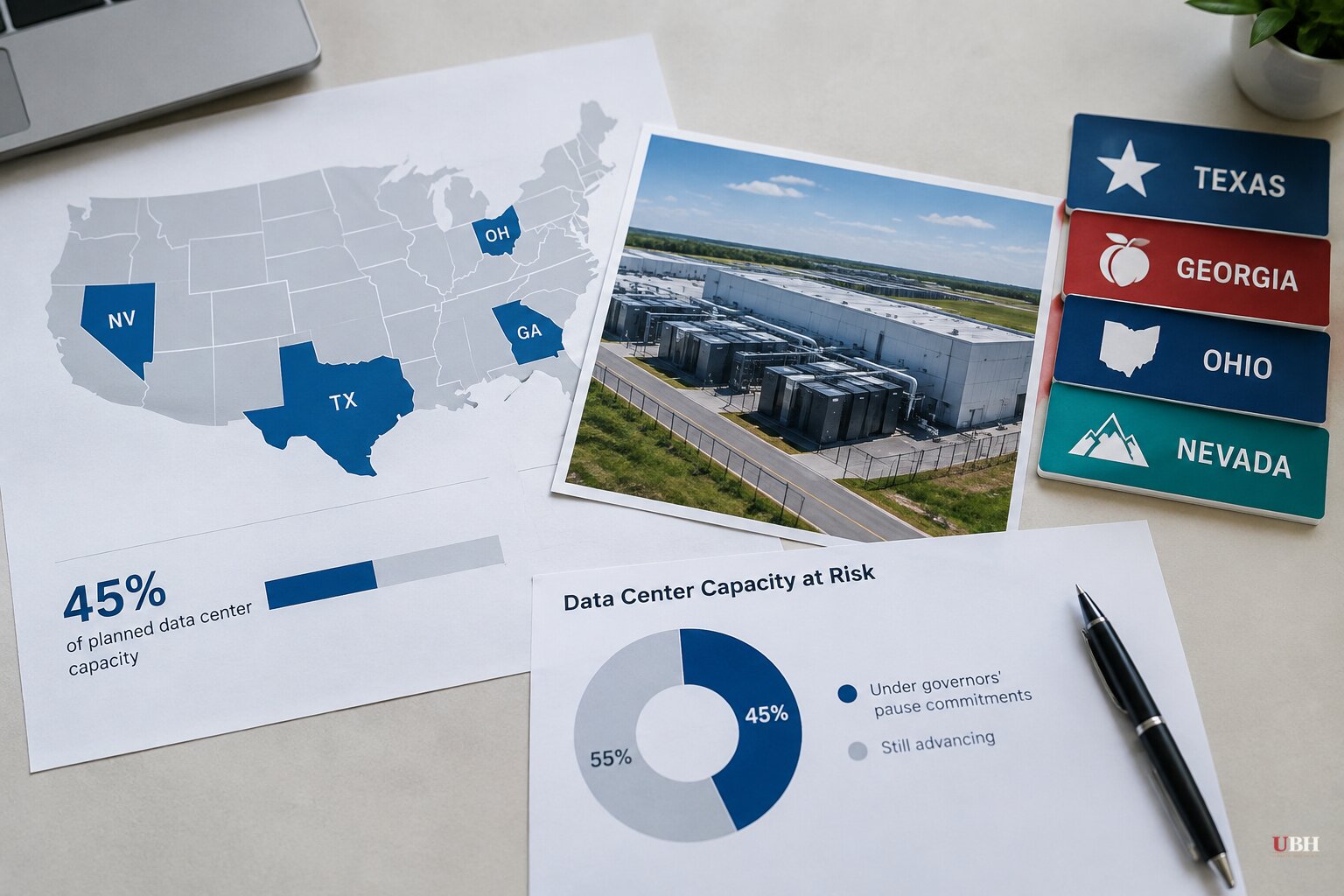
Democrats won governor's races in Texas, Georgia, Ohio and Nevada, among other states, on platforms of tighter data center rules. Goldman Sachs estimates that come January, states led by Democrats who support extending or expanding construction moratoriums will hold 45% of planned U.S. data center capacity.
Texas is the biggest piece. About a quarter of the planned U.S. AI buildout is slated for the state.
Democrat Gina Hinojosa beat Republican incumbent Greg Abbott after proposing a temporary ban on data center construction. Gordon Johnson, CEO of GLJ Research, told CBS News the win could stall 13 gigawatts of Texas data center power. He also noted that Abbott had already suspended data center approvals. "All the new governor has to do is keep it in place," Johnson said. A Republican governor built the freeze his successor can simply leave alone.
In Georgia, the third-largest data center market, Keisha Lance Bottoms said on CBS Mornings that she would "sign an executive order for that pause." She also plans to review the state's data center tax incentives.
Business says it will carry on
Duke Energy CEO Harry Sideris told investors on Thursday's third-quarter call that the "historic" election changes nothing. The utility's large-load pipeline is 15.4 GW, virtually unchanged since the first quarter, and includes 7.8 GW of signed service agreements. It is pursuing a $103 billion spending plan built heavily around natural gas.
"We have a track record of working with both sides of the aisle," Sideris said. He added that newly elected officials share Duke's goal of making sure large loads "pay for their fair share."
The gas buildout has already drawn resistance. North Carolina regulators denied approval for a 255 MW gas unit, citing its "staggering" cost and uncertain need.
On Wall Street, Dan Ives of Yorkville Ives & Co. says the answer to whether the midterms will slow the planned 800 to 1,000 U.S. data centers is "a clear YES." Franklin Templeton's Stephen Dover predicted a "slowdown in data centers being built," with new regulations and costs for developers.
The other side of the argument
President Trump is the loudest opponent of the moratorium push. He has said data center opponents "want to end up being backwards and poor," favors industry self-policing of AI, and argues the U.S. could lose the AI race to China without new data centers. CNN reports he is already "waving around his veto hat."
The economics back up the stakes. ING economists estimate AI investment accounted for as much as a quarter of U.S. economic growth this year. Columbia Business School economist Stijn Van Nieuwerburgh expects AI infrastructure spending to approach $1 trillion a year.
Voters' complaints are concrete: higher energy bills, noise, water use and farmland. Blue Rose Research polling found Americans would rather live near a prison, methadone clinic or nuclear plant than a data center. Brendan Steinhauser, a Republican strategist who runs The Alliance for Secure AI, said the AI industry should expect "a big deluge of bills at the state and federal level."
The backlash is not strictly partisan. Interconnected Capital tracks 372 data center moratoriums nationwide plus 43 permanent bans. Rich Razgaitis, CEO of water technology firm FloWater, called it "increasingly becoming a non-partisan issue that both parties will need to address."
Not every problem is political
Bloomberg reports Microsoft has spent recent months switching off AI cloud capacity it rented from Oracle after declining to renew the contract. According to Bloomberg, the Oracle hardware ran on older Nvidia chips that no longer fit Microsoft's specifications. That reason has nothing to do with the election. ZeroHedge reports Oracle shares fell about 4% on the news and that Oracle disputes the framing.
What comes next
Washington is unlikely to move fast. Democrats need Republican votes to override a veto on any federal AI legislation, TIME noted. Brookings says the House is likely to vote this month on a bipartisan permitting reform bill. It is unclear whether it has the votes, because Democrats may wait for their majority and some Republicans may now prefer slowing data center construction to speeding it up.
The first hard test comes in January. Bottoms has promised an executive order pausing new Georgia projects, and Hinojosa will decide whether to keep Abbott's Texas freeze in place. Neither has said how long a pause would last.
Sideris said the remaining 7.6 GW in Duke's pipeline is taking longer "because of the complexities."
Sources used for this briefing
8 links from 8 independent newsrooms (syndicated copies of the same report count once)
These are the sources it draws on, linked so you can verify.


