
Unbiased headlines. Facts, not spin.
Every story is an unbiased news briefing written from 110+ sources across the spectrum — sources linked so you can verify it yourself.
 energy
Major Story (8/10)
Event date: September 16, 2026
energy
Major Story (8/10)
Event date: September 16, 2026
Saudi Pipeline Damage and Refinery Outages Push Diesel to Record Highs as FTSE Russell Flags Energy Risk
FTSE Russell's global head of investment research, Indrani De, told Bloomberg this week that markets remain propped up by resilient corporate earnings and AI-driven investment, but she flagged one specific threat heading into winter: refining constraints and rising energy costs. The warning is already visible at the pump.
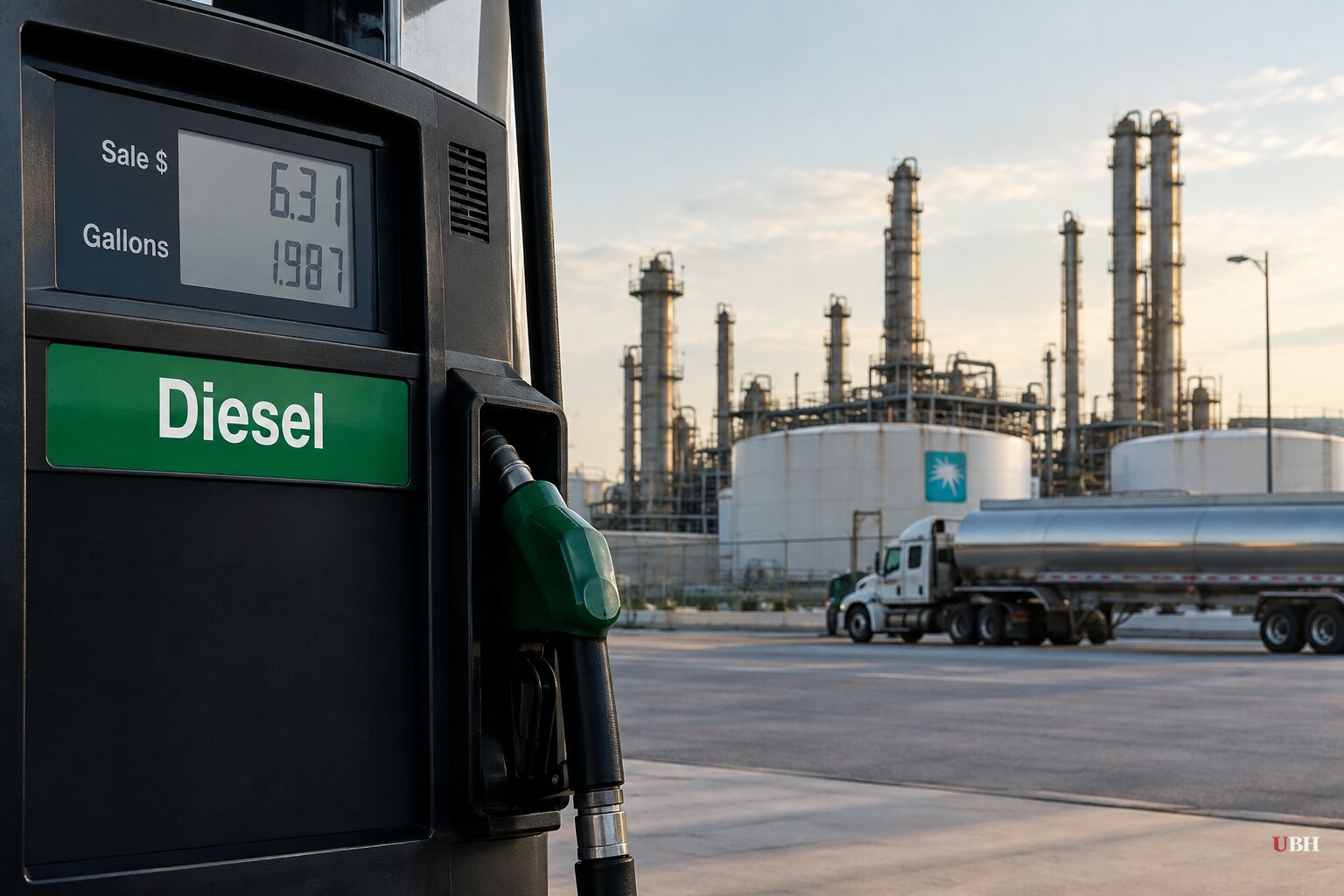
Diesel is averaging $6.31 a gallon nationally and $8.27 in California, according to the International Business Times, which cites real-time GasBuddy tracking. Gas prices have jumped roughly 30 cents a gallon in spots like Lawrence County, Ohio, and Edwardsburg, Michigan. Because diesel runs the trucking industry, that cost gets passed down the supply chain to everything else.
What broke
The proximate cause is damage to Saudi Arabia's 745-mile East-West pipeline, the kingdom's main route for moving crude to Red Sea export terminals without going through the Strait of Hormuz. The Washington Post reviewed satellite imagery showing damage at multiple pumping stations, with one station hit last week and a second, roughly 130 miles away, also damaged over the weekend.
Andrew Lipow, an energy consultant who advises companies on oil infrastructure repairs, told the Post the damage looked extensive. "They will need to replace piping, valves, all the electrical stuff," Lipow said, adding that repairing a major pipeline isn't a matter of grabbing parts off a shelf. Saudi Arabia says it expects to restore full pipeline capacity within six weeks.
According to Newsquawk's market wrap from Tuesday's trading session, the supply picture got worse on multiple fronts at once. Libya's National Oil Corporation suspended operations at three oil fields. Saudi Arabia reportedly told some European refiners their September crude cargo loadings were cancelled. And oil loadings were suspended at the Saudi Red Sea port of Yanbu following the pipeline attack. Crude rallied on the news, and energy was the only S&P sector to close higher that day while the rest of the market slid.
International Business Times ties the disruptions to the broader U.S.-led conflict with Iran, reporting that Iran-backed militias and Houthi rebels have targeted regional energy infrastructure as tensions escalate. That's the framing IBT and the Post are running with, tracing an arc from a shipping crisis in the Strait of Hormuz to direct hits on Saudi pipeline infrastructure.
The domestic squeeze
Supply disruptions overseas are colliding with a problem at home. An outage at ExxonMobil's Joliet refinery near Chicago, which normally pumps out millions of gallons of gasoline and diesel a day, has tightened Midwest fuel supplies further, according to IBT. Crypto Briefing reports that record refining margins and limited global refinery capacity are compounding the squeeze, and that the International Energy Agency has said the global refining system is under considerable strain, a dynamic that risks feeding directly into inflation.
Refining capacity has been tight for years, well before this latest round of attacks, so some of this price pressure may reflect structural underinvestment in refineries rather than any single event. The IEA's own framing, as relayed by Crypto Briefing, supports that broader-strain reading rather than pinning everything on one pipeline.
The bigger money picture
FTSE Russell's September 2026 Asset Allocation Insights report, covered by InvestmentNews, shows where investor capital is actually flowing while all this plays out. Advisors are running what the report calls a barbell strategy: chasing AI-linked equity growth while loading up on investment-grade bonds. Hyperscaler capital expenditure on AI is projected to top $1 trillion in 2027, and the five largest hyperscalers, Amazon, Alphabet, Meta, Microsoft and Oracle, now account for 12.9% of year-to-date investment-grade bond issuance in 2026, up from just 1.7% in 2024.
That debt-fueled buildout comes with a catch. Free-cash-flow margins have turned negative for four of the five major hyperscalers, InvestmentNews reports, even as revenue keeps climbing and Nvidia guides to 70% revenue growth for fiscal 2028. Meanwhile the 30-year Treasury yield hit a post-financial-crisis high of 5.3% in August, a move the report attributes to rising real yields rather than inflation fears, even after the Treasury Department doubled its long-dated debt buyback program to try to hold long-end yields down.
Add it up and you get two separate but overlapping pressure points: physical energy supply strained by attacks on Middle East infrastructure and refinery outages at home, and a bond market being reshaped by trillion-dollar AI spending commitments layered on top of already-elevated borrowing costs. FTSE Russell's De frames both as reasons for investors to get more selective rather than to panic.
The unresolved question is whether Saudi Arabia's six-week repair timeline holds. If it slips, or if another attack hits regional infrastructure before the East-West pipeline is back to full capacity, the diesel and gasoline prices already squeezing American drivers have further room to climb heading into winter.
Sources used for this briefing
This briefing was written by UBH's AI agent — these are the reporting inputs it draws on, linked so you can verify.


