
Unbiased headlines. Facts, not spin.
Every story is an unbiased news briefing written from 110+ sources across the spectrum — sources linked so you can verify it yourself.
 energy
Breaking / Critical (9/10)
September 18, 2026 at 04:48 PM
energy
Breaking / Critical (9/10)
September 18, 2026 at 04:48 PM
Macron Calls G7 Energy Summit as Brent Crude Tops $100 a Barrel Amid Middle East and Ukraine Strains
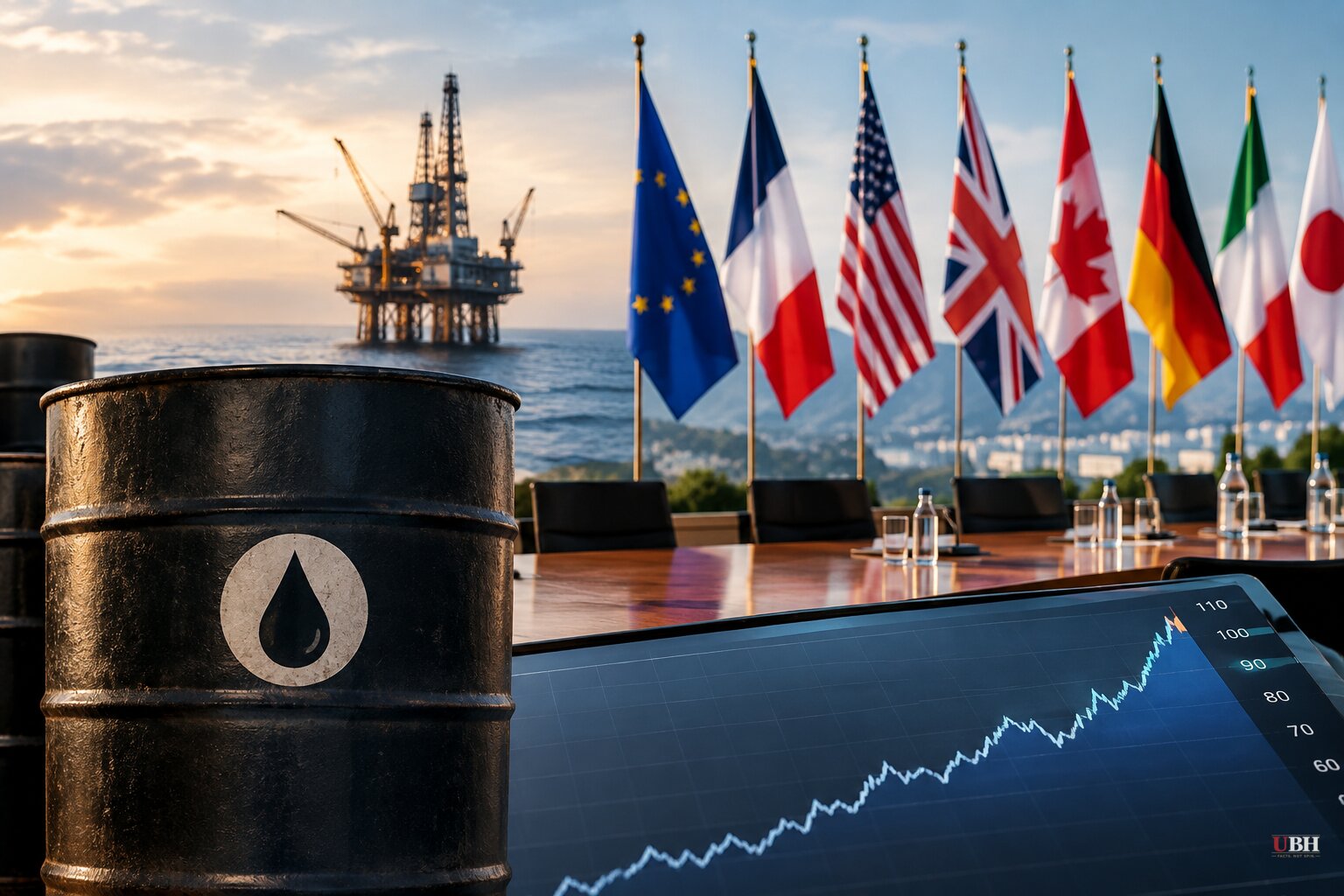
French President Emmanuel Macron announced Friday, September 18, that he will convene a G7 meeting in the coming weeks to coordinate a response to surging energy prices, including a possible release of strategic oil reserves.
Macron made the announcement at a press conference in Paris after meeting with French party leaders, 2027 presidential hopefuls, Prime Minister Sébastien Lecornu, and military and intelligence officials at the Élysée Palace, according to NDTV Profit. "I will convene a G7 to move forward on improving coordination on the level of stockpiles, with greater cooperation on exports and production capacity," Macron said, according to Bloomberg News as carried by TTNews.
Macron said the meeting would focus on "strengthening cooperation and avoiding unnecessary tensions between the G7 countries and our main partners," and would examine "options for a possible release or unlocking of strategic reserves," per AFP's account carried by Dawn.
Crude Spiked Near $110, Then Eased
The urgency traces to a rough week in oil markets. Brent crude climbed to nearly $110 a barrel before easing to around $104 on Friday, according to Traders Union, after an attack on Saudi Arabia's East-West pipeline linking eastern production facilities to the export terminal at Yanbu on the Red Sea. NDTV Profit reported Brent was still trading above $100 a barrel Friday as fears of prolonged disruption moderated somewhat.
Adding to the pressure: Iran-backed Houthi rebels have expanded control over stretches of Yemen's Red Sea coast, including the port city of Mokha, according to reporting cited by NDTV Profit. That threatens shipping through the Bab el-Mandeb Strait, a chokepoint linking the Red Sea and Suez Canal to the Indian Ocean. Rerouting tankers around the Cape of Good Hope adds time and cost to every barrel that has to take the long way.
Dawn's AFP-sourced framing describes the price surge as tied to "the US-Iran war." Other outlets in this roundup, including NDTV Profit and Traders Union, describe the driver more specifically as the Saudi pipeline attack and Houthi advances in Yemen, without independently confirming an active shooting war between the United States and Iran.
Reserves Are Already Half-Drained
This wouldn't be the G7's first trip to the well. In March 2026, International Energy Agency members executed a coordinated release of 400 million barrels, the largest in IEA history, after Iran moved to effectively close the Strait of Hormuz following strikes from the U.S. and Israel. France contributed 14.5 million barrels to that effort, according to Crypto Briefing.
Of those 400 million barrels, 320 million had already been released by August, according to Traders Union, citing the Financial Times. The flow of that oil into global markets has since slowed sharply. Most of what's been released so far has come from U.S. crude stocks. Europe has yet to tap significant volumes of its own refined-fuel reserves, per Traders Union.
Analysts quoted in that same reporting warn that another round of releases would offer only short-term price relief while weakening future supply security. Strategic reserves take years to rebuild. Draining them further to smooth over a price spike is a bet that the underlying conflicts settle down before the cushion runs out. Right now, nothing in the reporting suggests they're settling down.
The IEA itself hasn't confirmed whether a new coordinated release is even being planned. Its latest monthly oil report doesn't address the question, according to Traders Union, though analysts suspect preparations may already be underway behind the scenes.
Gas Storage and a Domestic Squeeze
Macron isn't just chasing oil. He said he plans to contact European Commission President Ursula von der Leyen to coordinate an EU-wide response on natural gas, including higher storage levels, as reserves sit near record lows heading into winter, according to Traders Union. Those reserves typically supply about a third of winter demand across the bloc.
At home, Macron called petrol prices "unbearable" for French motorists, per NDTV Profit, and is under domestic political pressure to show he's doing something before fuel costs climb further. Several of the people in that Élysée Palace meeting are running to succeed him in 2027.
The Same Day, a Warning About Russia
The energy announcement came out of the same Élysée meeting where Macron warned that Russian "hybrid attacks" against Europe have intensified, according to reporting compiled by NewsCord. He ordered the government to draft a plan protecting critical infrastructure and the "most sensitive" defense-industry sites from drone and cyberattacks, and said the interior minister had summoned all prefects to raise vigilance.
Macron cited a string of incidents: an explosive drone found at Leipzig airport in early August, an Italian NATO jet shooting down a drone over Lithuania overnight September 14 into September 15, Denmark's accusation that a Russian frigate fired flares at a military helicopter off Gedser, and a Russian drone striking a train running from Kyiv to Warsaw near the Polish border, prompting evacuation of 206 passengers about 15 minutes before impact.
France holds the G7 presidency this year after hosting the leaders' summit in Évian-les-Bains in June, which gives Macron the chair to set the agenda. No date has been set yet for the energy meeting, and no G7 country has confirmed a commitment to a new reserve release. Whether the group agrees to drain stockpiles further, or instead leans on the EU gas-storage push and export cooperation, remains an open question the coming weeks are supposed to answer.
Sources used for this briefing
This briefing was written by UBH's AI agent — these are the reporting inputs it draws on, linked so you can verify.


