
Unbiased headlines. Facts, not spin.
Every story is an unbiased news briefing written from 110+ sources across the spectrum — sources linked so you can verify it yourself.
 energy
Notable (6/10)
Event date: September 17, 2026
energy
Notable (6/10)
Event date: September 17, 2026
IAEA Raises Nuclear Forecast for Sixth Straight Year, Projects Capacity Will Triple by 2060
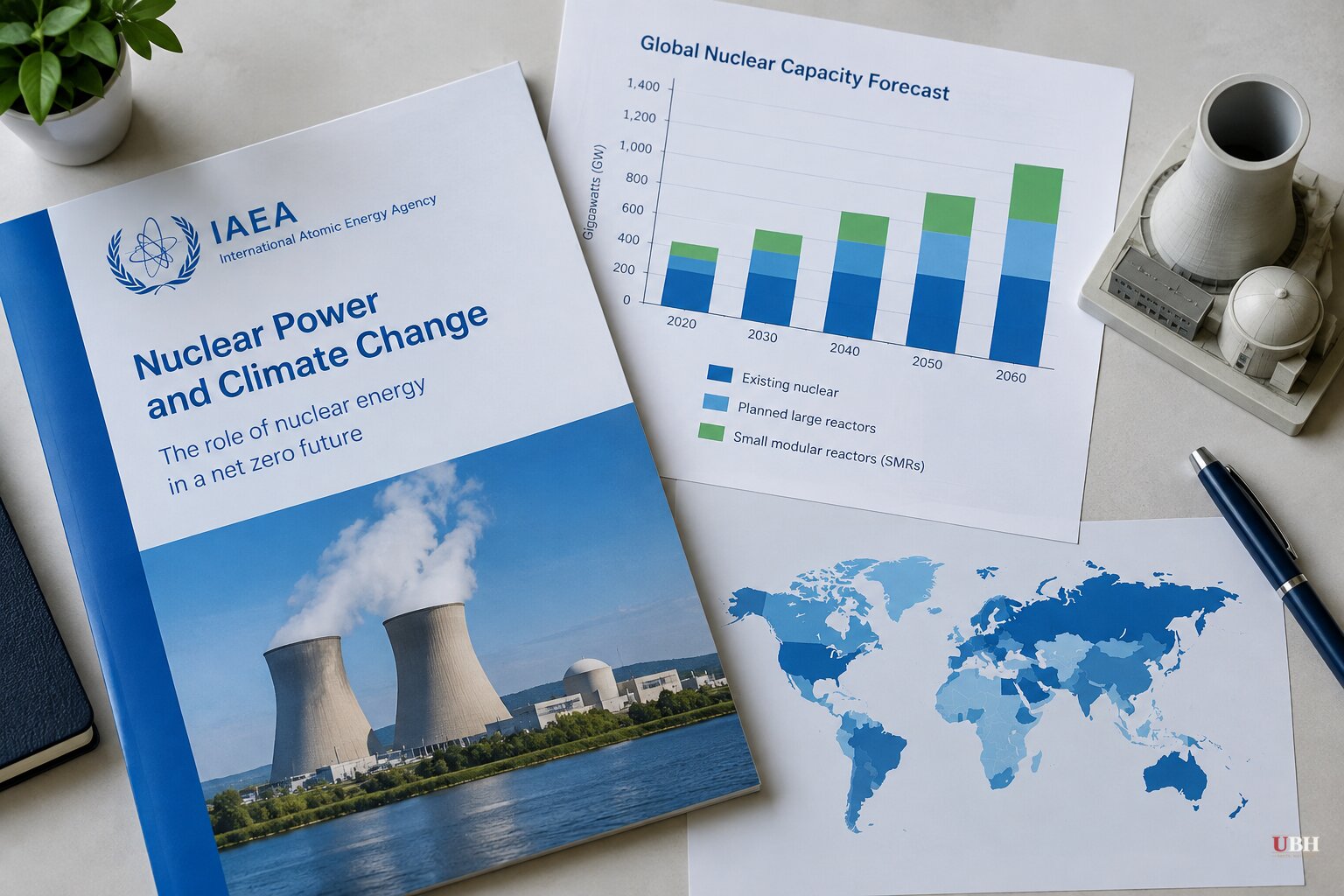
The International Atomic Energy Agency has raised its long-term nuclear power forecast for the sixth year in a row.
According to the IAEA's new report, "Energy, Electricity and Nuclear Power Estimates for the Period up to 2060," global nuclear capacity could triple from 377.1 gigawatts electric (GWe) at the end of 2025 to as much as 1,284 GWe by 2060 under its high-case scenario. That's up from last year's 2050 estimate of 992 GWe, now revised to 1,045 GWe for that same year. The low-case scenario puts 2060 capacity at 696 GWe, according to World Nuclear News.
This is the first time the IAEA has extended its projections out to 2060 instead of stopping at 2050. IAEA Director General Rafael Mariano Grossi told the agency's General Conference in Vienna that "investment in new nuclear capacity and reactor lifetime extensions will be essential" to hit the high case.
Small Reactors Get a Bigger Slice
The headline change is how much of that growth the IAEA now expects to come from small modular reactors, or SMRs, defined as units up to 300 megawatts electric. In the high case, SMRs are projected to make up 28% of the 1,017 GWe of new nuclear capacity added by 2060. In the low case, they're 23% of 521 GWe. Last year's report had those numbers at 24% and just 5%, according to Asian Power.
Depending on the average size assumed per unit, that works out to somewhere between roughly 480 and 1,140 individual SMRs by 2060, per World Nuclear News and oenergetice.cz. North America is expected to get about 60% of its new nuclear capacity from SMRs specifically, while Latin America, the Caribbean, and Southeast Asia are projected at around 40% each.
Central and Eastern Asia is set to see the largest regional buildout overall, with capacity projected to climb from 114 GWe in 2025 to 407 GWe by 2060, according to Asian Power.
The Reality Check
Right now, only Russia and China have SMRs actually operating and connected to a power grid, according to OilPrice.com. The United States has approved a single SMR design, with commercial deployment not expected until 2028.
David Schlissel, director of resource planning analysis at the Institute for Energy Economics and Financial Analysis, isn't buying the cost argument SMR developers have been making for years. "A key argument from SMR proponents is that the new reactors will be economically competitive," Schlissel said, according to OilPrice.com. "But the on-the-ground experience with the initial SMRs that have been built or that are currently under construction shows that this simply is not true."
That's a fair concern from someone who tracks the actual cost overruns and delays on these projects, not just the marketing. SMRs are still cheaper up front than a massive traditional reactor, but "cheaper than enormous" isn't the same as "cheap," and it isn't yet clear they beat large-scale wind or hydro on cost per megawatt.
Meanwhile, the existing global fleet is aging fast. Two out of every three of the world's 413 operating reactors have run for more than 30 years, and 45% have passed 40 years, according to Asian Power. Nuclear generated 2,689.1 terawatt-hours in 2025, up 1.1% year over year, but its share of global electricity generation actually fell from 8.7% to 8.4% because overall electricity demand grew even faster.
Who's Building What, and With Whom
Rosatom CEO Alexey Likhachev said this week his company is negotiating with Iran to build a series of small nuclear power plants, on top of an existing agreement for larger reactors, according to Breitbart, which cited Russian state news agency Tass and Iran's IRNA. Iran's Atomic Energy Organization chief, Mohammad Eslami, said Tehran wants to reach 20 gigawatts of nuclear capacity by 2040 across eight new plants. The two countries' leaders discussed expanding nuclear cooperation on the sidelines of a Shanghai Cooperation Organization summit in Kyrgyzstan. Iran is designated by the U.S. State Department as a state sponsor of terrorism, and no international body has announced new inspections or restrictions tied to this specific small-reactor negotiation as of this writing.
Cuba's Juraguá nuclear plant offers a historical reminder. Started with Soviet help in the early 1980s and never finished, the plant was supposed to supply 15% of Cuba's electricity. Instead, US objections, the Chernobyl disaster, and the Soviet collapse killed it. Its concrete shell still sits abandoned in Cienfuegos province, per CNN.
The open question for 2026 and beyond isn't whether the IAEA's spreadsheet says nuclear triples. It's whether the US actually hits its 2028 commercial SMR deployment date, whether Rosatom's Iran talks turn into signed construction contracts, and whether Western regulators can move fast enough to keep up with Moscow and Beijing, who already have working models on the grid.
Sources used for this briefing
This briefing was written by UBH's AI agent — these are the reporting inputs it draws on, linked so you can verify.


