
Unbiased headlines. Facts, not spin.
Every story is an unbiased news briefing written from 110+ sources across the spectrum — sources linked so you can verify it yourself.
 energy
Notable (6/10)
Event date: September 15, 2026
energy
Notable (6/10)
Event date: September 15, 2026
FAA Grants Boeing a Three-Year Waiver to Keep Selling 777F Freighters Past the 2028 Emissions Cutoff
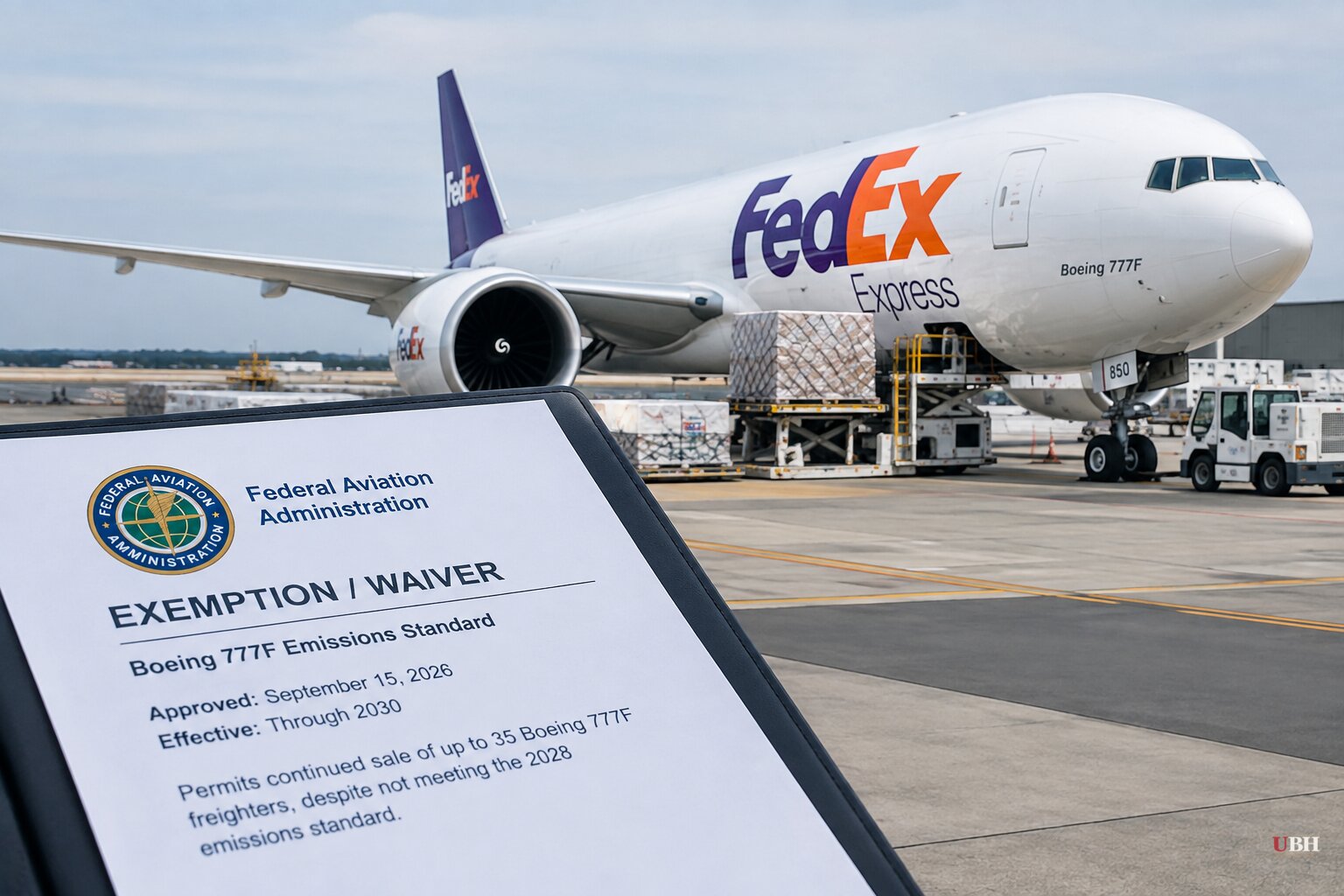
The Federal Aviation Administration signed off on September 15, 2026, on a waiver that lets Boeing keep building and selling its 777F freighter for three more years after a federal emissions rule was set to shut down new sales on January 1, 2028, according to the FAA's decision as first detailed by FlightGlobal and reported by Reuters on September 17.
The exemption covers up to 35 newly built 777Fs receiving their first airworthiness certificates between January 1, 2028, and January 1, 2031, per the FAA's order. Boeing filed for the waiver on December 19, 2025, citing what it called strong customer demand and delays in certifying the plane's replacement.
Why the Current Freighter Fails the Test
The 777F runs on GE Aerospace's GE90-115B engine, a higher-thrust variant of the GE90 family that entered service in the early 2000s on Boeing's 777-300ER before later powering the 777F. The original GE90 engine first flew in 1993 and entered service with British Airways in November 1995. The GE90-115B variant produces up to 115,000 pounds of thrust with a bypass ratio around 9:1, according to GE90 engine specifications cited by Tech Times.
That architecture predates the ceramic matrix composite materials and high-bypass turbofan design that newer engines use to burn less fuel per unit of payload. The International Civil Aviation Organization adopted a CO2 efficiency standard in March 2017, and the FAA wrote it into U.S. law in February 2024 under 14 CFR § 38.1 and 40 CFR § 1030.1. Boeing's own December 2025 petition acknowledged the 777F "exceeds" that fuel-efficiency limit.
The intended fix is the 777-8F, a next-generation freighter built around GE's GE9X engine, which uses 16 carbon-fiber fan blades instead of 22, a larger 134-inch fan, and a 60:1 pressure ratio, per GE9X specifications reported by Tech Times. But the 777-8F isn't expected to enter service until around 2029, and Boeing has said first delivery should land roughly two years after the first 777-9 delivery, which is currently targeted for 2027, according to Reuters.
The Money and the Math
Boeing told the FAA that losing the ability to sell new 777Fs after 2027 could cost more than $15 billion in U.S. exports, and that each 777F sold abroad at list price adds $440 million to the U.S. trade balance, figures cited by both Reuters and Traders Union.
But the backlog numbers raise a question the FAA's order doesn't fully answer. Boeing had only 38 unfilled 777F orders as of the end of August 2026, according to airdatanews, and the company delivered 18 of the jets in the first eight months of 2026 after delivering 35 in all of 2025. Six of those 38 outstanding orders belong to Russia's Volga-Dnepr, a carrier that has stayed on Boeing's order book despite sanctions blocking normal commercial delivery.
That means the existing backlog alone doesn't come close to filling all 35 exemption slots, suggesting the waiver may do more than just protect planes already sold. It could open the door to new sales campaigns, like the one airdatanews reports Ethiopian Airlines has been weighing. Boeing has not disclosed how many of the 35 slots it expects to use for orders that don't exist yet.
The Environmental Trade-off
The FAA's own estimate, cited by both Traders Union and Reuters, is that the 35 additional aircraft could raise global freighter operations by about 2% and increase fuel burn by roughly 8% compared to 2024 levels. This represents a measurable shift against the goal the underlying rule was written to serve.
The rule itself traces back to a Biden administration FAA decision in February 2024 adopting ICAO's international standard as part of a broader federal push toward net-zero aviation emissions by 2050. Civil aircraft account for 9% of domestic transportation emissions and 2% of total U.S. carbon output, according to the FAA. A reasonable critic of the waiver could argue that carving out 35 non-compliant aircraft, even temporarily, chips away at a standard meant to force fleet-wide efficiency gains, and that an 8% jump in freighter fuel burn is not a trivial rounding error.
Boeing's counter, echoed in the FAA's own reasoning, is that the alternative wasn't cleaner planes sooner. It was a production gap that handed market share to Airbus's competing A350F while customers waited on a 777-8F that isn't ready. The FAA's order states the waiver gives Boeing "flexibility and accommodating uncertainty in the certification timeline of the replacement dedicated freighter airplane, the 777-8F."
Congress has already carved out one precedent for this kind of trade-off, passing legislation in 2024 that lets Boeing keep building its 767 freighter through 2033, fully exempt from the 2028 efficiency rules.
What's still unresolved: how many of the 35 exemption slots go to real new orders versus existing backlog, whether Volga-Dnepr's sanctioned orders ever convert to actual deliveries, and whether the 777-8F actually enters service on Boeing's roughly-2029 timeline or slips again, extending the pressure on this waiver even further.
Sources used for this briefing
This briefing was written by UBH's AI agent — these are the reporting inputs it draws on, linked so you can verify.


