
Unbiased headlines. Facts, not spin.
Every story is an unbiased news briefing written from 110+ sources across the spectrum — sources linked so you can verify it yourself.
 energy
Notable (6/10)
Event date: September 17, 2026
energy
Notable (6/10)
Event date: September 17, 2026
Scottish Parliament Votes 80-26 to Freeze AI Data Center Approvals for Up to a Year
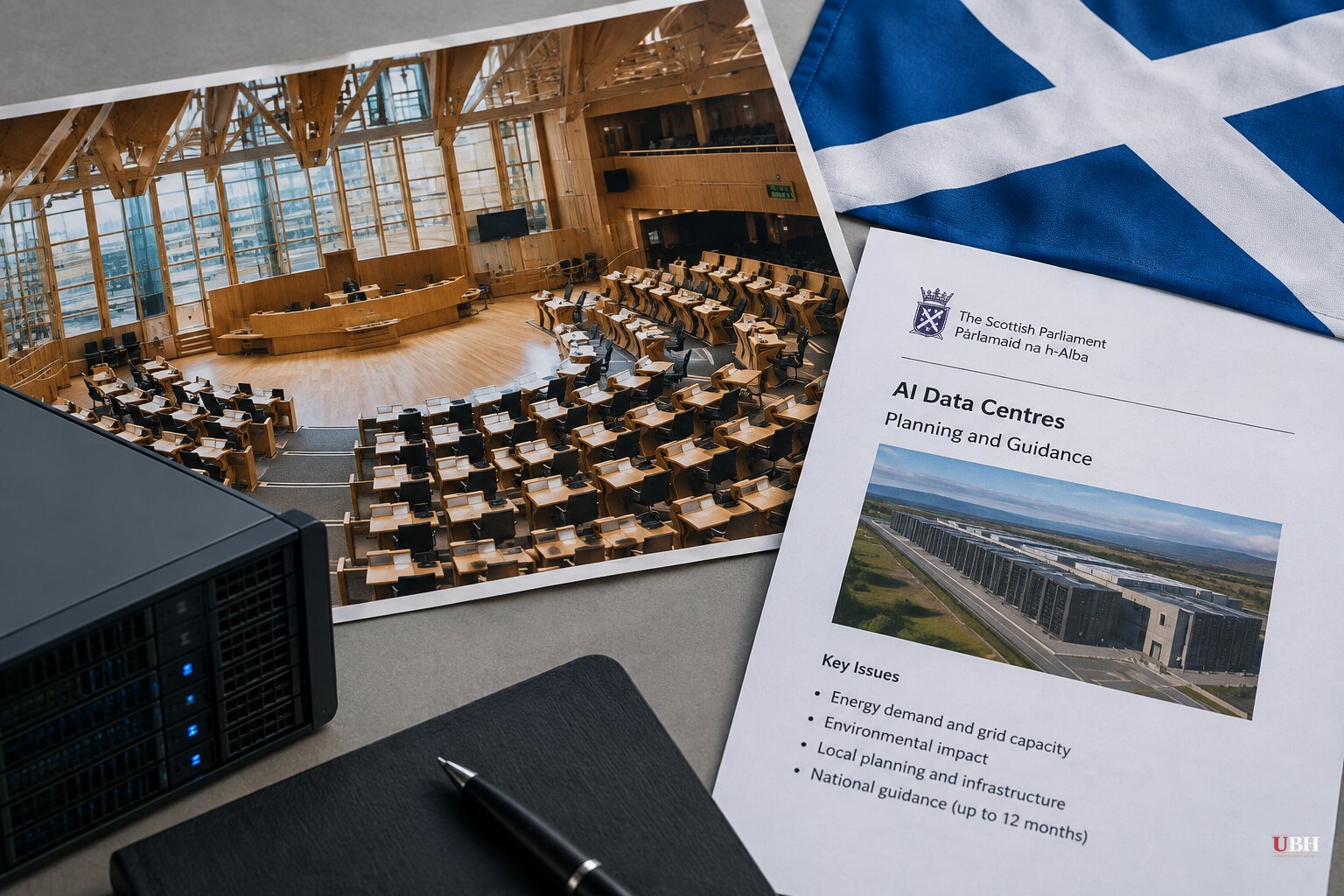
Scotland's Parliament voted 80-26 on Wednesday, September 16, to freeze planning and consenting decisions on new hyperscale AI data centers, according to the official parliamentary vote record cited by Tech Times. The Scottish Labour motion gives the Scottish government up to 12 months to publish national planning guidance before any of the pending projects can move forward, The Guardian reported.
The numbers explain why lawmakers acted. As of August 20, there were 23 hyperscale data centers proposed across Scotland, according to Action to Protect Rural Scotland (APRS), which tracks proposals on a public map cited by the Glasgow Guardian. Energy Live News reports that just the first four applications now under review would consume as much power as Torness nuclear station, which is due to close in 2030. Taken together, the pending proposals could require up to 6 gigawatts of power, more than 1.5 times Scotland's peak electricity demand, per Energy Live News.
A Grid Built to Export, Not Absorb
Scotland generates more wind power than its transmission lines can carry south to England, according to Tech Times. That mismatch already costs money: grid operators pay Scottish wind farms to shut off while paying gas plants in England to spin up, a mechanism NESO Chief Executive Fintan Slye addressed in a May 2026 statement in Glasgow. Those "constraint payments" ran to roughly £1.2 billion annually and are forecast to hit £3 billion a year by 2030, according to Scottish Financial News reporting cited by Tech Times.
Most of the proposed data center sites sit between two transmission bottlenecks, known as B4 (capped near 4 gigawatts) and B6 (capped near 6.7 gigawatts), according to IET engineers' analysis cited by Tech Times. The developer case, backed by the UK's National Energy System Operator, is that parking massive power users on the surplus side of those bottlenecks could lower bills over time. Slye made that argument directly in May, and the UK's Department for Science, Innovation and Technology has pushed for qualifying projects to move forward as part of its national AI strategy.
If data centers soak up power that would otherwise be curtailed and paid for anyway, the underlying cost to the system could fall. Whether that plays out as promised, and on whose timeline, is exactly what the parliamentary pause is designed to test before more projects are locked in.
The Opposition Isn't Buying It Yet
Kat Jones, director of APRS, called the September 16 vote "a huge step forward," per Tech Times, but said community groups will now expect ministers to "call in" applications nearing a decision date. In Larbert, in Scotland's Central Belt, developer Apatura's proposed 300-megawatt, 55-acre Larbert Data Centre Campus is the furthest through the planning process of any Scottish site, according to the Glasgow Guardian. Scotland's current largest operating data center, in Lanarkshire, runs at 12 megawatts on under two acres, by comparison.
Michael Maciocia, who founded the Say No to Larbert AI Data Centre group, told the Glasgow Guardian the fight has pulled in residents who have never opposed anything before. Green MSP Patrick Harvie argued at Holyrood that local planning boards can't weigh national grid and fossil-fuel-backup questions on a case-by-case basis, per the BBC.
Ahead of the September 16 vote, Public Finance Minister Hannah Mary Goodlad told MSPs the government would publish guidance "by Christmas" and called a formal moratorium unnecessary, according to the BBC. Parliament rejected that softer approach and passed a pause that runs up to 12 months, not three, per the Guardian and Tech Times. Scottish Labour economy spokesperson Daniel Johnson said the SNP government had "failed to do the work needed to get this right."
The Same Fight Is Playing Out in Washington
The underlying question, who pays when a hyperscaler shows up and demands gigawatts, isn't unique to Scotland. U.S. household electricity prices rose nearly 7% year-over-year in 2025, with data centers driving 40% of demand growth, according to a Goldman Sachs analysis cited by Breitbart.
Sen. Jon Husted (R-Ohio) tried to pass the Ratepayer Protection Act by unanimous consent after it cleared the House 417-3, requiring state regulators to consider standards making large power users cover their own infrastructure costs. Sen. Martin Heinrich (D-N.M.) blocked it, arguing the bill only asks states to "consider" the standard rather than requiring it, and pointed to his own GRID Savings Act, which would mandate that data centers pay for their grid connections outright, per Breitbart. Husted said the two agree on the underlying principle but called it "a shame" the narrower bill got blocked. Both senators claim the same goal: don't let households subsidize AI buildouts. They disagree only on how hard the mandate should be.
In Memphis, Tennessee, xAI's Colossus supercomputing campus has drawn sustained community objection in a historically Black neighborhood over environmental and power costs, according to the Epoch Times, which argues states need enforceable mechanisms, like a separate utility rate class for data centers with take-or-pay provisions, rather than vague pledges of "community input."
Scotland's government now has until roughly September 2027 to publish the guidance parliament demanded. Whether it meets that deadline, and whether the 23-plus pending applications get approved, modified, or scrapped once it does, remains open. In Washington, Husted said he intends to bring the Ratepayer Protection Act back for another vote; no date has been set.
Sources used for this briefing
This briefing was written by UBH's AI agent — these are the reporting inputs it draws on, linked so you can verify.


