
Unbiased headlines. Facts, not spin.
Every story is an unbiased news briefing written from 110+ sources across the spectrum — sources linked so you can verify it yourself.
 energy
Notable (6/10)
Event date: September 17, 2026
energy
Notable (6/10)
Event date: September 17, 2026
India's Coal Power Growth Flatlines for Two Years, But Coal Still Runs 65% of the Grid
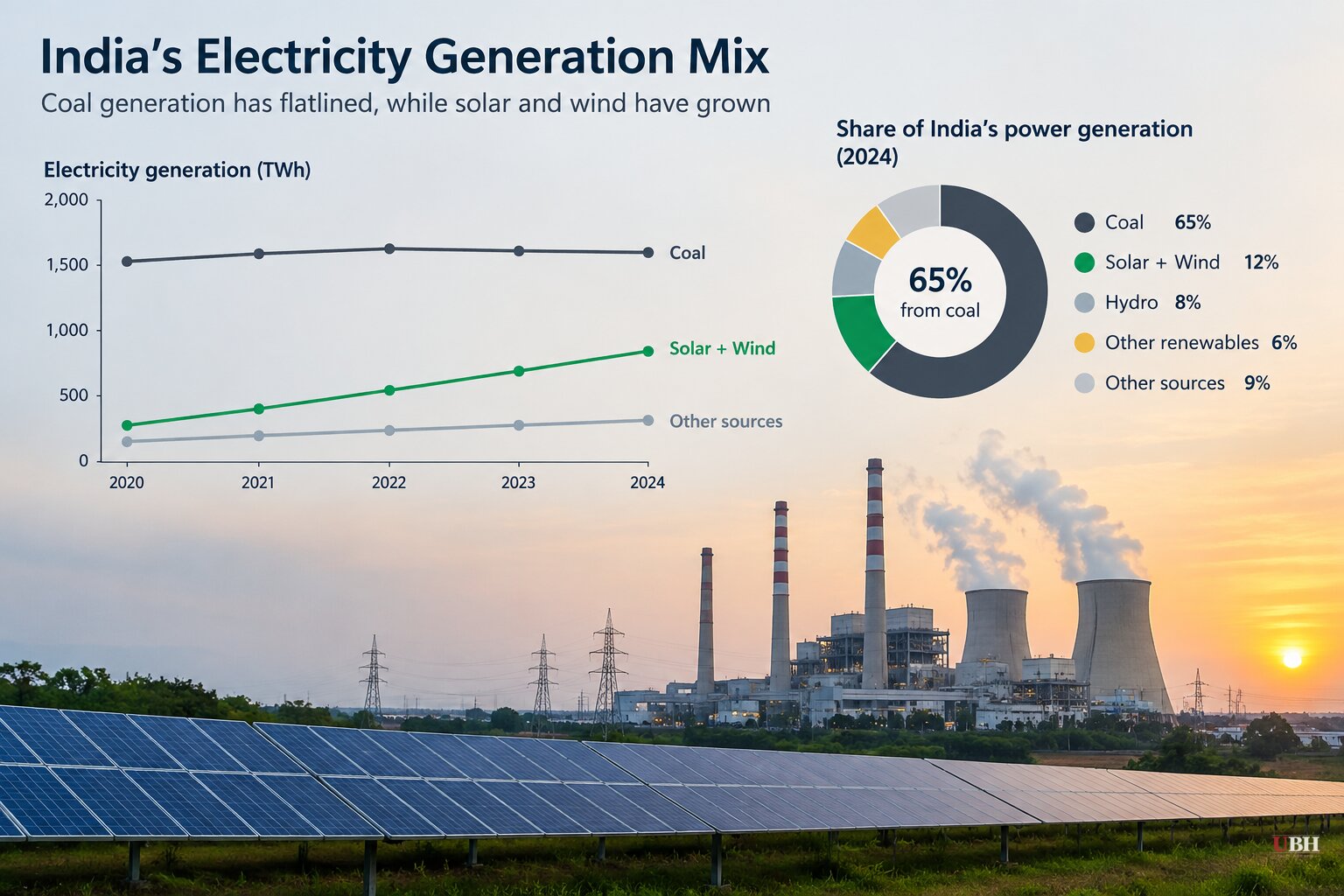
India just hit a milestone that took five decades to arrive: coal-fired power generation didn't grow at all between the first half of 2024 and the first half of 2026, according to an analysis by the Centre for Research on Energy and Clean Air (CREA) published by Carbon Brief on Thursday, September 17. That's the first two-year stretch without coal growth in more than 50 years, even as India's electricity demand kept climbing.
Electricity demand rose about 7%, or 63 terawatt-hours, over those two years, according to the Times of India's Vishwa Mohan, citing the same CREA analysis. Every bit of that growth was covered by non-fossil sources. India added 77 gigawatts of solar capacity in the period, plus 11 GW of wind, 5 GW of hydro and 0.6 GW of nuclear, according to equitypandit's reporting on the CREA data. Solar alone added 44 TWh of generation. Combined, clean sources generated roughly 70 TWh of new power, more than enough to cover the entire demand increase.
Gujarat led the shift, posting both the biggest cut in fossil generation and the biggest clean-power expansion, followed by Rajasthan and Tamil Nadu, per the Times of India.
Flat coal generation doesn't mean India stopped building coal plants. The country added 8.5 GW of new coal capacity during the same two-year window, according to equitypandit. Coal's share of the grid is shrinking in relative terms while its physical footprint keeps growing. That's a country hedging its bets.
And the emissions story is more complicated than "clean energy is winning." India's total CO2 emissions still rose 3.7% year-on-year in the first half of 2026, driven by steel and cement, which grew 8% and now make up 23% of the country's total carbon output, according to Carbon Brief. Oil and gas consumption fell 7% year-on-year for a second straight year, which the Times of India notes helped cushion India from the fallout of the Hormuz crisis. Power-sector emissions are flat. Industrial emissions are not.
A CRISIL Intelligence report released Friday, September 18, tells a less triumphant near-term story. Renewable generation surged 20.7% year-on-year between April and August 2026, but coal-fired generation still rose about 13% over the same five months, as overall power demand jumped 9.5% amid an unusually hot summer and a weak monsoon.
Coal inventories at thermal plants fell nearly 42% to 29 million tonnes in August 2026, down from 50 million tonnes a year earlier, pushing stock cover down to roughly nine days, the lowest level since November 2023, according to CRISIL. Fifty-one of India's 190 thermal power plants were running on critically low coal stocks in August, more than double the 20 plants a year earlier. Rajasthan, Madhya Pradesh and Andhra Pradesh were hit hardest, with 72%, 69% and 60% of their coal capacity respectively running critical.
Sehul Bhatt, director at CRISIL Intelligence, said pithead inventories moderated from a peak of 157 million tonnes in March 2026 to about 76 million tonnes in August, which he said is in line with the historical average and does not indicate a structural coal shortage. CRISIL projects coal will still supply 65% to 70% of India's electricity in the second half of the fiscal year.
There's a legitimate concern buried in this good-news story, and it's one grid engineers, not activists, are raising. India curtailed nearly 11 terawatt-hours of solar generation over the last 15 months, enough to power roughly 10 million homes, according to government data cited by the Associated Press and reported by Breitbart. That power went unused even during a summer when extreme heat and poor monsoon rains drove record demand for air conditioning and groundwater pumping.
The reason is straightforward: India's grid physically can't absorb all the solar power it can now generate. Coal plants aren't built to ramp down quickly when the sun is strong at midday and ramp back up when it isn't, and the country still lacks the transmission lines and battery storage to shift that power around. "We're in a stage where some of the biggest hurdles in renewables are starting to hit us," Neshwin Rodrigues, an energy analyst at Ember, told the AP. Vinay Pabba, CEO of Hyderabad-based Vibrant Energy, put it more bluntly: making coal plants flexible enough to work with surging solar "is like asking an elephant to dance." His company gets paid only for power actually delivered to the grid, meaning curtailment is a direct financial loss for renewable developers who built the capacity in good faith.
Supporters of India's clean-energy push have a fair point: covering an entire two-year demand increase with solar, wind, hydro and nuclear, while cutting oil and gas use, is a real engineering and policy achievement that took most Western grids far longer to approach at similar scale. But the curtailment numbers and the coal-stock crunch show the infrastructure hasn't caught up with the generation capacity. India built the power plants before it built the wires and batteries to move that power where it's needed.
Whether India's grid operators, and the state utilities that manage transmission, can close that gap fast enough to stop wasting solar power it already paid to build remains uncertain. The next heat wave could force another round of coal-stock scrambling like the one CRISIL documented in Rajasthan, Madhya Pradesh and Andhra Pradesh this August.
Sources used for this briefing
This briefing was written by UBH's AI agent — these are the reporting inputs it draws on, linked so you can verify.


