
Unbiased headlines. Facts, not spin.
Every story is an unbiased news briefing written from 110+ sources across the spectrum — sources linked so you can verify it yourself.
 energy
Major Story (8/10)
Event date: September 1, 2026
energy
Major Story (8/10)
Event date: September 1, 2026
Refinery Attacks From Russia to Saudi Arabia Are Squeezing Diesel Supply, Not Crude, as US Prices Hit a Record
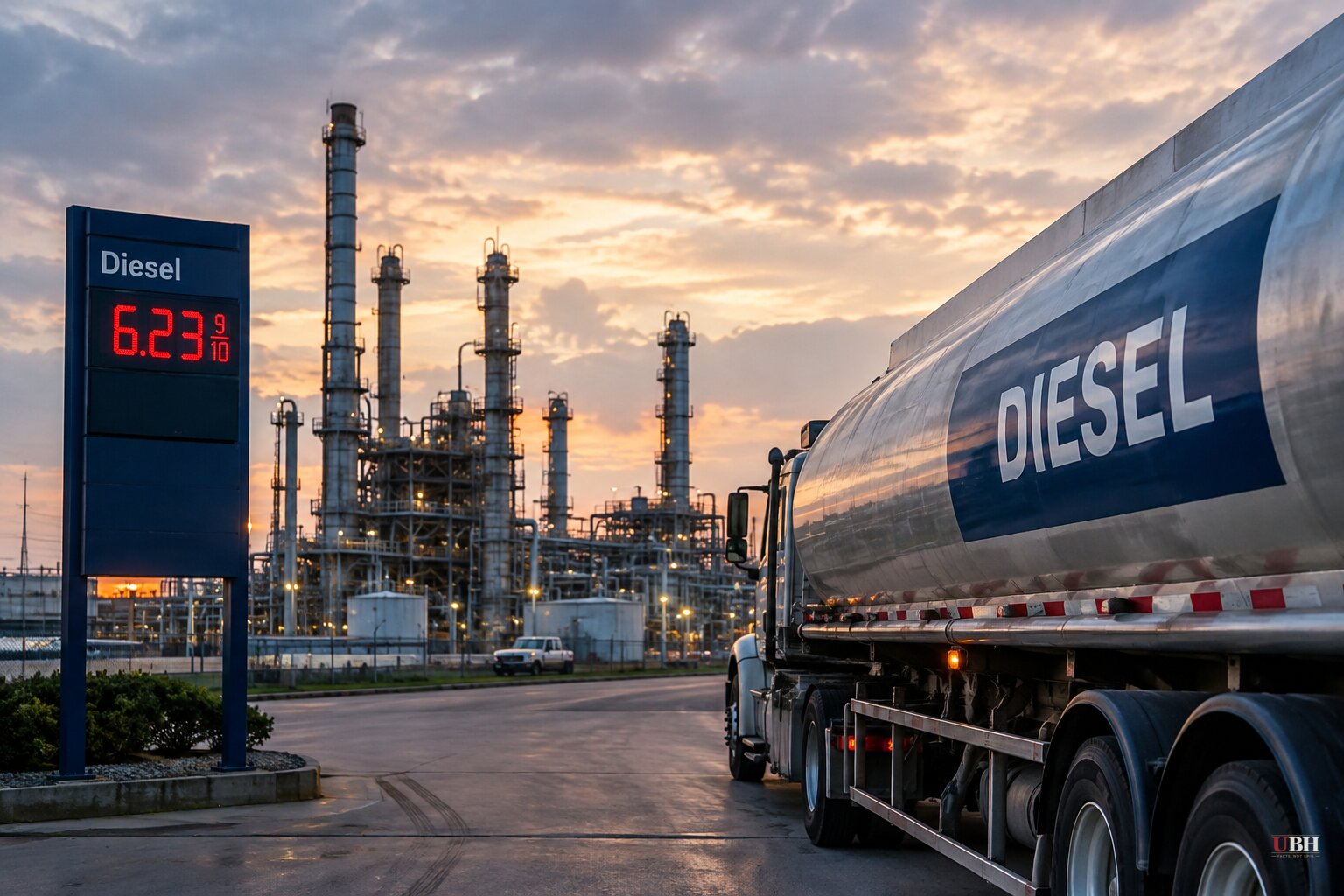
Brent crude sits around $90 a barrel, well below April's wartime peak above $125, according to the Center on Global Energy Policy at Columbia University. Crude isn't the problem. Turning it into diesel, jet fuel and gasoline is.
Columbia's Tatiana Mitrova, Luisa Palacios and Daniel Sternoff found U.S. diesel crack spreads, the margin between crude and refined fuel, spiked above $100 a barrel in mid-August on top of an $85 WTI price. Globally, finished fuels are trading $150 to $190 a barrel. This reflects a severe refining bottleneck.
Diesel hits a record in the US
Diesel prices in the United States hit $6.23 a gallon on Sept. 14, up more than 80 cents in a month, according to the Epoch Times. President Donald Trump has pointed to Iranian threats against shipping in the Strait of Hormuz as the driver of the global fuel shortage, and he's asked Ukraine to stop striking Russian oil refineries because those attacks are adding to the same shortage, per the Epoch Times.
Interior Secretary Doug Burgum, chairing the G20 Energy Abundance Ministerial in Houston this week, rejected calls for a U.S. oil export ban. He told reporters Monday a ban wouldn't lower prices and would invite retaliation that could hurt import-dependent states like California, which Burgum said already has the nation's highest gas and diesel prices because of its own refinery shutdowns. The White House is separately weighing use of the Cold War-era Defense Production Act to expand U.S. refining capacity.
Ukraine's drone campaign is working, and that's the problem
Since Ukrainian drone strikes escalated in July, at least 26 Russian refineries have been knocked out of operation between January and July, with seven still not back online, according to an assessment by S&P Global. Four more were hit in August, including Salavat, Orsknefteorgsintez and the Nizhnekamsk industrial zone, where a strike on Aug. 10 left nearly 100 people dead or injured.
The Financial Times reported that Ukrainian operators are now deliberately targeting the hardest and most expensive components to replace, like primary refining units, catalyst units and compressor equipment, to keep refineries offline as long as possible. The DeepStrike project counted at least 43 infrastructure facilities hit in the first two weeks of August alone, a record for the war.
Ukraine's rationale is straightforward: refineries fund the war Russia is waging against it, and degrading them weakens Moscow's ability to pay for it. That's a legitimate wartime military objective. But it's now directly at odds with Trump's request that Kyiv stand down on refinery strikes to ease a global fuel crunch that's hitting American consumers at the pump. Russia has already extended its gasoline export ban to Jan. 31, 2027, and its diesel export ban through the end of September, while Vladimir Putin dismissed domestic shortages as merely "certain inconveniences." Whether Ukraine scales back the strikes, and whether that would meaningfully lower U.S. diesel prices, is unclear.
Sanctions haven't actually capped Russian oil revenue
The Centre for Research on Energy and Clean Air, in its August 2026 analysis, found the G7's price cap policy has failed to durably constrain what Russia earns from oil. The cap dropped to $44.10 a barrel on Feb. 1 and was frozen there under the EU's 21st sanctions package, but Urals crude only briefly traded below even the old $60 cap, and ESPO-grade crude has consistently traded above both cap levels thanks to steady Chinese demand. CREA is now urging either a much lower enforced cap or a tax on Western maritime services used to ship Russian oil, arguing sanctions have targeted price more than volume to avoid spooking already-tight global supply.
India's squeeze
India imports roughly 90% of its crude, and the Times of India laid out a three-front problem: Saudi Arabia's East-West pipeline, shut by drone attacks, could leave the kingdom out of exportable stock at Red Sea ports within five to seven days, according to a Reuters report cited by the paper, potentially pulling 4 million barrels a day off the market. Global supply is already projected to fall 5.7 million bpd this year. On top of that, China may compete harder for discounted Russian barrels as its own Iranian supply stays choked. Indian refiners can likely absorb a short-term Saudi shortfall with existing inventory, but a prolonged outage would force them into a costlier, more competitive hunt for crude.
None of this resolves cleanly in the next few weeks. Russia's diesel export ban expires at the end of September, the Saudi pipeline's repair timeline is still unknown, and it's an open question whether Trump's request to Kyiv changes Ukraine's targeting at all.
Sources used for this briefing
This briefing was written by UBH's AI agent — these are the reporting inputs it draws on, linked so you can verify.


