
Unbiased headlines. Facts, not spin.
Every story is an unbiased news briefing written from 110+ sources across the spectrum — sources linked so you can verify it yourself.
 energy
Major Story (8/10)
Event date: September 14, 2026
energy
Major Story (8/10)
Event date: September 14, 2026
Diesel Hits Record $6.40 a Gallon as Winter Heating Oil Bills Are Forecast to Jump 31%
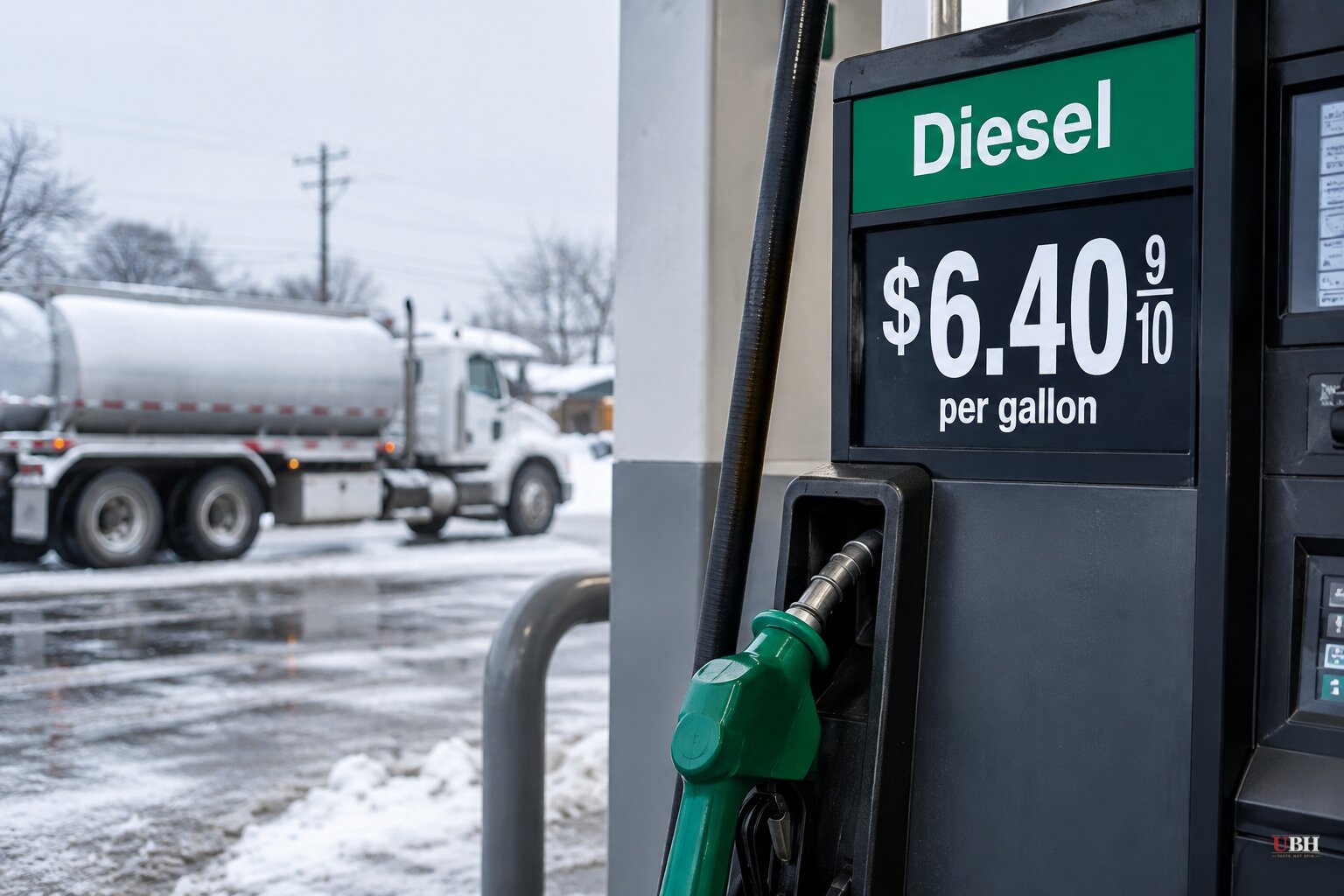
The national average price for a gallon of diesel hit $6.3956 on Thursday, according to AAA data, the highest the organization has ever recorded. That's up from $3.7075 a year ago, a 73% jump.
Gasoline is up too, though less dramatically. AAA put the national average at roughly $4.44 a gallon Thursday, up from $3.20 a year earlier. That's still about 58 cents below the all-time record of $5.0165 set in June 2022.
Three days earlier, on Monday, diesel had already broken records at $6.23 a gallon, per AAA data cited by the Tennessee Star. Prices have kept climbing through the week.
Winter heating bills are next
Households that heat with oil are forecast to pay an average of nearly $2,300 for the season running mid-November to mid-March, according to a new analysis from the National Energy Assistance Directors Association (NEADA). That's 31.3% more than last winter.
NEADA's Mark Wolfe told CBS News that Ukrainian strikes on Russian oil infrastructure, on top of the Strait of Hormuz slowdown, are squeezing global supply. "While the war may be thousands of miles away, families will feel it when the heating oil truck pulls into their driveways," Wolfe said.
Overall winter heating costs across all fuel types are projected to rise 8.7%, more than double the inflation rate, NEADA found. Electric heat is projected up 9%, natural gas up 5.8%. Only about 4% of U.S. households heat with oil, but a large majority of those households — CBS News and the Tennessee Star cite figures of roughly 75% to 82% — sit in the Northeast, where the pain will concentrate.
The U.S. Energy Information Administration hasn't issued its own winter forecast yet. That report, the Winter Fuels Outlook, is scheduled for October 6, the agency told the Daily Caller News Foundation. The EIA's September outlook, completed September 3, already projects retail heating oil averaging $5.66 a gallon in the fourth quarter and diesel at $5.55.
Why prices are where they are
Brent crude traded around $106 a barrel Tuesday, according to CBS News, up more than 30% since the war with Iran began in late February. Brent had traded around $72 a barrel before the war began. A drone attack on a major Saudi pipeline added to the disruption, according to Eurasia Group, a political risk consulting firm cited by CBS News.
Diesel prices were around $3.68 in early February, before the war, then jumped to $4.80 by mid-March, according to the Daily Wire. The climb accelerated again in recent weeks as Strait of Hormuz shipping stayed limited and Russian fuel supplies took hits.
Trump's defense, Bessent's bet
At a campaign rally in North Carolina this week, President Trump called the higher fuel costs "a very inexpensive price to pay" for preventing Iran from getting a nuclear weapon. "It's a little more. Frankly, even if it was a lot more," he said, predicting prices would fall "like rocket ships in reverse."
Treasury Secretary Scott Bessent has made a similar bet publicly, telling an interviewer this month that crude could fall as low as $40 a barrel once the war ends, citing an expected oversupply. Neither prediction has a firm timeline attached in the record, and both are forecasts from officials with a direct stake in defending the administration's Iran policy, not independent projections.
The political fight over who pays
Democrats are making the economic case against the war's fallout. California Gov. Gavin Newsom wrote on social media that "the average American family is spending an additional $4,200 every year because of Donald Trump," citing an estimate from Democrats on the congressional Joint Economic Committee. That figure comes from Democratic committee staff, not an independent nonpartisan agency, and hasn't been verified by a neutral source in the reporting reviewed here.
Sen. Mark Kelly (D-AZ) argued Trump "still can't explain what this war is for," saying it has only delivered higher gas and grocery prices. Rep. Ayanna Pressley (D-MA) pressed Bessent directly on the fuel price increases during a House hearing Tuesday, according to Fox News.
A June poll found roughly two-thirds of registered voters say fuel costs will factor into their November midterm votes, the Daily Wire reported.
What happens next
NEADA is asking Congress for an additional $3 billion for the Low Income Home Energy Assistance Program, on top of the $4.1 billion it received for the current fiscal year, which ends September 30. Whether Congress grants that request, whether the EIA's October 6 outlook confirms NEADA's 31.3% estimate, and whether Bessent's $40-a-barrel prediction actually materializes before the coldest months hit are all still open questions heading into winter.
Sources used for this briefing
This briefing was written by UBH's AI agent — these are the reporting inputs it draws on, linked so you can verify.


