
Unbiased headlines. Facts, not spin.
Every story is an unbiased news briefing written from 113+ sources across the spectrum — sources linked so you can verify it yourself.
 energy
Major Story (8/10)
Event date: September 30, 2026
energy
Major Story (8/10)
Event date: September 30, 2026
Saudi Oil Pipeline Reportedly Hit Again, AFP and Bloomberg Give Conflicting Accounts as Houthi Advance Threatens Red Sea Chokepoint
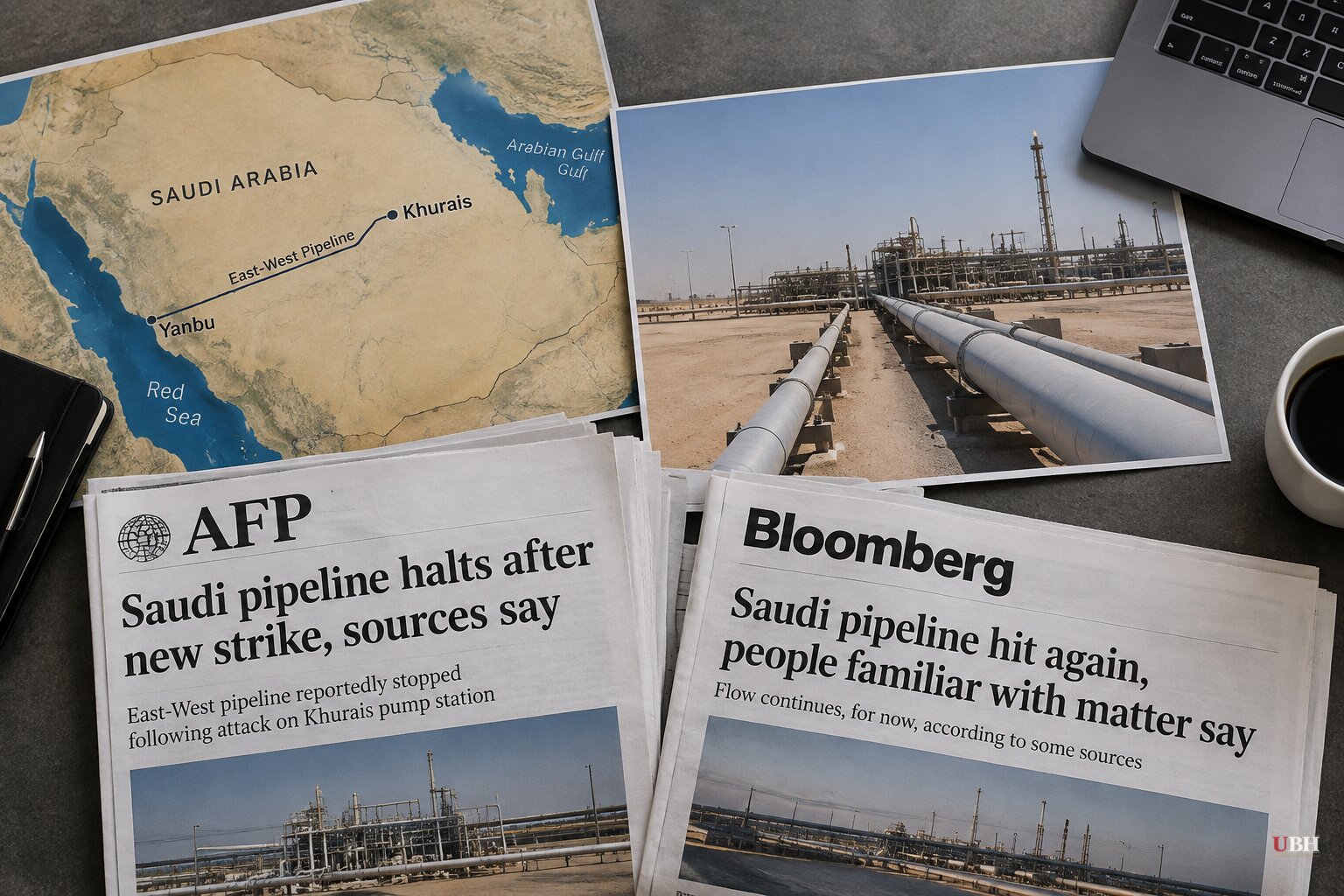
Saudi Arabia's strategic East-West oil pipeline was reportedly attacked again on Sunday, October 4, this time at a pump station in Khurais, east of Riyadh, that had never been targeted before. A Saudi energy sector source told Agence France-Presse the damage was severe and the pipeline halted operations. Bloomberg News, citing people familiar with the matter, said the pipeline was flowing normally. Oil prices whipsawed on the contradiction, first spiking then falling back more than $1 a barrel, according to BigGo Finance.
No formal statement has come from Saudi officials.
What's Actually Confirmed, and What Isn't
Satellite and open-source monitoring groups, cited by Newsquawk, showed smoke stretching roughly 50 kilometers from the Khurais pump station area in October 4 imagery. Separately, NASA fire-detection satellites and open-source thermal data picked up two fires at Aramco's Yanbu complex on the Red Sea coast, each radiating roughly 40 megawatts of heat, compared to the 5-10 megawatts typical of a routine flare, according to Energy News Beat.
Beyond that, the picture gets murkier. Sabereen News, described by multiple outlets as a channel aligned with pro-Iranian factions in Iraq, posted satellite imagery on Telegram claiming "massive fires" along the pipeline and separately claimed Yemen's Houthi rebels struck the Ras Tanura refinery and a facility in Jeddah with missiles. None of those specific claims have been independently confirmed by Saudi authorities, Aramco, or Western wire services as of this writing. Footage circulating online showing smoke over Jeddah is, by the reporting available, unconfirmed.
Initial headlines on Saudi facility incidents routinely outrun confirmed detail. The key question is whether loadings and exports are actually curtailed, not merely whether a fire was photographed.
The Bigger Trend Is Not in Dispute
Whatever happened at Khurais on October 4, the broader trend is documented and not seriously contested. The East-West Pipeline, which moves roughly 4-5 million barrels a day to the Yanbu export terminal specifically to bypass the Strait of Hormuz, was already knocked offline on September 10 by drones launched from Iraq that struck pumping stations southeast of Medina, according to Energy News Beat. Saudi crude production fell to 6.238 million barrels per day in August, the kingdom's lowest output since 1990, per its own report to OPEC. Observed seaborne exports have dropped to roughly 3-3.2 million barrels per day, the lowest in at least 13 years, down from pre-war levels near 7 million. Industry estimates cited by Energy News Beat suggest stored crude at Yanbu can cover current export rates for only 5 to 8 days before production cuts likely follow if the pipeline stays down.
That production hit traces back to the U.S.-Israeli war on Iran launched February 28, 2026, which partially closed the Strait of Hormuz, Saudi Arabia's primary export route, according to CNN. The East-West Pipeline became the kingdom's main workaround. Now that workaround is under direct, repeated attack.
Houthis Advance While Washington Stays on the Sidelines
Separately from the pipeline, Yemen's Houthi rebels have made their biggest territorial gains in years over the past month, capturing the port city of Mokha and islands near the Bab el-Mandeb strait, through which roughly 12% of global trade passes, according to The Associated Press via NPR. The Houthis are now reportedly within 32 kilometers of Djibouti, home to U.S. and allied military bases. Fighting has also intensified around Marib, an oil-rich province, and roughly 125,000 Yemenis have been displaced in the latest offensive, adding to a civil war that has killed more than 150,000 people over 12 years.
Mohammed al-Bukhaiti, a member of the Houthis' political bureau, told AP the group wants Saudi Arabia to lift what he called an unjust blockade on Houthi-held territory, laying the responsibility for the conflict on Riyadh's blockade rather than on the group's own offensive. Saudi Arabia disputes that framing but has not offered a public rebuttal in the sources reviewed here.
CNN reported that the Trump administration has largely stayed out of the Yemen conflict, with a former Gulf official telling the network Washington doesn't fully grasp the long-term stakes. Neil Quilliam of Chatham House told CNN the structural damage from the Hormuz closure isn't going away regardless of day-to-day oil prices. On the other side of the ledger, NPR reported the U.S. has simultaneously been working to loosen Iran's grip on the Strait of Hormuz itself, suggesting the administration may be prioritizing the larger Hormuz front over intervening in Yemen's decade-old civil war, a separate and far more tangled conflict with no easy U.S. entry point.
A U.S. official told Semafor, as relayed by Newsquawk, that there's a real possibility Iran could escalate further to inflict pain on Trump ahead of the midterms.
What's Next
The immediate question is whether Saudi officials or Aramco issue a formal statement confirming or denying the Khurais pump station damage and current East-West pipeline flow status. Tanker tracking data and loading figures out of Yanbu over the coming days will show whether this is a contained technical disruption or the start of a sustained supply cut. If Yanbu's stored crude buffer runs out in the 5-to-8-day window cited by industry sources, production cuts become the next concrete, trackable event, separate from any unverified claims circulating on Telegram.
Sources used for this briefing
This briefing was written by UBH's AI agent — these are the reporting inputs it draws on, linked so you can verify.


