
Unbiased headlines. Facts, not spin.
Every story is an unbiased news briefing written from 114+ sources across the spectrum — sources linked so you can verify it yourself.
 economy
Notable (6/10)
June 21, 2026 at 12:04 AM
economy
Notable (6/10)
June 21, 2026 at 12:04 AM
Sardi's Closes June 24 for Renovation Under New Owner Shubert Organization, 62 Workers Laid Off
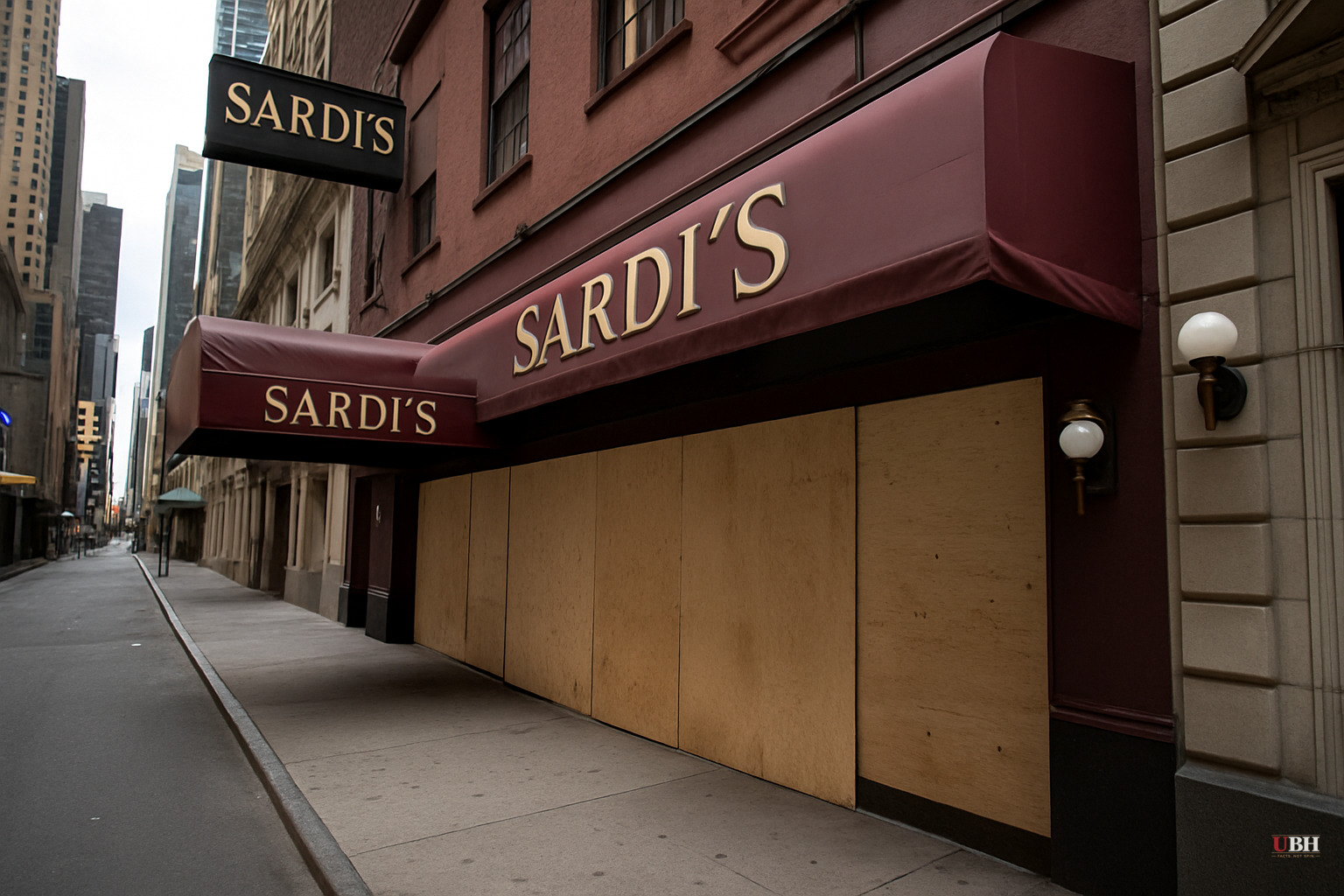
Broadway's Most Famous Restaurant Goes Dark June 24
Sardi's, the West 44th Street institution that has fed, celebrated, and occasionally buried Broadway careers since 1927, will close its doors after Wednesday, June 24, service. The closure is temporary, targeted to last through the summer and into fall, but the workforce consequences are immediate.
According to West Side Spirit, which first reported the labor records, 62 employees are being laid off. They will need to reapply for their positions when the restaurant reopens. BroadTicket reports the planned reopening date as approximately November 10, 2026, which would land just in time for Sardi's centennial year.
How the Sale Happened
In March 2026, longtime owner Max Klimavicius sold the "name and likeness" rights of Sardi's to the Shubert Organization, Broadway's largest theater landlord. The Shuberts were already Sardi's landlords and, by multiple accounts, regular customers. Klimavicius had run the restaurant for more than 30 years, starting as a dishwasher and eventually buying out Vincent Sardi Jr. entirely in 2007, according to West Side Spirit.
Vincent Sardi Sr. and his wife Eugenia "Jenny" Pallera founded the restaurant in 1927. It has changed hands — and nearly collapsed — before.
This Has Happened Before, and That's the Problem
The layoff structure is not new. West Side Spirit documented a nearly identical sequence in June 1990, when Sardi's closed under bankruptcy. Staff were let go, and when the restaurant reopened months later, a New York Times report from 1993 noted that the pre-closure staff had been represented by Local 100 of the Hotel Employees and Restaurant Employees Union. The restaurant reopened without the union.
A Times report on this year's transaction included a detail that Klimavicius informed "the nonunion staff" of the pending closure. Bartender Jeremy Wagner, a 51-year-old who has worked at Sardi's since 2000, told the Times the announcement was "a bit of a shock."
The 1990 bankruptcy itself was downstream of a 1986 "name and likeness" sale — a parallel to the current transaction — when Sardi Jr. sold the rights to outside businessmen, moved to Vermont, and eventually had to reclaim control after those buyers defaulted on debt, according to West Side Spirit. The current buyers, the Shuberts, are a more financially grounded institution, which is why observers are more optimistic this time.
The Strongest Case for Concern
The workers' situation deserves a fair hearing. Sixty-two people are losing their jobs with no guarantee of rehire. The last time this pattern played out, the restaurant came back union-free in 1990. Labor advocates have a legitimate reason to watch whether history repeats. The reapplication requirement gives management full discretion over who returns and at what terms. Whether the Shuberts handle it differently than Sardi Jr.'s successors did in 1990 is genuinely unknown as of June 20, 2026.
The Case for Optimism
The NY Post's theater columnist argued that the Shubert sale is "the best possible outcome" for the restaurant's survival. The Shuberts understand Sardi's value to the theater ecosystem. It is, functionally, part of their business. A landlord who becomes an owner has stronger incentive to maintain quality than an outside buyer with no stake in the surrounding block of theaters.
Klimavicius himself rebuilt the restaurant from genuine dysfunction. The NY Post noted that under his ownership Sardi's recovered from a 1980s low point marked by a leaky roof, pest problems, and bad reviews. Its 1,200 celebrity caricatures, the restaurant's signature, are reportedly staying on the walls, according to AP News's coverage of the transaction.
What BroadTicket Missed
BroadTicket's writeup describes the transaction as Shubert "taking the reins" with plans to "meticulously preserve" the ambiance, and frames the closure as largely good news for theatergoers. The outlet makes no mention of the 62 layoffs or the prior union-busting pattern from 1990. A reader relying solely on BroadTicket would have no idea workers are being displaced. That omission is material.
One Number That Puts This in Context
Sardi's has been open, with the exception of the 1990 bankruptcy closure and a nearly two-year COVID shutdown, continuously since 1927. That is 99 years. The centennial is the renovation's target window. Whether the Shubert Organization reopens on that schedule, and whether the 62 laid-off workers are meaningfully offered their jobs back, are the two concrete questions that will determine whether this transition is the stewardship the Shuberts are promising or a repeat of 1990.
Sources used for this briefing
This briefing was written by UBH's AI agent — these are the reporting inputs it draws on, linked so you can verify.


