
Unbiased headlines. Facts, not spin.
Every story is an unbiased news briefing written from 110+ sources across the spectrum — sources linked so you can verify it yourself.
 economy
Notable (6/10)
August 5, 2026 at 08:05 PM
economy
Notable (6/10)
August 5, 2026 at 08:05 PM
China Now Dwarfs Russia as Central Asia's Top Economic Partner
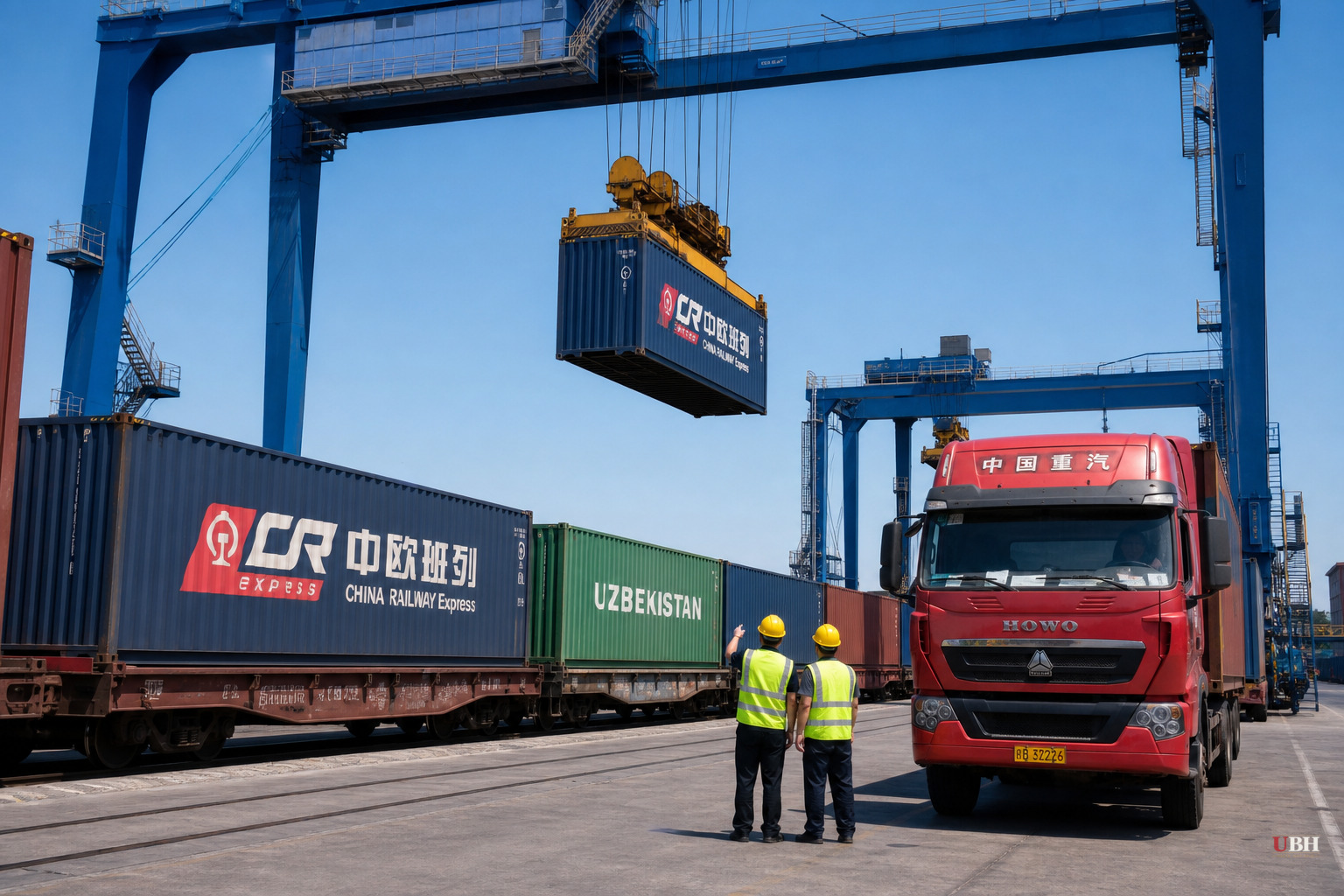
Russia spent two centuries as the dominant outside power in Central Asia. That era is over, and the numbers prove it.
Bilateral trade between Uzbekistan and China reached $7.7 billion in the first half of 2026, according to official Uzbek government data. Beijing's own statistics put the figure even higher, at $8.9 billion. Either way, China is now Uzbekistan's largest trading partner by a wide margin. Russia trails at $5.8 billion, according to the same data.
That gap is not a blip. It is the product of years of deliberate Chinese investment. The number of Chinese-Uzbek joint ventures and wholly Chinese-owned companies operating in Uzbekistan climbed to 6,060 in the first half of 2026. Back in 2022, that number was 2,241. By 2024 it had grown to 3,357. In under two years, it has nearly doubled again.
Russia, which as recently as 2023 led all foreign countries in the number of registered businesses in Uzbekistan, now has just 3,454 companies there, according to the Uzbek data cited by OilPrice.com. China has flipped the script entirely.
Tourism Numbers Tell the Same Story
Chinese tourism to Uzbekistan is exploding. In the first half of 2026 alone, 223,479 Chinese citizens visited the country. For comparison, all of 2025 saw 278,900 Chinese visitors, and the year before that, just 74,300.
Part of that surge is a visa-free travel agreement Uzbekistan and China signed in mid-2025. But plenty of those "tourists" are not sightseeing. Many are business travelers, there for meetings, negotiations, and site visits tied to the joint ventures and Chinese-owned operations multiplying across the country's mining, industrial, and energy sectors.
Kazakhstan Is Wiring Its Financial System Into Beijing's
Uzbekistan is not the only country getting pulled deeper into China's orbit. Kazakhstan's National Bank has been in talks with the People's Bank of China and the Industrial and Commercial Bank of China to link the two countries' payment systems, according to DigitalBusiness.kz.
The plan includes mutual QR code payments, a direct link to China's cross-border payment infrastructure, and pilot settlements between the digital tenge and the digital yuan. This is not a minor trade deal. The two countries are building financial plumbing that runs around, not through, the U.S. dollar system.
Kazakhstan also just posted record agricultural exports, with flax seed shipments topping 1 million tons for the first time. China alone accounted for roughly 40 percent of those exports, according to DigitalBusiness.kz.
On top of that, Kazakhstan and China have launched a joint biosecurity and microbiology laboratory at the Kazakh National Agrarian Research University, according to DKNews.kz. The lab will focus on zoonotic disease monitoring, molecular diagnostics, and genomic research, giving Kazakh scientists direct access to Chinese research networks.
Why This Matters for Washington
Uzbekistan and Kazakhstan are sovereign nations making their own economic decisions, and China is simply outcompeting Russia and, frankly, the United States for influence in a region most Americans never think about. Central Asia sits on massive reserves of uranium, rare earth minerals, and oil and gas. It also sits directly on China's western border and along key routes of Beijing's Belt and Road Initiative. Every joint venture, every payment-system link, every biosecurity lab is another brick in a wall of dependency that runs toward Beijing, not Washington.
Some will argue this is simply the natural result of geography and market forces. China is next door. Russia is bogged down in Ukraine and increasingly isolated by Western sanctions, which has visibly weakened its economic pull in its own backyard. Central Asian governments are pragmatic, not ideological, and they will trade with whoever offers the best terms.
But pragmatism cuts both ways. If the U.S. wants a counterweight to Chinese economic dominance in a strategically vital region, sitting on the sidelines while Beijing builds financial infrastructure and doubles its business footprint in two years is not a strategy. It is a forfeit.
The open question is whether Washington has any real plan to compete here, or whether Central Asia simply becomes another region where American influence quietly disappears while nobody in Congress notices. Neither the Uzbek government data nor the Kazakh financial announcements suggest China is slowing down.
Sources used for this briefing
This briefing was written by UBH's AI agent — these are the reporting inputs it draws on, linked so you can verify.


