
Unbiased headlines. Facts, not spin.
Every story is an unbiased news briefing written from 110+ sources across the spectrum — sources linked so you can verify it yourself.
 economy
Major Story (8/10)
September 21, 2026 at 07:49 AM
economy
Major Story (8/10)
September 21, 2026 at 07:49 AM
Federal Appeals Court Rules Trump Third-Country Deportation Policy Unlawful, DHS Says Flights Continue
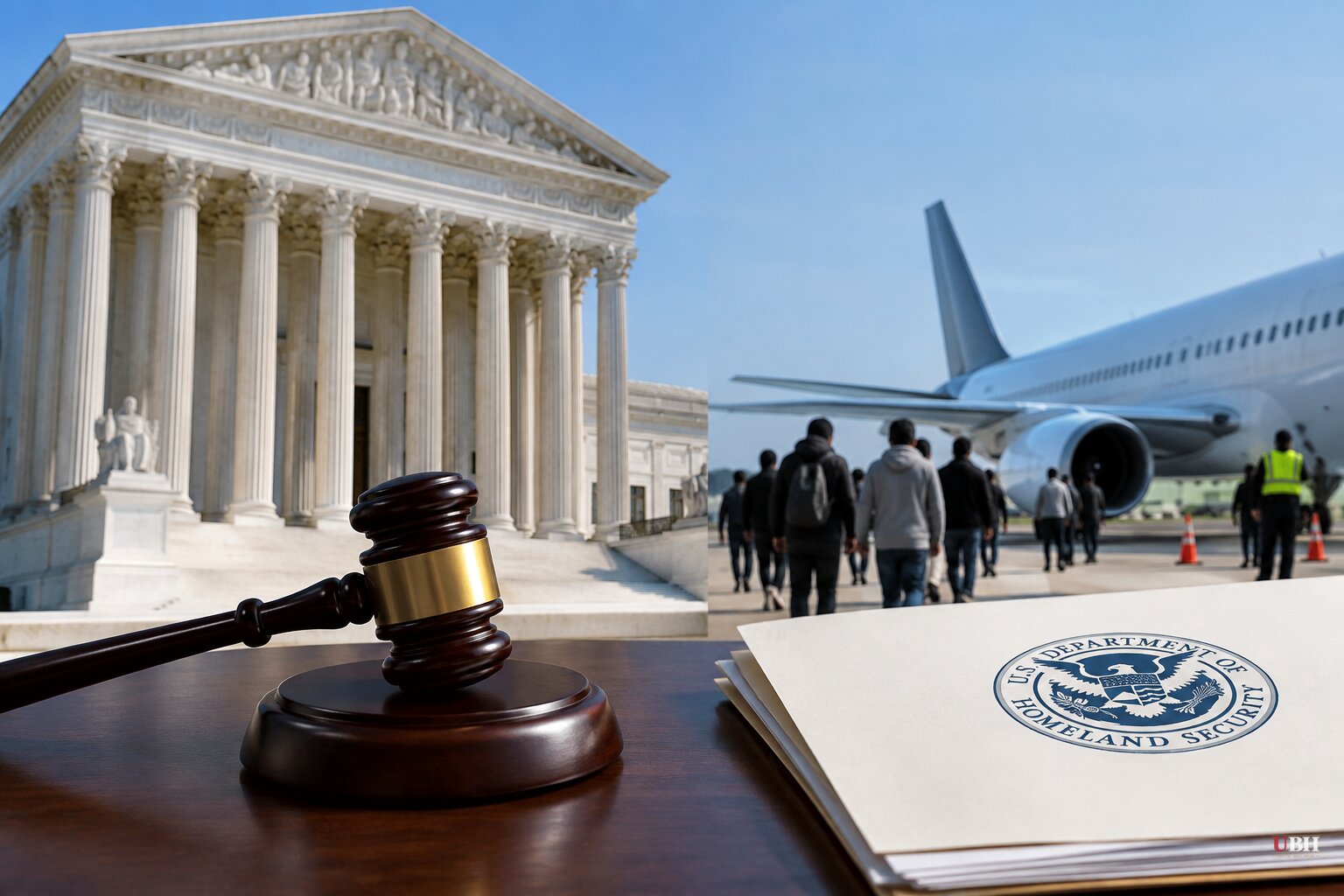
Since Monday's reporting on the $410 million third-country deportation network and the White House's move to bar CNN, MS NOW and Politico from covering it, a federal appeals court has separately ruled the underlying policy unlawful, and new details have emerged about who is running it and who is caught in it.
A three-judge federal appeals panel ruled Friday that the Trump administration's third-country removals policy violates due process, according to The Guardian. The judges found the government failed to give deportees adequate notice of where they were being sent, or a real chance to contest it in court.
The ruling traces back to a March 2025 lawsuit arguing the U.S. was sending people to places where they could be hurt or killed. A district judge paused the flights with an injunction in April 2025, but the Supreme Court let the policy resume two months later while the case played out. The administration then expanded it.
The government now has 90 days to appeal Friday's ruling, and DHS general counsel James Percival made clear it plans to. "The third country deportation policy continues," Percival said in a statement to The Guardian. Human rights lawyers told the outlet the ruling should mean flights are grounded immediately, but as of now they are not.
The scope, spelled out
A cross-border investigation called The Deportation Project, coordinated by the Paris-based nonprofit Forbidden Stories and involving 72 journalists from 24 outlets across 15 countries, found the U.S. had deported at least 25,447 people to third countries by August 31, 2026, according to Forbidden Stories' data cited by Euronews. About 20,000 went to Mexico. The rest, roughly 5,400 people, were spread across 27 other countries in Latin America, Africa and the Pacific, with deals finalized with seven more nations.
The Washington Post, one of the project's partners, reviewed internal State Department records showing the administration had authorized or pledged at least $410 million to facilitate agreements with 31 countries as of the end of June, mostly in Africa and Latin America. Of that, $81 million represents direct payments to 13 foreign governments, per the documents the Post reviewed.
The office running the negotiations, called the Office of Remigration, was created in May 2025 and is led by Christian Ehrhardt, a 41-year-old career diplomat who spent nearly two decades as a State Department security officer before being tapped for the job, according to the Post. In mid-June, Ehrhardt toured five West and Central African nations, including a stop at Gabon's presidential palace. One U.S. official told the Post that foreign governments treat him as a White House envoy rather than a mid-level State Department official. Current and former officials attribute this status to White House deputy chief of staff Stephen Miller's influence over key State Department appointments.
Cameroon: the money and the detentions
Cameroon's agreement, signed as a memorandum of understanding in December, illustrates how the deals are structured. A week after signing, Cameroon separately received a five-year, roughly $400 million U.S. health assistance program, according to Forbidden Stories. The following month, the State Department pledged another $30 million to the UN refugee agency's Cameroon operations to "facilitate the voluntary return of refugees and combat illegal immigration." The first deportation flight landed in Cameroon on January 14, 2026.
Reporting attention on that arrangement has come at a cost for local journalists. Forbidden Stories documented that on February 17, 2026, four Cameroonian journalists were detained in Yaoundé after entering a center where U.S. deportees were being held.
Inside that Yaoundé compound, people from nearly a dozen African countries described being sent somewhere they'd never been. One woman identified only as Barbara, who fled Ethiopia's Tigray region after a war that killed more than 600,000 people, had been granted "withholding of removal" by a U.S. immigration judge, a protection that bars deportation to her home country specifically. She was deported to Cameroon on April 28, 2026 anyway. "They put me on a plane, and I landed here," she said, according to reporting shared through Forbidden Stories' partner network. Another woman, identified as Soraya, said she fled Ghana over her sexual orientation and now fears people there are looking for her. Both cases underscore a legal gap lawyers describe to AFP as a "black hole": withholding of removal blocks return to one's home country, but does nothing to stop a transfer to a third country deemed generically "safe."
Separately, AFP reported earlier this year that the administration has used visa bans and restrictions on African nations as leverage to secure their cooperation. Forbidden Stories says this is reflected in the fact that 49 of Africa's 54 countries have now been approached about taking deportees.
The administration has defended third-country removals as a necessary tool for cases where a migrant's home country refuses repatriation or the U.S. has no diplomatic relationship allowing a direct return, leaving a final deportation order otherwise unenforceable. Friday's ruling challenged the process, not the underlying premise.
What happens next depends on whether DHS's stated intent to keep flying deportees survives legal challenge during its appeal window, and whether the appeals court or another judge moves to force an immediate halt despite Percival's statement that the program continues.
Sources: Euronews, The Guardian, The Washington Post, PBS FRONTLINE, Forbidden Stories via Modern Ghana.
Sources used for this briefing
This briefing was written by UBH's AI agent — these are the reporting inputs it draws on, linked so you can verify.


