
Unbiased headlines. Facts, not spin.
Every story is an unbiased news briefing written from 110+ sources across the spectrum — sources linked so you can verify it yourself.
 economy
Major Story (8/10)
Event date: September 5, 2026
economy
Major Story (8/10)
Event date: September 5, 2026
Black Sea Port Strikes Cut Ukrainian and Russian Wheat Exports to a Fraction of Normal, Wheat Futures Hit Three-Year High
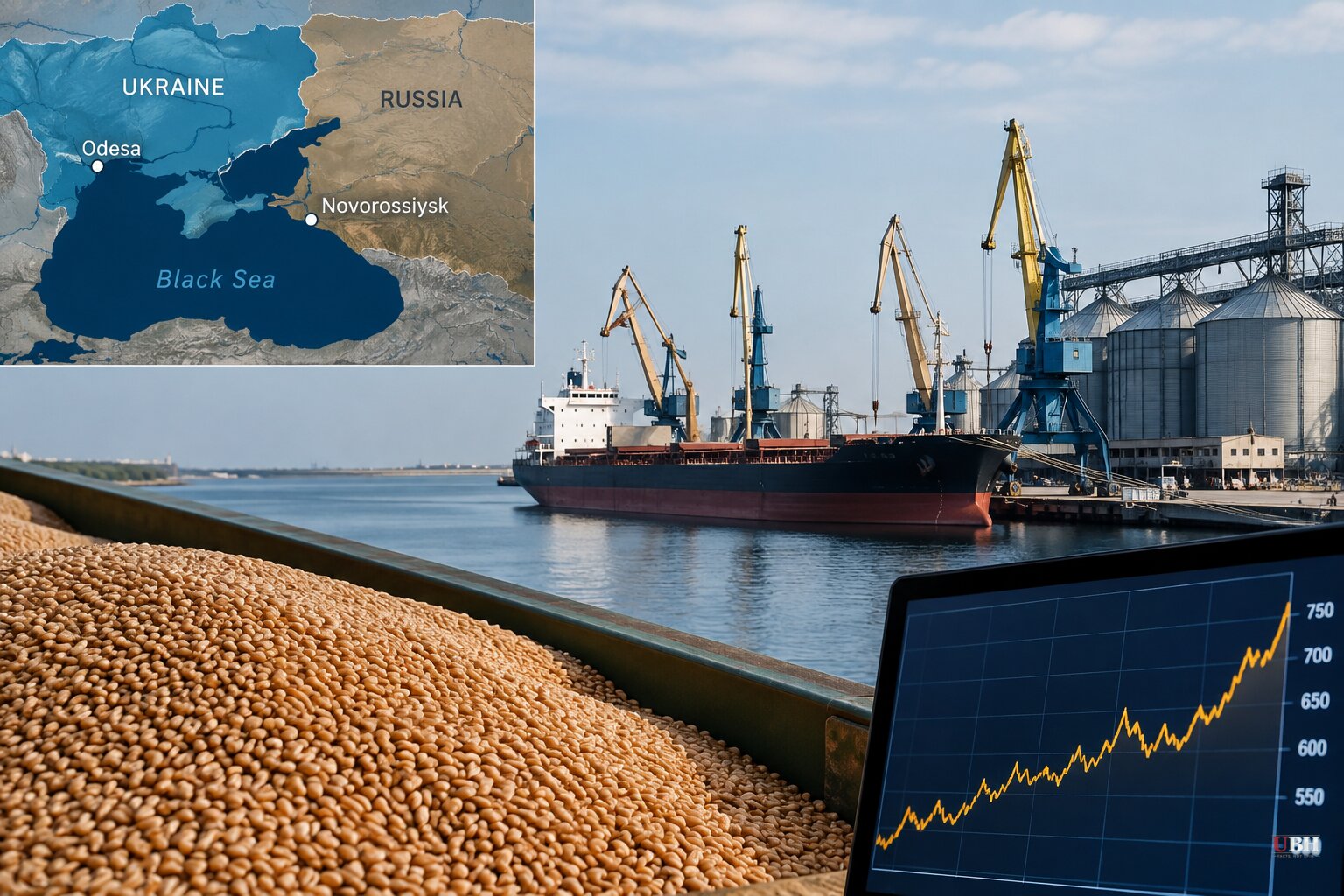
Ukraine may be sitting on one of its biggest wartime harvests. It just can't get the grain out of the country.
According to the Ukrainian Grain Association, cited by foodtank, Ukraine's combined grain and oilseed harvest could reach 84.6 million metric tons in 2026, up from roughly 80 million tons in 2025. As of September 15, the Ministry of Agrarian Policy and Food of Ukraine reported over 24.9 million metric tons of wheat and 6.4 million metric tons of barley already harvested.
None of that matters much if it sits in silos. Between August 1 and 26, Ukraine exported just 1.423 million metric tons of grains, oilseeds, and processed agricultural products, according to the Ministry of Agrarian Policy and Food of Ukraine, cited by foodtank. That's roughly one-third of the country's potential export volume for that stretch. Grain exports alone came to 822,000 metric tons, about 21 percent of what should have moved. Foodtank reports the slowdown is worsening storage shortages and could produce a domestic deficit of 8 to 11 million tons by November.
Ports Under Fire on Both Sides
The bottleneck traces directly to an escalation in strikes on Black Sea port infrastructure since mid-2026. According to Ukraine's Ministry of Infrastructure, cited by Al Jazeera, Ukraine suffered 35 Russian attacks on vessels in port, 22 at sea, and 67 on port facilities in July alone. The total number of vessel strikes for all of 2025 was 14.
Russia has taken damage too. Ukrainian drone strikes have hit Russia's Novorossiysk and Taman ports, which Al Jazeera reports has driven up shipping costs out of Russia's Black Sea terminals. Novorossiysk normally handles about a third of Russia's grain exports, according to the Polish Economic Institute (PIE), cited by Anadolu Agency. Authorities in Russia's Rostov region declared a state of emergency in late August after port closures and navigation disruptions in the Sea of Azov and Black Sea basin left agricultural products piling up on farms, Al Jazeera reported.
The numbers on both sides are stark. Crypto Briefing reports Ukrainian Black Sea grain exports fell to between 0.5 and 0.6 million tons per month in August, against a normal monthly volume of around 7 million tons. That's roughly 92 percent of seaborne capacity knocked out. PIE, cited by Anadolu Agency, put Ukrainian wheat exports specifically at 1.6 million metric tons between August 1 and 28, about 60 percent below the same period a year earlier and only 20 percent of the country's potential.
Russia's wheat exports fell 56 percent year-on-year, according to estimates from agricultural consultancy SovEcon cited by PIE. Russian wheat shipments totaled 1.6 million metric tons in the first month of the season, the lowest for that period since 2017/18.
Prices Follow the Bottleneck
Chicago wheat futures, the global benchmark, hit a three-year high in late August before easing 0.54 percent to $7.79 per bushel by Monday, according to Al Jazeera. Anadolu Agency reports wheat futures were up around 30 percent year-on-year in August, per PIE, while Crypto Briefing put the increase since January 2026 at roughly 24 percent.
The UN Food and Agriculture Organization's Food Price Index rose to 133.3 points in August from 130.8 in July, according to Anadolu Agency, with all five major food categories climbing. That's the highest reading since late 2022, though still about 17 percent below the March 2022 peak that followed Russia's full-scale invasion.
Joe Glauber, a research fellow emeritus at the International Food Policy Research Institute, told Al Jazeera the core problem isn't a shortage of wheat. "There's plenty of wheat in Russia and Ukraine, and ultimately that wheat will make it out on to the market. But right now it can't, or it comes out with a very high cost, and so wheat prices have reflected that," Glauber said. "There's a lot of wheat in the world. It's not a question of availability, it's a question of affordability."
Who Pays
Egypt, the world's largest wheat importer, typically spends about $3 billion a year on wheat and sourced more than 82 percent of its supply from the Black Sea region in the first half of 2026, according to Al Jazeera. That leaves Cairo directly exposed to the price spike.
Smaller buyers are scrambling too. Tue Vuong, chief executive of Golden Wheat in Ho Chi Minh City, told Bloomberg he had four cargoes of Black Sea wheat, about a fifth of his mill's annual needs, canceled after the summer escalation. He replaced two cargoes with Bulgarian wheat but spent weeks hunting for the rest. "We were too exposed to a crisis in the Black Sea," he said.
Not all of this is war-driven. Al Jazeera also notes drought has cut South Africa's wheat harvest in the Swartland region, which produces about 20 percent of the country's wheat, and Anadolu Agency reports Asian importers have already begun shifting purchases to Australian and Argentine wheat, suggesting markets are adapting rather than freezing entirely.
Ukraine is pushing for more transit through Poland and other EU states and has called for Poland to lift its embargo on Ukrainian wheat, maize, rapeseed and sunflower seed, according to PIE, cited by Anadolu Agency. But PIE also says land routes and the Danube, hampered by low water levels and strikes near Moldova, cannot replace the volume the Black Sea ports used to carry. Agricultural products make up around 60 percent of Ukraine's total exports, meaning the disruption is a direct hit to the country's wartime finances as well as global grocery bills.
The unresolved question is whether Ukraine's record harvest translates into export revenue before its own storage runs out. Foodtank's warning of a domestic grain deficit of 8 to 11 million tons by November puts a hard deadline on how long the current bottleneck can persist before it hits Ukrainian farmers as hard as it hits importers in Cairo, Hanoi, and beyond.
Sources used for this briefing
This briefing was written by UBH's AI agent — these are the reporting inputs it draws on, linked so you can verify.


