
Unbiased headlines. Facts, not spin.
Every story is an unbiased news briefing written from 110+ sources across the spectrum — sources linked so you can verify it yourself.
 economy
Major Story (8/10)
Event date: September 16, 2026
economy
Major Story (8/10)
Event date: September 16, 2026
Data Center Spending Overtakes Housing Investment for the First Time, BEA Data Shows
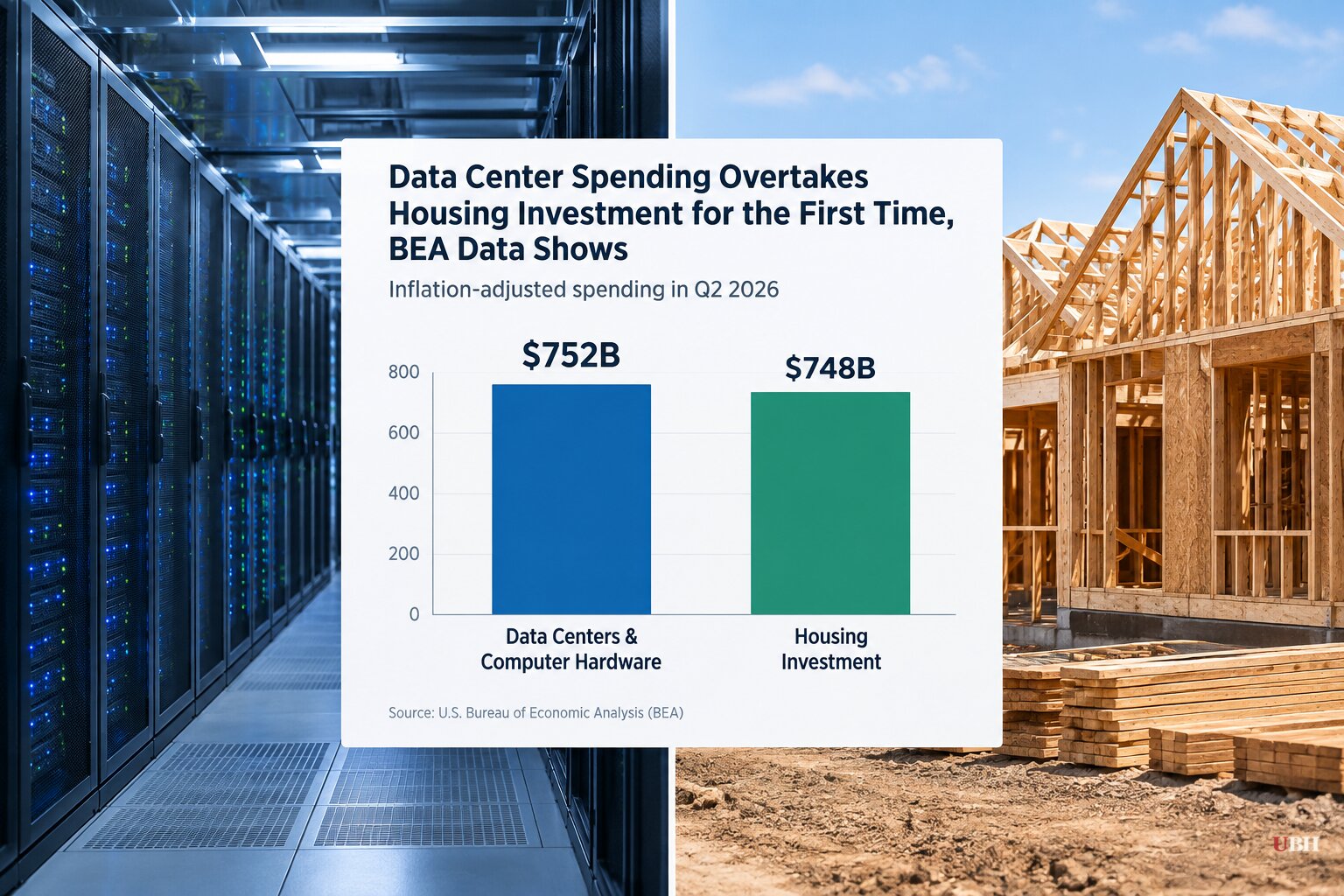
For the first time on record, America is spending more building AI infrastructure than it's spending on housing.
Real private residential fixed investment came in at $748 billion in the second quarter of 2026, according to Bureau of Economic Analysis data cited by Fortune. Spending on information-processing equipment, which covers data centers and computer hardware, hit $752 billion over the same stretch.
Adam Shapiro, a vice president at the San Francisco Fed, flagged the crossover in a recent LinkedIn post: "We're seeing a pivotal shift in the US economy: investment is shifting away from residential investment and towards computers." Since 2021, residential investment is down 18%. Information-processing spending is up 51% over the same window.
The reasons for that split are straightforward. The 30-year mortgage rate is sitting near 7%, and the 10-year Treasury yield has hit its highest level since 2007, according to Fortune. Housing is rate-sensitive. Homebuyers and builders are frozen out.
AI capital spending isn't behaving the same way. Treasury Secretary Scott Bessent recently described a lot of the corporate debt tied to the AI build-out as "almost yield-agnostic," telling reporters that companies "believe they're going to be so high" on returns that "they don't really care what they're paying." That's the Treasury Secretary saying, on the record, that hyperscalers are borrowing without much regard for cost.
The Numbers Behind the Boom
S&P Global Ratings projected in an Aug. 27 report that combined capital spending from Alphabet, Amazon, Microsoft, Meta, Oracle and SpaceX will top $1.3 trillion by 2027, up from roughly $470 billion in 2025 and a projected $870 billion in 2026. S&P also warned that capex across the industry is growing faster than revenue, and that the buildout could produce overcapacity if AI demand doesn't arrive on the timeline these companies are betting on. The firm doesn't see the group's operating cash flow turning positive until 2028.
Alphabet's free cash flow went negative in the second quarter of 2026 for the first time since its 2004 IPO, a development Fortune reported triggered a 7% single-day stock drop.
On the ground, the spending is showing up in construction data. The U.S. Census Bureau reported total construction spending fell 0.5% in July and is down 3.8% year over year, driven mainly by a 7.3% annual drop in residential construction. Anirban Basu, chief economist at the Associated Builders and Contractors, said the entire increase in nonresidential spending that month came from data centers. Strip that category out, and nonresidential spending is at its lowest level since September 2023. Office spending, which includes data centers, is up 16.9% year over year. Power-sector spending, boosted by data center electricity demand, is up 5.3%.
A University of Virginia Weldon Cooper Center forecast credited AI-related investment in IT, software and data centers with giving the national economy "slightly stronger momentum" heading into the middle of 2026. Dutch financial firm ING went further, estimating AI now accounts for roughly one-third of U.S. economic growth this year, according to Cardinal News.
The Backlash, and the Fairest Version of It
Communities hosting these facilities are increasingly furious about who's covering the cost of the power grid upgrades needed to run them.
In southwest Memphis, residents in a historically Black neighborhood near Elon Musk's xAI "Colossus" supercomputing campus have raised concerns that the environmental and power costs of a massive industrial facility will land on their community, according to the Epoch Times. That's a legitimate concern: giant electricity users can push grid upgrade costs onto ordinary ratepayers if utility rate structures don't separate them out.
Congress actually did something about it. The House passed the Ratepayer Protection Act 417-3 in September, according to Fox News. The bill, sponsored by Rep. Gabe Evans, a Colorado Republican, and co-sponsored by Rep. Kathy Castor, a Florida Democrat, doesn't ban data centers or cap their growth. It amends the Public Utility Regulatory Policies Act so data centers using 100 megawatts or more pay the full cost of the generation and transmission upgrades built to serve them, and it requires financial guarantees in case a project falls through. Evans framed it as keeping America ahead of China on AI without sticking families with the bill. Castor said her constituents are "grappling with skyrocketing electric bills" and shouldn't subsidize corporate growth.
A narrower Senate version from Sen. Jon Husted, an Ohio Republican, was blocked from a unanimous vote by Sen. Martin Heinrich, a New Mexico Democrat, who argued it didn't go far enough, according to Breitbart.
In Virginia, home to roughly 13% of the world's operational data center capacity according to Fox News, state Sen. Louise Lucas, a Portsmouth Democrat, is pushing to tax data centers more heavily, while state Sen. Glen Sturtevant, a Chesterfield County Republican, wants a construction moratorium. Cardinal News reported that President Trump has warned on Truth Social that killing the "Golden Goose" of data center investment would only hurt the people complaining about it, putting him at odds with rural supporters in his own party.
The open question is whether Congress and state legislatures land on Evans-Castor-style cost allocation rules before the political backlash hardens into outright moratoriums. S&P Global's own timeline says the industry doesn't expect its cash flow to turn positive until 2028. Until then, the bet that AI demand shows up on schedule is being financed on debt markets that, by the Treasury Secretary's own description, aren't pricing in the risk that it doesn't.
Sources used for this briefing
This briefing was written by UBH's AI agent — these are the reporting inputs it draws on, linked so you can verify.


