
Unbiased headlines. Facts, not spin.
Every story is an unbiased news briefing written from 110+ sources across the spectrum — sources linked so you can verify it yourself.
 economy
Major Story (8/10)
September 20, 2026 at 05:39 PM
economy
Major Story (8/10)
September 20, 2026 at 05:39 PM
Election Betting Hits $20 Billion a Month as States Try to Shut Prediction Markets Down
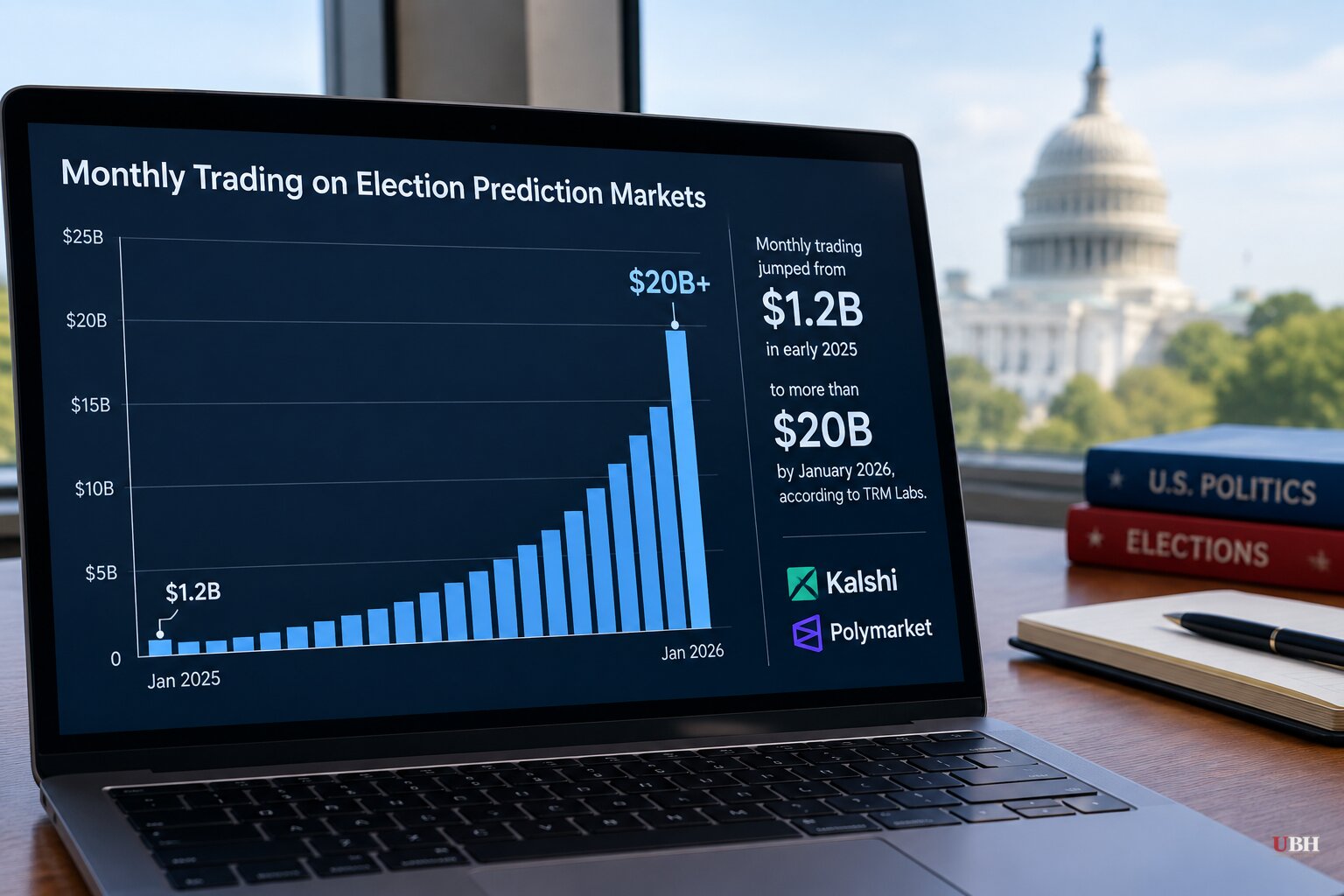
Prediction markets went from a niche corner of the internet to a fixture of election coverage in about a year and a half.
Monthly trading volume across major platforms rose from roughly $1.2 billion in early 2025 to more than $20 billion by January 2026, according to crypto analytics firm TRM Labs, as reported by GZERO Media. The single biggest market in 2025 was the New York City mayoral race, which drew over $150 million in wagers from 70,000 traders on Polymarket, per the same report.
The surge traces back to a 2024 court win for Kalshi Inc. that cleared the way for regulated event contracts on U.S. elections, according to Bloomberg. Since then, Kalshi and Polymarket have struck partnerships with CNN, CNBC and Fox, and Polymarket has launched its own newsletter, The Oracle, according to ats.io. The Wall Street Journal has also folded prediction-market odds into its political coverage, GZERO Media reported.
Kalshi told ats.io that roughly 70% of visitors to its platform in 2026 were checking forecasts rather than placing trades, meaning the odds themselves have become a media product independent of whether anyone actually bets.
Why some election officials are worried
Jared DeMarinis, the administrator for the Maryland State Board of Elections, called the trend "troubling" in comments carried by the Associated Press. His concern, reported by both AP and PBS, is that pervasive financial incentives around election outcomes could further erode public confidence in the results if voters believe money is influencing what happens.
If a market can move on rumor or a coordinated push of cash, and news outlets are broadcasting that number as if it were a poll, it risks looking like Wall Street picking winners instead of voters. States are already moving to ban the platforms as unlicensed casinos, according to the AP report carried by both Breitbart and PBS, though the AP piece does not name which states or detail the specific legal theories being used.
Kalshi and Polymarket reject the casino comparison. Company officials argue the trading is closer to hedging in the stock or bond markets, where investors position themselves ahead of an election based on how the winner's policies might hit their portfolios. Joshua Mitts, a Columbia Law School professor who studies securities law, backed that framing in comments to the AP: "One can make the argument that the entire stock market, at some level, is affected by elections and outcomes."
The platforms also point to built-in safeguards. Federal law requires insider-trading protections meant to stop candidates and campaign staff from betting on their own races. Kalshi disclosed on August 31 that it handed a three-year suspension and a fine to Laurie Buckhout, a Republican congressional candidate in North Carolina, for trading on her own race, according to the AP. That's an actual enforcement action, not a promise on paper.
Kalshi also says its own data shows strong correlation between market odds and real outcomes, claiming events priced at a 60% probability happen close to 60% of the time.
Do markets actually beat polls?
Research supports the accuracy case. GZERO Media cited a 2025 Vanderbilt University study finding Polymarket outperformed traditional polling in forecasting the 2024 presidential race, particularly in swing states, with researchers suggesting Polymarket bettors may represent a broader slice of the population than typical poll samples. Earlier research going back to 2008 found prediction markets beat pollsters 74% of the time, especially when forecasting more than 100 days out, per the same report.
Markets also move faster than polls. GZERO Media noted that Polymarket odds spiked immediately after the 2024 assassination attempt on Donald Trump, a real-time reaction no weekly poll could match.
The AP's reporting, carried by both Breitbart and PBS, also links the prediction-market boom to a separate development: President Trump's push for stricter voter ID rules and changes to mail-in voting, which the AP describes as based on claims of fraud that AP calls false. That framing is the AP's own characterization of a disputed political claim, not an independent finding in these reports, and none of the sources here present verified fraud evidence one way or the other. Voter ID and mail-ballot security remain a mainstream policy debate independent of whatever prediction markets are doing.
What happens next
The CFTC signaled on September 19 that it may open the door for more financial apps to offer prediction-market access directly, according to ats.io, which would push election odds even further into everyday financial dashboards ahead of November's midterms. Whether states succeed in banning the platforms as gambling, or whether federal regulators keep clearing the way for expansion, will likely be decided in court and at the CFTC well before the 2026 cycle wraps up.
Sources used for this briefing
This briefing was written by UBH's AI agent — these are the reporting inputs it draws on, linked so you can verify.


