
Unbiased headlines. Facts, not spin.
Every story is an unbiased news briefing written from 110+ sources across the spectrum — sources linked so you can verify it yourself.
 economy
Breaking / Critical (9/10)
Event date: September 17, 2026
economy
Breaking / Critical (9/10)
Event date: September 17, 2026
Trump's New Russia Sanctions Law Puts India and China on the Clock for 100% Oil Tariffs
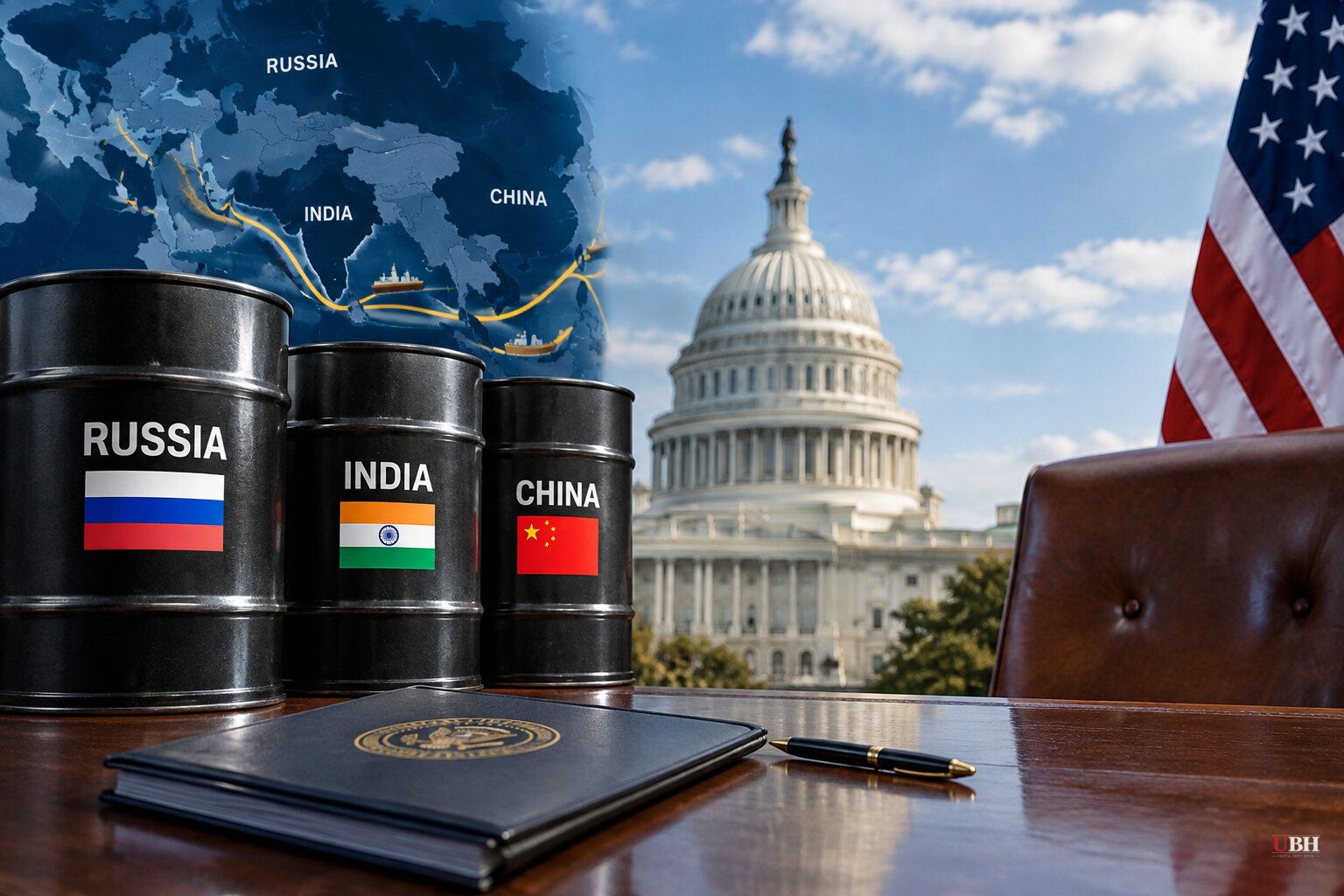
Since the U.S. House passed the sanctions package 262-159 on Wednesday, September 16, President Trump has signed it into law, starting a 30-day clock before he can act on it, according to The Hindu.
The bill, known as the Lindsey O. Graham Sanctioning Russia and Iran Act of 2026, cleared the Senate 86-11 last month before the House vote, per Breitbart. Business Insider Africa reported Trump signed it on September 18; Millennium Post put the signing on September 19.
What the Law Actually Does
The legislation targets Russia's energy and defense sectors, President Vladimir Putin and senior officials by name, and Moscow's so-called shadow fleet of tankers used to dodge existing sanctions, according to Al Jazeera. It also extends sanctions tied to Iran.
The headline provision gives Trump authority to impose tariffs of up to 100% on countries that keep buying large volumes of Russian oil and gas, a list that explicitly includes India and China, per Al Jazeera and Breitbart.
The Hindu's editorial board flags the bigger shift: last year's 50% tariffs on India over Russian oil ran through an executive order, meaning Trump could scrap them with a signature. This time Congress passed the law itself, so any waiver Trump wants to grant now requires written justification to lawmakers.
A Split Congress
The bill did not sail through without friction. Gregory Meeks, the top Democrat on the House Foreign Affairs Committee, called it "deeply flawed," arguing that "White House lawyers drafted the current text to maximize President Trump's authority to impose new import taxes on the American people, and to minimize any obligation to actually impose new sanctions on Russia or its enablers," according to Breitbart. Meeks said he'd have backed the bill if the secondary tariff powers were stripped out, but Republicans rejected amendments to narrow them.
A handful of Republicans voted no too, objecting on free-market and non-interventionist grounds, Breitbart reported. Dozens of Democrats backed the bill anyway, framing it as pressure on Moscow as the war grinds into its fifth year with no ceasefire. Ukrainian President Volodymyr Zelensky pushed Congress toward passage during a July visit to Washington, saying Putin was "losing 30,000 his soldiers per month" but still refusing to stop the war.
India's Position
India's Ministry of External Affairs says it "remains firmly committed to ensuring energy security for its 1.4 billion people" and has told U.S. officials directly that the tariffs would carry "implications for the bilateral relationship and the international energy market," according to Al Jazeera. New Delhi also said it would keep buying oil "through diversified sourcing and on the basis of evolving market dynamics," per Breitbart.
India is the world's third-largest oil importer, and Russian crude made up roughly 51-52% of its imports as of July 2026, according to both The Hindu and Millennium Post. Cutting that off overnight is not a policy tweak. It is a supply-chain overhaul for an economy of 1.4 billion people, competing with China, Europe and other Asian refiners for the same barrels from Saudi Arabia, Iraq, the UAE, Brazil and Guyana, as Inventiva noted.
But the scale of India's exposure to the U.S. market cuts the other way. The U.S. buys about 20% of India's total goods exports, per The Hindu, and India's small and medium exporters absorbed real financial pain sharing the cost of last year's 50% tariff. A 100% tariff on top of existing 10% forced-labor tariffs and 50% steel-and-aluminum tariffs would make most Indian exports to the U.S. simply uncompetitive.
The Money Behind the Pressure
The scale of Russia's dependence on Asian buyers is clear. China accounted for roughly 50% of Russia's crude exports and India about 37% since December 2022, according to the Centre for Research on Energy and Clean Air, cited by Business Insider Africa. In August alone, China bought €8.4 billion in Russian fossil fuels and India bought €4.8 billion. CREA also found sanctioned tankers carried 52% of Russia's seaborne oil and 61% of its crude shipments that month, with shadow-fleet vessels turning up in incidents off Algeria and Libya, and Egypt emerging as Russia's fifth-largest fossil-fuel buyer at €513 million in August.
Millennium Post raises a separate, harder-to-prove concern: that Washington's posture toward India echoes the wariness U.S. officials now express about having helped build up China economically over decades. That comparison is a framing choice by Indian commentators, not a documented U.S. policy objective, and no U.S. official is quoted making that link directly.
What Happens Next
India has three paths, per The Hindu: cut Russian oil purchases, keep buying and absorb the tariffs, or lobby Washington to use the law's "up to 100%" language to land on something far lower. Commerce Minister Piyush Goyal is scheduled to travel to the U.S. at the end of September for the G-20 Trade Ministerial, a trip that will now double as tariff diplomacy. With the 30-day clock running from Trump's signature, any resolution should become clear by mid-October.
Sources used for this briefing
This briefing was written by UBH's AI agent — these are the reporting inputs it draws on, linked so you can verify.


