
Unbiased headlines. Facts, not spin.
Unbiased Headlines is an independently owned news organization. We bring you the facts, not opinions, written fresh from 110+ named sources. Sources linked so you can verify it yourself.
 economy
Major Story (7/10)
Event date: November 5, 2026 ·
U.S. Industry Groups Ask USTR to Examine South Korean Fines on American Firms
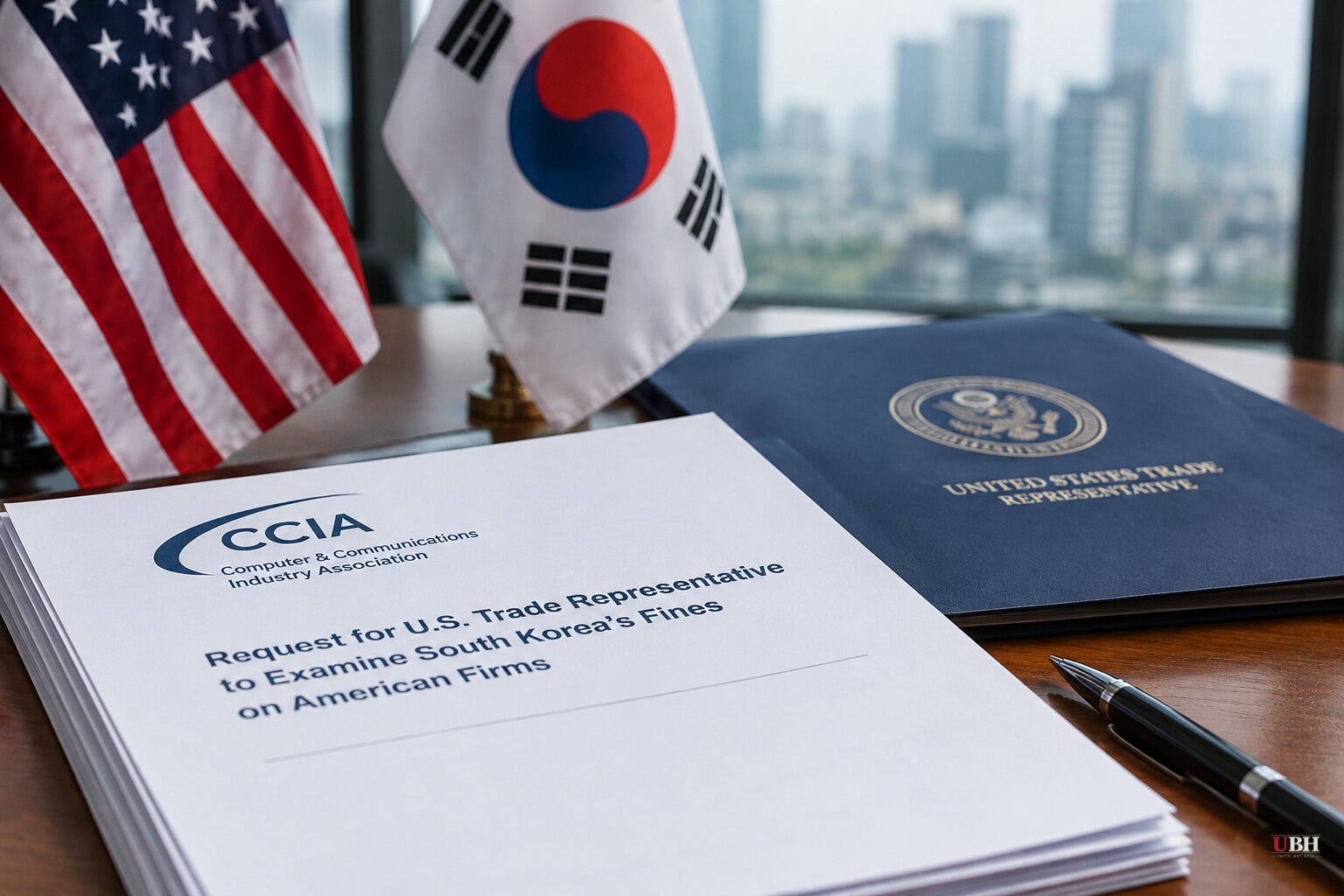
A coalition of American business groups is pressing U.S. Trade Representative Jamieson Greer to confront South Korea over how its competition regulator treats U.S. companies. The argument rests on a decade of fine data, and the regulator disputes how that data should be read.
The numbers behind the complaint
The Computer & Communications Industry Association's research arm studied 1,203 Korea Fair Trade Commission sanction decisions from 2016 through 2025. Total penalties came to KRW 6.7 trillion. U.S. companies absorbed KRW 1.52 trillion of that, or 22.8%, while making up only 1.6% of sanctioned companies, CCIA said at an online media session on Nov. 5.
Adjusted for business activity in Korea, CCIA says U.S. firms faced fines 4.2 to 6.6 times higher than Korean ones. A statistical model controlling for legal provision, industry and sanction year put the gap at about 5.1 times. In abuse-of-dominance cases alone, CCIA puts it at 216 to 341 times.
The group also says U.S. firms were penalized roughly 80 to 90 times more heavily than Chinese companies. CCIA's own release converts the totals to about $5.6 billion overall and $1.3 billion for U.S. firms. Other conversions of the same won figures come out lower, so the won amounts are the firmer numbers.
The largest single example is the roughly KRW 1.03 trillion fine on Qualcomm over patent licensing practices. Trevor Wagener, director of the CCIA Research Center and chief economist, who conducted the study, said that even excluding Qualcomm and Coupang, the result that fines on U.S. companies are higher remains statistically significant. In his words, the problem cannot be explained by individual companies or a few large-scale sanction decisions alone.
CCIA also pointed to differences in how fines changed after they were announced. Google's fine rose 8.5% from an initially announced KRW 207.4 billion to a final KRW 224.9 billion, and Coupang's rose 16.3% from KRW 140 billion to KRW 162.8 billion. Kakao Mobility's fell about 79%, from KRW 72.4 billion to KRW 15.1 billion, and fines on the three major mobile carriers declined 15.5%, from KRW 114 billion to KRW 96.4 billion. CCIA says about 91% of the top six fines on Korean companies were canceled, reduced or had related rulings overturned, while about 97% of the top five fines on U.S. companies were upheld as is.
CCIA says the disparity is concentrated in cases where the KFTC has discretion over which sales are used to calculate penalties. It has urged U.S. trade officials to seek "clear, enforceable commitments" that competition rules apply consistently regardless of nationality. It also raised possible violations of national treatment obligations under the KORUS free trade agreement and called for a Section 301 investigation and government-to-government consultations.
A separate analysis from the Information Technology and Innovation Foundation, cited in submissions for USTR's annual National Trade Estimate report, found the average fine on an American firm approached $29 million, versus $1.4 million for Korean entities. It also found American companies bore more than 81% of penalties on foreign firms.
What the KFTC says
The KFTC rejects the premise. Its response is that the gap reflects large-scale, serious violations by major global companies. It called the comparison a "trap of averages."
The regulator's point is that a handful of big cases can skew a comparison of averages. CCIA's economist counters that the disparity remains statistically significant even with Qualcomm and Coupang excluded.
The messenger also matters. CCIA's members include Google and Apple, and Coupang, which does most of its business in South Korea. Those are companies with direct interests in how the KFTC behaves. That does not make the data wrong, but the KFTC's penalty calculations have not been independently audited in anything cited here.
The legislation on deck
The fines are the past. The next fight is over bills in South Korea's National Assembly. On Nov. 2, the U.S. Chamber of Commerce, the Association for Competitive Technology, the Coalition of Services Industries, CCIA and the Software & Information Industry Association sent a joint letter to Greer.
The letter targets three measures:
- Platform Transaction Fairness Bill. The groups say it targets U.S. companies operating in a digital market worth $100 billion or more while excluding traditional suppliers, including Korean and Chinese ones. They say it could ban a wide range of commercial practices, impose financial custody obligations and price regulation, and expand the KFTC's enforcement discretion.
- Telecommunications Business Act amendment. The groups describe it as importing the EU Digital Markets Act's interoperability rules and say it effectively targets two U.S. companies.
- Delivery platform bill. It would cap combined brokerage, advertising and delivery fees at 15% of the order amount.
The groups also object to disclosure of commercially sensitive information and to sanctions that range from administrative penalties of up to 10% of revenue to criminal penalties.
Their core claim is that the bills "run counter, at a minimum, to the spirit of the agreement, regardless of whether they violate the wording of the commitments Korea made in the U.S.-Korea Joint Fact Sheet." They warned the bills could pass by the end of the year and urged USTR to consult with the South Korean government and convey its opposition.
The wider alliance strain
The complaint lands amid friction that South Korean lawmakers aired themselves. A month-long parliamentary audit that ended last week surfaced strains over intelligence sharing, access to White House officials and U.S. visa denials.
Spy chief Lee Jong-seok acknowledged that Washington curtailed some sensitive intelligence sharing after accusing a South Korean minister of publicly disclosing the location of a previously unconfirmed North Korean nuclear site. Lee and the military declined to give details. The ambassador to Washington raised limited access to key White House officials, and two prominent lawmakers protested visas that were not issued in time for official U.S. trips.
A Pew survey published in August found 55% of South Koreans view the U.S. unfavorably, the highest in more than 20 years. Reuters also noted suspicion among some lawmakers in Washington that Seoul has benefited from its access to the U.S. market while being less welcoming to American companies.
The opposition People Power Party blames President Lee Jae Myung. "The cause of the break-up is not external; it's inside (the government)," spokesperson Park Choong-kwon said last week. Foreign Minister Cho Hyun, asked about U.S. Ambassador Michelle Steel calling the alliance in "turbulence," told parliament: "When you're in a turbulence, fasten your seatbelt and it won't be a problem."
Seoul's government portrays the strains as temporary. Breitbart reports that Korean officials have also invoked "judicial sovereignty" in rejecting claims of discriminatory treatment.
The context for the money is sizable. Samsung is building a multibillion-dollar chip project in Texas and Hyundai an electric vehicle complex in Georgia. Seoul is simultaneously seeking tariff relief and other concessions from Washington.
CCIA's vice president for digital trade, Jonathan McHale, said the group is not challenging the regulator's authority itself and wants the KFTC to establish statistical evidence that its enforcement against foreign companies is not disproportionate.
USTR has not said whether it will act on the request for a Section 301 investigation. Whether the KFTC's figures stand up to scrutiny over how penalties are calculated, and not just who pays them, is the open question.
Both sides have a point. The KFTC's explanation is one that U.S. officials can test in individual cases, and CCIA's request for enforceable consistency is one Seoul can answer with its own data.
Sources used for this briefing
6 links from 6 independent newsrooms (syndicated copies of the same report count once)
These are the sources it draws on, linked so you can verify.


