
Unbiased headlines. Facts, not spin.
Unbiased Headlines is an independently owned news organization. We bring you the facts, not opinions, written fresh from 110+ named sources. Sources linked so you can verify it yourself.
 economy
Major Story (8/10)
Event date: October 23, 2026 ·
French 10-Year Yield Tops 5% for First Time Since 2002 as Riots and Budget Stalemate Collide With 119% Debt Load
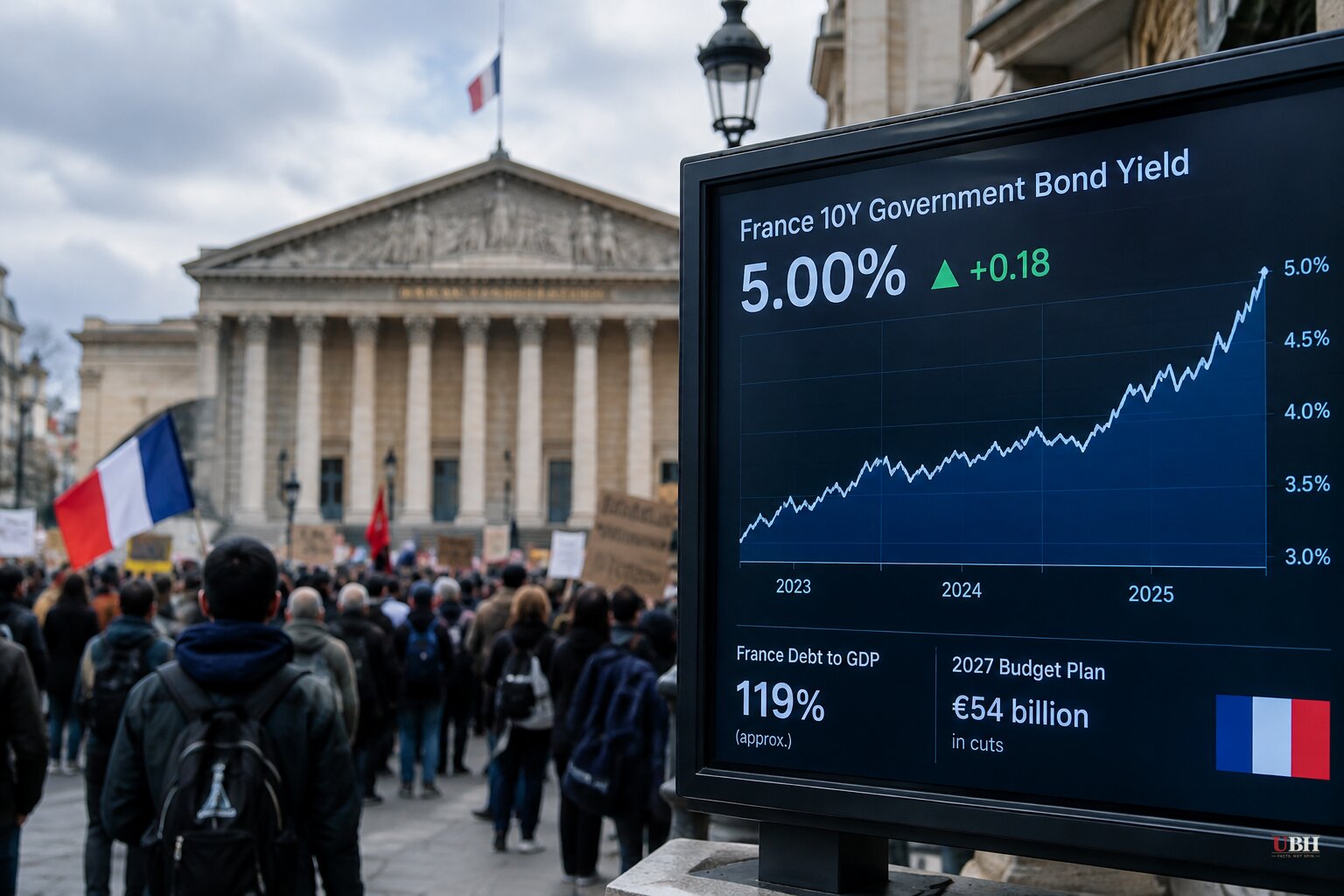
France's cost of borrowing has climbed to levels not seen in decades, and the people who pay the bills are in the streets.
The yield on France's 10-year government bond rose as much as 16 basis points to 4.94% on a Monday in late October, after a weekend of violence that produced thousands of arrests, burned public buildings and hundreds of looted shops. By Tuesday, Oct. 20, it stood at 4.96%, against 3.43% for Germany. Within days it crossed 5% for the first time since 2002. The gap between French and German 10-year yields passed 170 basis points, the widest since the euro zone debt crisis of the early 2010s. The cost of insuring French debt against default, measured by credit default swaps, is also the highest since that period.
The numbers behind the stress
France's public debt is roughly 119.3% of GDP, according to the Finance Ministry's September draft budget. The ministry projects it will reach a record 121.7% in 2027. The EU's reference ceiling is 60%.
The deficit is above 5% of GDP, versus the EU's 3% reference. Data from the Ministry of Public Action and Accounts put it at roughly $180 billion in September.
Growth has stalled. GDP contracted 0.2% in the first quarter and was flat in the second. Forecasts for 2026 run from ING's 0.3% to the government's 0.5%. Unemployment hit 8.3% in the second quarter, the highest since 2020, and the youth rate is closing in on 22%.
Prices are squeezing households. Inflation hit 3.1% in September, the highest since January 2024, driven almost entirely by energy costs tied to the U.S.-Iran conflict that began in late February. Wage growth averaged 1.7% in the April to June period.
Moody's kept France at Aa3 on Oct. 23 but held its negative outlook, citing "the fragmentation of France's political landscape."
A budget with no majority
The protests began about a month before the violence, when students at a high school outside Paris blockaded their school over leaks, cracking walls and a shortage of teachers. The movement spread nationwide and widened into anger over the cost of living, fuel prices and workers' rights.
Prime Minister Sébastien Lecornu's government wants to push through a 2027 budget with €54 billion in cuts. Alexandra Roulet, president of the Circle of Economists of France, called that figure historic and "well above what some economists were even proposing." She also said the government has "little room to maneuver."
The Assembly is not cooperating. Lawmakers rejected the Social Security financing bill in October. Parliament then postponed the revenue vote for a second time while high schoolers marched in Paris and other cities. François Facchini, an economist at Paris 1 Panthéon-Sorbonne, noted that the rejected bill covers pensions, healthcare and family benefits.
Mathieu Plane of the French Institute of Economics described the bind: voters expect more spending on purchasing power, schools, pensions and healthcare, "and at the same time, you also have to be fiscally responsible, which means we no longer have the means to fund all of this."
President Emmanuel Macron condemned the "unbridled violence" in a televised address. Five prime ministers have served under him since 2022. His government has since banned what it called illegitimate protest groups and deployed 70,000 officers ahead of a Saturday protest. Macron has blamed the far left for the riots.
How big is the contagion risk?
The alarm is not universal. Goldman Sachs analysts wrote that the risks of "disorderly market escalation and real economy contagion look notably lower" than in 2011 to 2015. They added that the underlying fiscal problems, especially in France, "look harder now."
Carsten Brzeski of ING said there is no risk of an imminent liquidity problem for the French government. He also said, "We are deep into French crisis territory."
OilPrice.com goes further, arguing that a French default would shake confidence in the euro and that the only way to prevent one would be European Central Bank support, which would fall hardest on German savers. No central bank or government official in the notes has proposed or ruled out such a step.
The worry about a spiral is more widely shared. Economists cited by CNBC warn that rising yields raise interest costs, which swell the debt, which pushes yields higher. Paul Krugman described the downside on Oct. 8 as a loop in which fear of default drives capital flight, which raises interest rates further.
This is not only France's problem. The IMF reported that the average 10-year yield across G7 economies has risen more than 1 percentage point since February, to the highest level in nearly 20 years. It projects G7 public debt will collectively exceed economic output by the end of the decade, a first since World War II.
CNN argues the U.S. is not about to become France. It points to France's much larger safety net and to the structure of the American economy, even though U.S. public debt, at about $32 trillion, roughly equals annual GDP, and the deficit it just closed the books on was about $2 trillion.
What comes next
The French state is borrowing at close to 5% to fund a deficit above 5% of GDP, with growth near zero. The budget it needs to fix that has no stable majority behind it.
A nationwide general strike backed by students was projected to draw the biggest turnout in years. The revenue vote has been postponed twice. Whether Parliament passes €54 billion in cuts, or the deadlock pushes bond yields past their current 24-year high, is the open question for French and euro zone markets.
Sources used for this briefing
7 links from 7 independent newsrooms (syndicated copies of the same report count once)
These are the sources it draws on, linked so you can verify.


