
Unbiased headlines. Facts, not spin.
Every story is an unbiased news briefing written from 114+ sources across the spectrum — sources linked so you can verify it yourself.
 energy
Major Story (8/10)
Event date: October 5, 2026
energy
Major Story (8/10)
Event date: October 5, 2026
Sailors Earn $25,000 a Trip Running the Hormuz Gauntlet as the Iran Oil War Grinds On
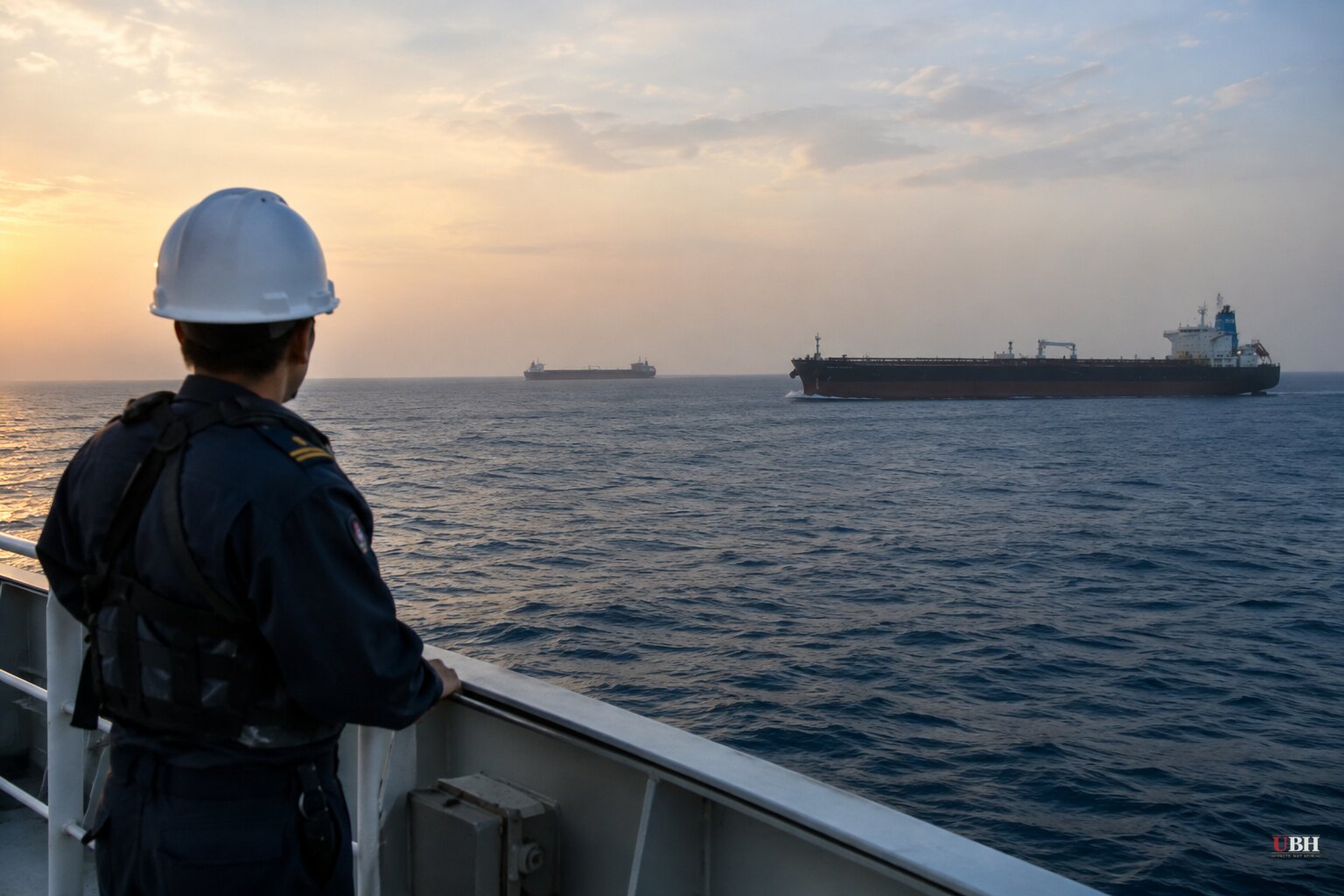
The going rate for a war-zone oil run: $25,000
Seafarers moving crude through the Strait of Hormuz are now being paid up to $25,000 for a single round trip, according to the Wall Street Journal, as reported by Mish Talk and LiveMint. For oilers and cadets, that's more than a year's normal wages, earned in under a week.
Nine commercial vessels have been attacked near the strait over a recent two-week stretch, according to BigGo Finance, and one seafarer has died. LiveMint, citing the U.K. Maritime Trade Operations (affiliated with the Royal Navy), put the figure at seven ships hit since September 28, with some identified as shuttle tankers.
Why shippers are paying $40 million a trip
Buyers in Asia grew reluctant to send their own ships into the Gulf after Tehran began targeting commercial vessels in the strait. Producers responded by chartering Very Large Crude Carriers for what the industry calls a "shuttle run": enter the strait, load at Gulf ports, exit again, then transfer cargo to another tanker waiting offshore.
Each round trip now costs between $30 million and $40 million, or $15 to $20 a barrel excluding insurance, according to shipbrokers cited by both Mish Talk and LiveMint. Dimitris Maniatis, founder and CEO of maritime-risk firm Marisks, said the current market is achieving revenue levels rarely seen in recent industry history. Richard Matthews, director of consulting and research at shipbroker E.A. Gibson, said the payouts to sailors are "absolutely nothing" compared to what shipowners are making.
Charter rates for a VLCC from the Persian Gulf to China topped $1.2 million a day in late September, according to Clarksons Research, up from about $231,400 a day before the war and under $40,000 a day back in January.
The flow is recovering, but the math is changing
Kpler data cited by BigGo Finance shows crude exports through the strait rebounded to 16.5 million barrels per day in September, up from a low of 5 million barrels per day earlier in the war. Separately, CNN Business reported that strait throughput averaged 13.1 million barrels per day last week, about 80% of the 17.1 million barrel prewar average, with total Middle Eastern crude flows through the strait and around it back to 98% of prewar levels, according to JPMorgan.
The gap between those numbers reflects a structural shift. Roughly 40% of regional exports now bypass Hormuz entirely through pipelines in Saudi Arabia and the UAE, compared with 17% before the war, per Kpler data cited by BigGo. Matt Smith, director of commodity research at Kpler, told CNN that given the volume still getting through, "it is clear Iran is losing its influence over" the strait.
Not sustainable forever, JPMorgan warns
Global oil inventories have fallen by about 2 billion barrels since the war began, according to JPMorgan, even as the shuttle system and pipeline diversions have kept crude moving. Natasha Kaneva, JPMorgan's head of global commodities strategy, told clients two weeks ago that "for the first time since the start of the Iran conflict, we don't have a baseline view." CNN's analysis is blunt: the current arrangement, propped up by heavy U.S. Navy involvement, "simply cannot last forever" once shrinking inventories force prices higher to choke off demand.
Brent crude settled at $103.50 a barrel on the expiring November contract at the end of September, a 14% monthly gain, according to Reuters as reported by Fox News. By Monday, Brent had slipped to $100.74, a 1.5% drop, according to BigGo Finance. WTI settled near $90.42 at the same September close.
The political fight hasn't cooled either
Secretary of State Marco Rubio ordered Iran's U.N. delegation to leave the United States after the General Assembly session wrapped, an official told Fox News Digital, saying the delegation had "overstayed their welcome." The delegation had arrived in New York on September 22 for talks that included meetings with a U.S. team on the sidelines.
Treasury Secretary Scott Bessent said Tehran could have "nothing left to trade" within two weeks. Iranian Parliament Speaker Mohammad Bagher Ghalibaf rejected that on X, posting memes arguing Washington faces its own debt crisis from rising Treasury yields and energy costs. Neither claim is independently verified in available reporting; both are competing assertions from officials with a stake in the outcome.
NATO Secretary-General Mark Rutte told the Euronews Defence and Space Summit that only the U.S. had the capability to neutralize Iran's nuclear program, calling the threat one that extends beyond Israel and the Middle East to Europe. Secretary of War Pete Hegseth said U.S. forces "destroyed major elements" of Iran's military and crippled its nuclear ambitions, a claim attributed to the Pentagon that has not been independently confirmed in these reports.
President Trump has said a decision on Iran is coming "very soon," according to Fox News, which also reported that U.S. investigators are examining possible links between Iran and a terror plot tied to RAF Fairford in the U.K. No charges or formal findings tied to that investigation have been disclosed.
The open question is the one JPMorgan's Kaneva can't answer: how long shipowners, producers and sailors can keep absorbing record costs before the physical limits of a 2-billion-barrel inventory drawdown force prices and the war's economics somewhere nobody has modeled yet.
Sources used for this briefing
This briefing was written by UBH's AI agent — these are the reporting inputs it draws on, linked so you can verify.


