
Unbiased headlines. Facts, not spin.
Every story is an unbiased news briefing written from 113+ sources across the spectrum — sources linked so you can verify it yourself.
 energy
Major Story (8/10)
Event date: September 6, 2026
energy
Major Story (8/10)
Event date: September 6, 2026
Iran's Oil Exports Hit Zero as Gulf Rebuild Costs Climb Toward $2.5 Trillion and G7 Taps Reserves
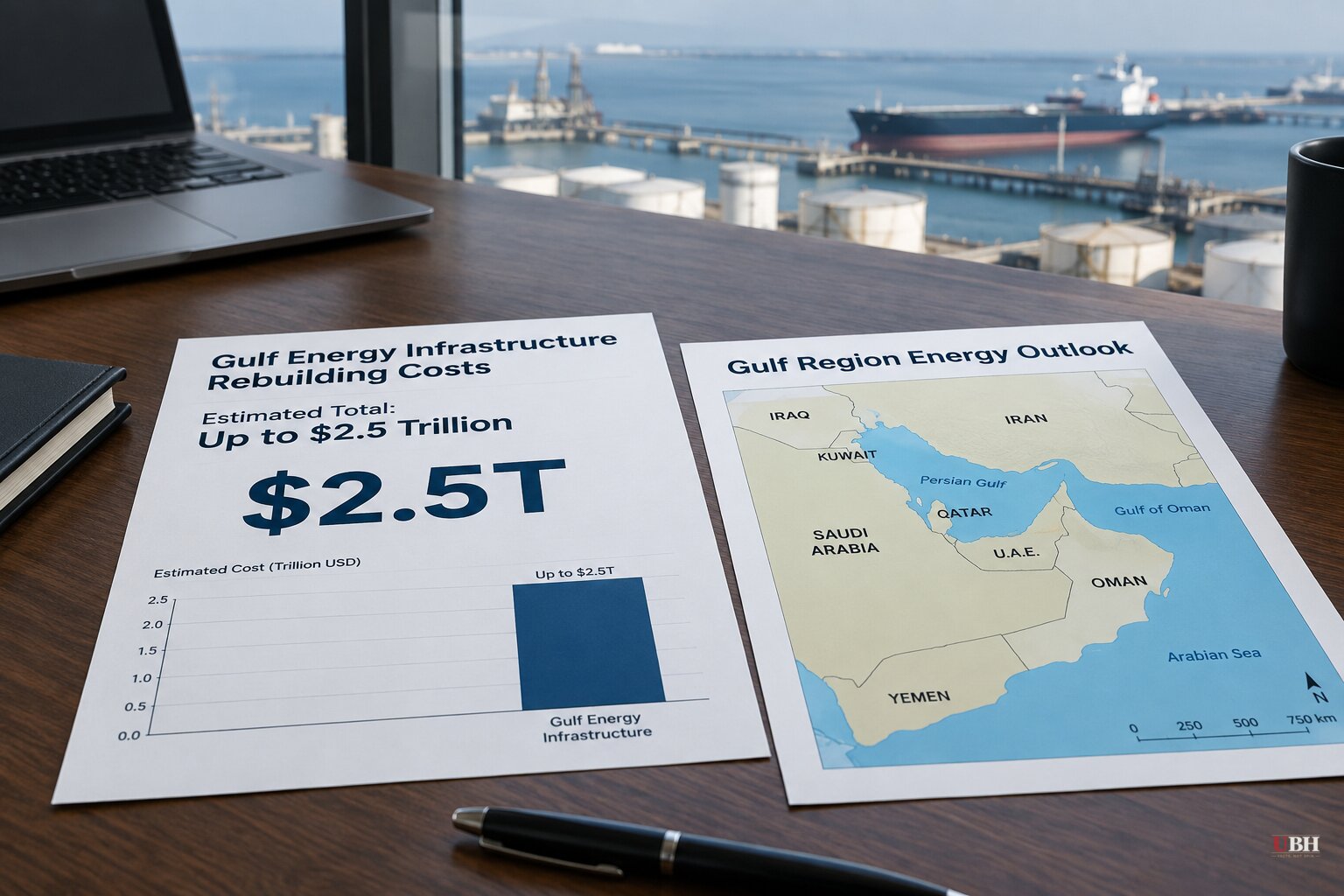
Eight months after US and Israeli strikes touched off war with Iran in February 2026, the fuel market still hasn't found a floor. Brent crude sat at $102 a barrel as of October 3, and U.S. on-highway diesel hit $6.529 a gallon last month, according to the Energy Information Administration, as cited by TIME.
Iran's Exports Flatline
Iran loaded zero crude onto tankers in September, according to maritime tracking service Kpler, the first full month of zero exports since Kpler began monitoring Iran in 2013. The last successful loading was August 25, CNN reported.
Oil Iran can still sell outside the U.S. blockade zone has collapsed to 45 million barrels, down from 100 million in July, Kpler data shows. At its current sales pace, Iran could run out of exportable crude by the end of October, per Kpler's tracking cited by CNN.
With nowhere to ship newly drilled oil, Iran's onshore stockpiles are nearing 70 million barrels, close to the country's pandemic-era peak, Kpler's Matt Smith told CNN. Iranian production has been cut roughly in half to about 2 million barrels a day, barely enough for domestic demand.
The economic damage at home is severe. Iran's economy shrank at a 10% annualized rate between March and June, according to Iranian government data cited by CNN. Inflation hit 90% last month and has averaged 73% over the past year, the worst since World War II by that measure. Adnan Mazarei of the Peterson Institute for International Economics told CNN that Iranians now spend cash immediately because it loses value if they don't.
Yet the regime hasn't budged on its nuclear program, and negotiations over freedom of transit through the Strait of Hormuz have repeatedly stalled, CNN reported. Whether that reflects genuine resilience built from five decades of sanctions, as CNN suggests, or simply that Tehran has no better option on the table is an open question none of the available reporting resolves.
The Rebuild Nobody Can Afford Yet
A forward outlook by analyst Karl W. Miller, dated October 3 and distributed through Larry C. Johnson's Sonar21 newsletter, puts a number on what comes after any ceasefire. Miller's aggressive-case estimate for rebuilding damaged Gulf energy infrastructure is $1.16 trillion. Under prolonged stress, with scarce equipment and rising prices, his model runs the bill to $2.53 trillion. Even his most favorable scenario costs nearly half a trillion dollars.
That's a massive jump from an April assessment that put energy-related repair costs at just $34 billion to $58 billion. Miller himself cautions these are model outputs, not contractor quotes, and that the true scope of the damage remains the largest unknown in his analysis. A single analyst's forward model, built on assumptions about equipment scarcity and labor costs years out, is not the same as an engineering firm's bid. Treat the trillion-dollar figures as a directional warning, not a locked-in invoice.
The timeline is the less disputable part. Weighted by cost, Miller's model shows the rebuild averaging nearly five years, with only 60% of the work complete by 2031 and the longest-lead equipment packages running seven years.
Miller's more original point concerns cash flow, not concrete. A damaged refinery can be technically repairable and still sit idle because the government that owns it has to cover food imports, salaries, electricity and water before it can pay an engineering contractor. Iraq illustrates the bind: in July it faced a $5.96 billion monthly public salary obligation against a $2.52 billion shortfall. A government in that position pays its people first. Reconstruction waits, and vendor slots for scarce equipment go to whoever can pay a deposit today.
The fuel effect is already visible. Gulf diesel exports in August ran at roughly a quarter of prewar levels, and combined Gulf and Russian diesel exports sat 1.6 million barrels a day below February levels, according to Miller's figures carried by Sonar21.
G7 Opens the Reserves
The G7 nations announced on Friday, October 2, that they would release 100 million barrels of oil and fuel products over the next four months, coordinated by the International Energy Agency, with a frontloaded diesel release in the first 20 days, TIME reported. The joint statement tied the move to record fuel prices driven by both the Iran war and what the G7 called a recent escalation in the Russia-Ukraine conflict.
Trump claimed credit on Truth Social, writing that "Europe has just agreed to release a massive amount of their heavily stocked Diesel Oil" and that "the process will begin immediately." TIME reported that Trump had pressured European partners for weeks, and that his administration's earlier threat to temporarily halt U.S. diesel exports, which triggered backlash from Canada, Mexico and much of Europe, likely helped force the release. European officials at the time warned such a ban would be disastrous for long-term oil flow.
Whether the release reaches American pumps fast enough to matter is unresolved. TIME noted the relief for U.S. consumers depends on fuel type, how much reaches the market and when, and whether disruptions persist. The Washington Post, citing researchers Joshua Busby and Greg Pollock writing for The Conversation, warned fuel prices "may go higher still," noting Strait of Hormuz traffic has been running below 15% of prewar levels.
That figure sits awkwardly next to CNN's reporting that flow from non-Iranian Gulf producers through the Strait "has effectively returned to normal." The two claims aren't necessarily contradictory. Iran's own exports are the ones blockaded to zero; other Gulf nations' tankers may be moving closer to normal volumes. But none of the available reporting pins these figures to the same date, making it hard to know exactly how open the Strait is on any given day, or how much of the squeeze is physical versus financial.
The Climate Argument Nobody Asked For
California Governor Gavin Newsom told The Guardian during Climate Week in New York that Trump is the "greatest gift" to the environmental movement, arguing the war "completely gutted any sort of romantic notions of energy security" and accelerated clean-energy investment. The Guardian cited a Carbon Brief estimate that global fossil fuel emissions could fall 0.5% this year because of the crisis, and noted the International Energy Agency moved up its forecast for peak oil consumption to this year from a prior 2029 estimate.
The Guardian also noted the obvious tension: the same administration has eased pollution limits on vehicles and power plants and expanded support for domestic fossil fuel producers. Newsom's framing is his own political argument, not a neutral assessment, and it says nothing about whether Americans paying $6.53 a gallon for diesel consider that a fair trade.
Kpler's own data suggests Iran could run out of exportable crude within weeks. The G7 reserve release is scheduled to run through four months starting in October, with the bulk of diesel frontloaded in the first 20 days. Whether that dent in reserves shows up at the pump before winter, or whether the trillion-dollar rebuild math catches up with fuel markets first, remains uncertain.
Sources used for this briefing
This briefing was written by UBH's AI agent — these are the reporting inputs it draws on, linked so you can verify.


