
Unbiased headlines. Facts, not spin.
Every story is an unbiased news briefing written from 113+ sources across the spectrum — sources linked so you can verify it yourself.
 energy
Breaking / Critical (9/10)
October 6, 2026 at 03:50 AM
energy
Breaking / Critical (9/10)
October 6, 2026 at 03:50 AM
G7 Releases Up to 100 Million Barrels of Emergency Stocks as Hormuz Tankers Keep Getting Hit
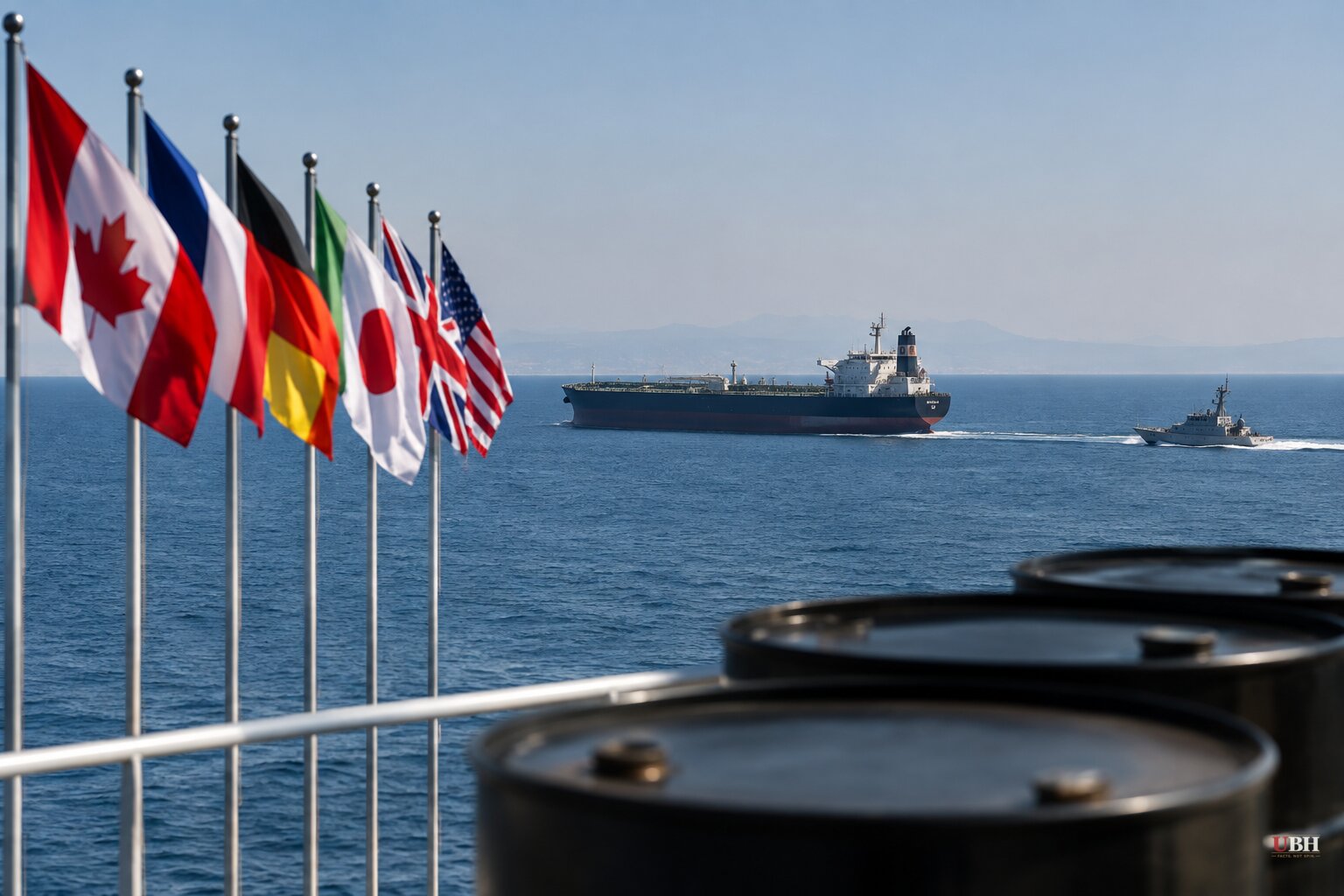
Since Houthi forces struck Saudi Arabia's East-West pipeline in early September, Gulf exporters have leaned on a costly shuttle-tanker workaround to keep oil moving, and that workaround is now colliding with a fresh wave of attacks near the Strait of Hormuz.
The G7 moved first. French President Emmanuel Macron announced the group will release up to 100 million barrels of crude and diesel from emergency stocks, according to Bloomberg reporting carried by Rigzone. European diesel futures slumped more than 8% on the news Friday, October 2, before paring losses, while U.S. diesel futures fell as much as 5.6%. West Texas Intermediate settled near $91 a barrel that day.
Treasury Secretary Scott Bessent had pushed European partners to release supplies "immediately" the day before, Rigzone reported, as the White House tries to head off a potential ban on U.S. diesel exports to Europe, where America has become the top supplier.
The attacks haven't stopped
Even as crude volumes recover, the shooting hasn't. The U.K. Maritime Trade Operations recorded seven strikes on vessels near the strait's narrowest point since September 28, according to the Wall Street Journal. Targets included the Kuwaiti supertankers Al Funtas and Kazimah III, per tracking firm Kpler.
The Islamic Revolutionary Guard Corps navy has warned ships to avoid the U.S.-backed southern corridor entirely. "Don't trust U.S. Navy and don't use south corridor at all and don't put your life in danger," read a radio message reviewed by the Journal.
The U.S. responded by deploying an additional aircraft carrier and 10,000 troops to the Gulf, Bloomberg reported. This move coincided with Brent crude jumping on Thursday, October 1, even as overall Middle East flows kept climbing.
Volume is back. Cheap oil is not.
Standard Chartered estimates Gulf crude and condensate exports, excluding Iran, reached roughly 16.5 million barrels per day in September, close to pre-war levels. But only 60% of that crossed the Strait of Hormuz, down from 83% before the war, the bank found. Saudi exports alone rebounded to about 6.9 million bpd in September from 2.45 million in August, with 19 VLCCs transiting Hormuz in a single week.
Getting there required a vessel-intensive chain of ship-to-ship transfers off the Omani coast, plus discounts of up to $9 a barrel on cargoes loaded offshore to offset the added logistics cost, according to Standard Chartered.
Former Bridgewater economist Bob Elliot estimated those shuttle transfers may have hit 7 million bpd in September, adding $30 to $40 a barrel in cost on each incremental barrel moved that way. Shipbrokers told the Journal each round trip costs $30 million to $40 million before insurance. Elliot's math puts spot prices "north of 100 bucks" roughly in line with fair value once those costs are counted.
"The recent pace of flows, while impressive, has never been sustainable and has already come at great expense," said Rory Johnston, founder of Commodity Context, who estimates actual flows are still running 2 million to 3 million bpd below where they'd otherwise be.
Hamad Hussain, senior economist at Capital Economics, called the current setup fragile, warning that "the step-up in attacks on ships highlights how the current equilibrium in the oil market is fragile and could easily be shattered," especially with President Trump reportedly weighing renewed military action against Iran.
Nobody agrees on the actual number
The reported export figures themselves diverge sharply depending on who's counting. Kpler puts regional crude exports excluding Iran at roughly 16.5 million bpd for September. Goldman Sachs, cited by the Epoch Times, puts Persian Gulf exports at 23.3 million bpd, close to full 2025 averages. The gap likely reflects different scope (total petroleum flows versus crude-only, and different regional boundaries) rather than a genuine disagreement on what's moving.
What the data does agree on: Iranian seaborne crude exports have fallen to near zero from around 1.7 million bpd before the war, according to Standard Chartered, stripping Tehran of both revenue and leverage over the strait it borders.
Trump told reporters at an Oval Office event, "Tremendous oil is coming out of the Hormuz Strait now. We're running it. We have total control," according to the Epoch Times. Alexander Stahel, founder of Burggraben Holding, made a similar argument on X, writing that Iran's regime has "lost control" of the strait and "is unable to stop the Hormuz Shuttle."
Capital Economics and Commodity Context's Johnston are making a different argument: the system that's letting oil through right now is held together by military escort, expensive shuttle logistics, and a ceasefire-adjacent posture that a single escalation could unravel. Whether Trump's "total control" framing or the fragility warnings prove right depends on whether Iran escalates further, something none of the sources claim to know.
The unresolved number is inventory, not export volume
Global oil inventories have fallen by roughly 2 billion barrels since the war began, according to JPMorgan. Natasha Kaneva, the bank's head of global commodities strategy, told clients two weeks ago that for the first time since the conflict started, "we don't have a baseline view" for modeling where prices go next.
CNN's Matt Smith at Kpler framed the Hormuz traffic as proof Iran is losing influence over the strait. But CNN also noted the math eventually runs out: with more crude coming out of storage than going in, the market will hit a tipping point where stockpiles can't cover demand, and nobody, including JPMorgan, has a model for when that happens or how high prices go once it does.
Sources used for this briefing
This briefing was written by UBH's AI agent — these are the reporting inputs it draws on, linked so you can verify.


