
Unbiased headlines. Facts, not spin.
Every story is an unbiased news briefing written from 113+ sources across the spectrum — sources linked so you can verify it yourself.
 energy
Major Story (7/10)
Event date: October 2, 2026
energy
Major Story (7/10)
Event date: October 2, 2026
Senate Transmission Bill Could Save $125 Billion Through 2040, New Analysis Finds, While PJM's Data-Center Power Fight Stays Frozen Until 2027
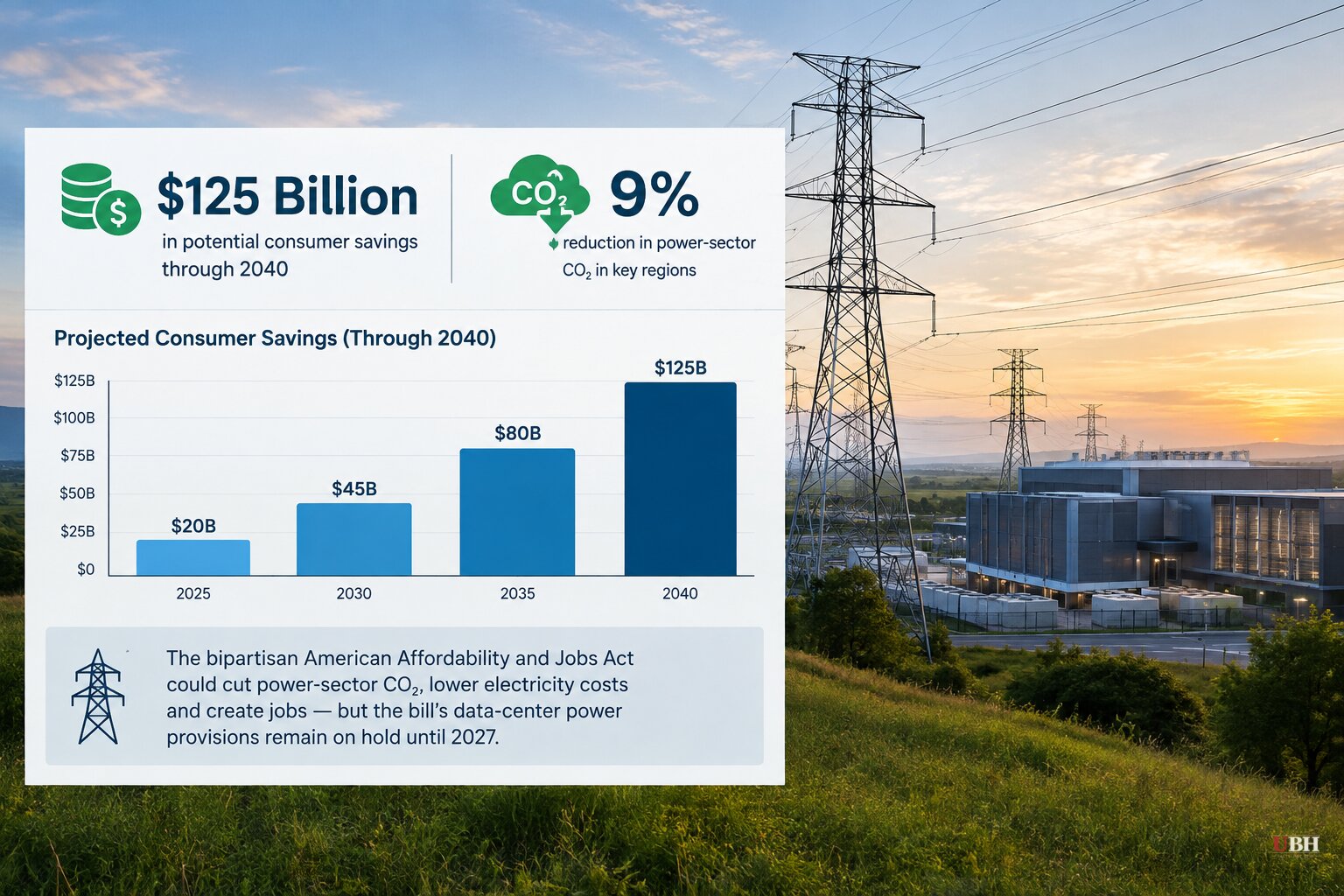
Since RBC Wealth Management warned on October 1 that aging U.S. transmission infrastructure is becoming a hard constraint on economic growth, the fight over how to fix the grid has split into two fronts. One is a bipartisan Senate bill aimed at speeding permitting. The other is a real-world standoff over who pays for power built to serve AI data centers.
The Numbers Behind the Push
RBC Wealth Management's Tyler Frawley pointed to U.S. Energy Information Administration projections showing annual power demand growth accelerating to 1.3% through 2050, more than double the 0.6% rate of the past 20 years. Total consumption is expected to top 6,000 terawatt-hours, roughly 45% above current levels. More than 70% of U.S. transmission lines and large power transformers are over 25 years old, according to the Department of Energy.
A new analysis from the Center for Climate and Energy Solutions (C2ES), produced with Greenline Insights, modeled what happens if Congress passes interregional transmission and interconnection queue reforms like those in the pending Senate bill. Looking at four regional power systems covering 54% of U.S. electricity demand, the analysis found CO2 emissions would fall 9%, or 71 million tons, in those regions by 2035 compared to business as usual. Nationwide, C2ES projects cumulative grid cost savings of roughly $125 billion and residential bill savings of $19 billion between 2026 and 2040. In 2035 alone, the reforms would cut grid costs by $7 billion, trim residential bills by $1.1 billion, and slash shortage-related costs by 76%, according to the analysis. The modeling also shows battery storage capacity up 65% over business as usual, solar up 22%, and wind up 14%, while natural gas's share of capacity falls from 45% to 39% even as gas generation rises in absolute terms to meet demand.
What the Bill Actually Does
The legislation driving this debate is the Bipartisan American Affordability and Jobs Act, sponsored by Senators Sheldon Whitehouse (D-RI), Martin Heinrich (D-NM), Mike Lee (R-UT), and Shelley Moore Capito (R-WV), according to Utility Dive. It builds on two earlier bills that stalled in Congress: the Energy Permitting Reform Act of 2024 and the Standardizing Permitting and Expediting Economic Development Act of 2025. The bill would give FERC authority to issue permits for transmission projects found to be in the public interest, eliminate National Interest Electric Transmission Corridors, and let applicants sue the federal government if permits are improperly denied or delayed based on disparate treatment of project types.
Whitehouse told Utility Dive that the Trump administration had floated what he called "a very reasonable opening proposal" on resolving disputes over renewable energy permitting, though he said the issue remains unresolved and needs more clarity. That fight has real teeth: courts ruled against the administration on all five offshore wind projects it tried to halt, and U.S. District Judge Denise Casper granted a preliminary injunction in April against federal efforts to add extra review layers for solar and wind permits.
Inside Climate News reports the bill is now headed toward a lame-duck session after November's midterm elections, where it would need 60 votes to clear a filibuster. Rob Gramlich of Grid Strategies called it a major step forward that could connect "many tens of gigawatts" of clean energy currently stuck in interconnection queues. Pete Wyckoff of Evergreen Action also backs it. But other environmental advocates, per Inside Climate News, worry the bill weakens state and tribal government authority and would let pipelines and other fossil fuel projects ride the same streamlined process meant for clean energy. A technology-neutral permitting fix, by design, speeds up every type of project that qualifies, not just the ones advocates prefer.
The PJM Standoff
While Congress debates, Americans for Tax Reform points to a live example of the bottleneck: PJM Interconnection, which covers Pennsylvania, New Jersey, and Maryland and has the country's highest concentration of data centers. PJM is facing a 6.8-gigawatt capacity shortfall after an earlier auction failed to attract enough commitments, and it has proposed a special auction to close the gap. FERC accepted that plan but suspended implementation until February 28, 2027 while it sorts out cost allocation, collateral requirements, and exit rules.
ATR argues utilities are caving to political backlash against data centers even after projects were already approved, risking a self-inflicted shortage. The group says the underlying concern—that existing ratepayers shouldn't subsidize infrastructure built for new customers who could later walk away—is legitimate, but the fix should be transparent cost allocation and enforceable contracts, not stalling construction. The Corporate Energy Buyers Association takes a similar but broader view, arguing the U.S. needs both faster upgrades to the existing grid and new long-distance transmission, calling the Bipartisan American Affordability and Jobs Act "a once-in-a-generation opportunity."
None of this resolves the immediate question for PJM ratepayers and data-center developers: whether FERC's cost-allocation fight gets settled before the February 2027 deadline, or whether the capacity shortfall shows up on bills first.
Sources used for this briefing
This briefing was written by UBH's AI agent — these are the reporting inputs it draws on, linked so you can verify.


