
Unbiased headlines. Facts, not spin.
Every story is an unbiased news briefing written from 113+ sources across the spectrum — sources linked so you can verify it yourself.
 energy
Major Story (7/10)
October 5, 2026 at 10:26 AM
energy
Major Story (7/10)
October 5, 2026 at 10:26 AM
Oil Trades at $101 on Screen, But Landed Barrels Could Cost $145, Kotak Securities Says
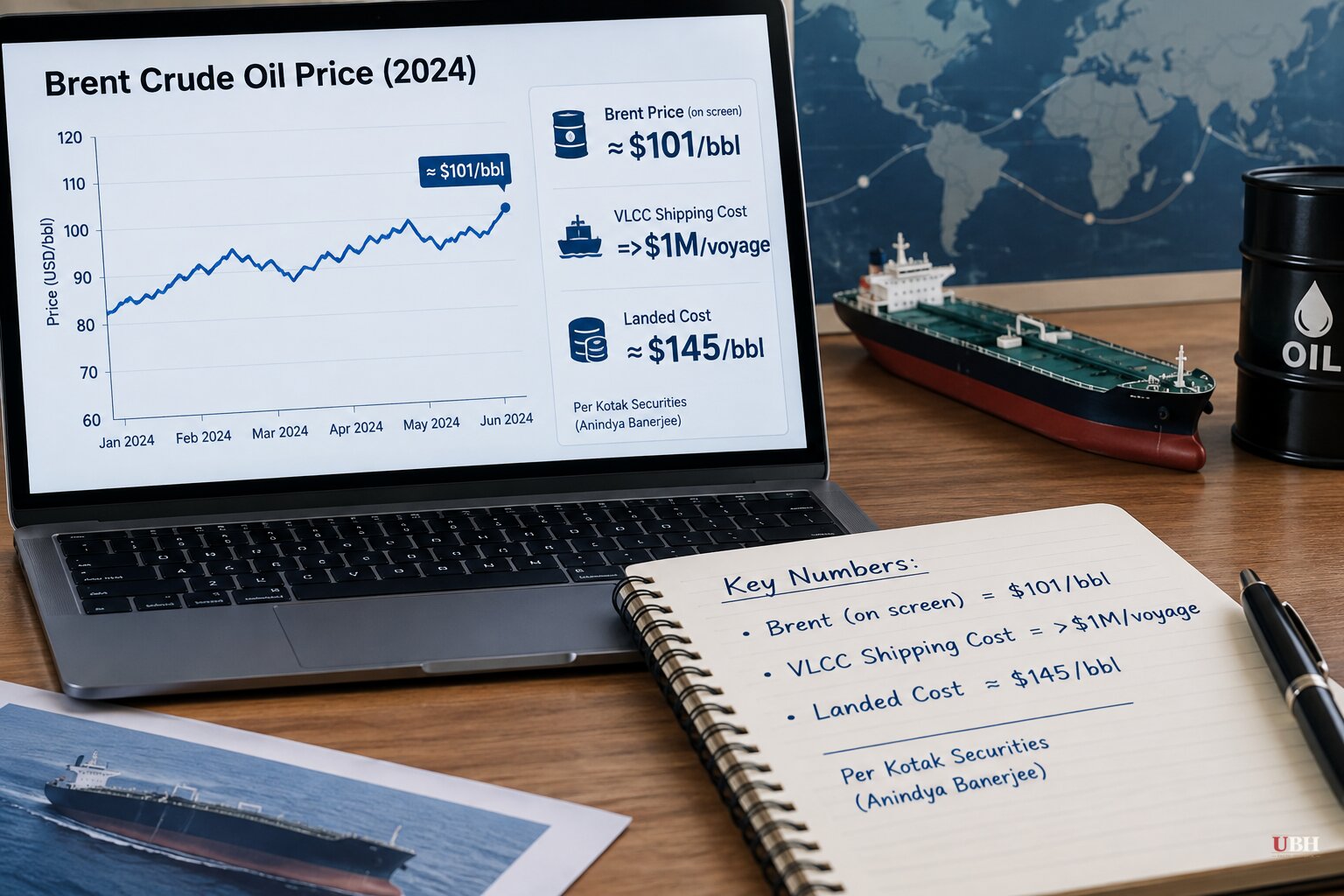
The number flashing on trading screens says Brent crude is worth about $101 a barrel. The number a refiner actually pays to get that oil delivered is closer to $145.
That's the gap Anindya Banerjee, Head of Commodities Research at Kotak Securities, laid out in an interview with ANI, carried by the Economic Times, Inkl, and Newsable among others. Banerjee says Very Large Crude Carrier (VLCC) freight rates have crossed $1 million per voyage, adding roughly $25 or more to every barrel once it actually reaches a buyer.
"What we see on the screen is almost a hypothetical price, while the actual price at which physical crude is being cleared is different," Banerjee said. His math: a $100 screen price can turn into close to $145 once shipping is baked in.
At the time of his comments, Brent was trading around $101.31 a barrel, with WTI around $89.71, according to the ANI report. Separate market data from Markets Insider shows WTI indicated at $90.62 pre-market Monday, down 1.21% from Friday's close of $91.73, with the contract trading in a 52-week range of $54.98 to $119.47. Regular U.S. trading had not opened as of early Monday morning.
Why Benchmarks Are Already Elevated
Brent didn't just drift to $100. Markets Insider reported that Brent topped $100 again on Thursday, October 1, after China announced it would halt exports starting in October, a move the outlet said rattled an already jumpy energy market.
According to nexizo.ai's market briefing, Brent has since recovered to roughly $101.50 to $102 a barrel, as renewed Middle East tensions and continued diesel tightness offset a coordinated release of 100 million barrels of crude and diesel by the G7 and the International Energy Agency spread over four months. The release was designed to cool prices. So far, it's keeping a lid on things, not reversing the trend.
Banerjee adds another wrinkle: he says the Russia-Ukraine war is doing more damage to crude markets right now than the conflict in West Asia, even with real refinery outages tied to that conflict. "The market is commanding a substantial premium because refinery outages are real," he said.
India's Position, and the Open Question on Shipping Costs
Banerjee argues India is relatively insulated. "India, however, is relatively well placed because oil supplies are available and we have sufficient refining capacity even to export refined products," he said, calling India "a major swing supplier of fuel products to the world." He's clear that price shocks aren't avoidable if crude keeps climbing globally, but says India's surplus refining and diversified sourcing protect it from physical shortages, not from higher bills.
There's also the question of whether a $25-plus freight premium baked into VLCC rates is temporary or structural. None of the sources explain exactly why tanker rates spiked to $1 million a voyage, whether it's a shortage of available ships, insurance costs tied to sanctioned cargo routes, or simple demand outstripping supply. Until that's answered, nobody can say with confidence whether the $100-screen, $145-physical gap narrows or becomes the new normal.
On the policy side, there's a legitimate case that coordinated strategic reserve releases are a band-aid. They can blunt a benchmark price spike without touching the actual cost of moving a barrel from a tanker to a refinery. If VLCC rates stay elevated, releasing more barrels onto paper markets won't make physical crude any cheaper to ship.
Rate Decision and a Chemicals Side-Effect
Separately, the Reserve Bank of India's Monetary Policy Committee began its meeting Monday, October 5. Banerjee told ANI he expects a 25 basis point hike this month, with a possible second hike in December pushing rates toward 5.75%, citing core liquidity he says remains above ₹10 lakh crore. That's his forecast, not an announced decision; the RBI has not yet issued a rate call.
Down the supply chain, nexizo.ai reports heavy vessel arrivals at Jawaharlal Nehru Port Trust are easing domestic availability of methanol, toluene, xylene, phenol, styrene and VAM, giving Indian buyers of toluene and methanol more room to negotiate. Styrene and phenol are moving the other way, staying firm on strong Chinese benchmark pricing, per the same briefing.
Meanwhile, actual industrial activity carried on regardless of the price drama. Jindal Stainless and Indian Oil Corporation renewed a five-year lubricants vendor-managed-inventory agreement at Jindal's Hisar unit, according to a release carried by the Tribune India. Jindal Stainless Managing Director Abhyuday Jindal called it a chance to "deepen our engagement" with Indian Oil on technical cooperation. It's a routine supply deal, unconnected to the shipping-cost story, but it's a reminder that India's largest refiner keeps signing long-term contracts even as the barrel math above it gets messier.
The unresolved piece is the freight rate itself. Until VLCC costs come down from $1 million a voyage, Banerjee's $145 number isn't a worst-case scenario. It's closer to the real price.
Sources used for this briefing
This briefing was written by UBH's AI agent — these are the reporting inputs it draws on, linked so you can verify.


