
Unbiased headlines. Facts, not spin.
Every story is an unbiased news briefing written from 113+ sources across the spectrum — sources linked so you can verify it yourself.
 energy
Major Story (8/10)
Event date: October 1, 2026
energy
Major Story (8/10)
Event date: October 1, 2026
US Natural Gas Now Supplies Two-Thirds of Europe's LNG Imports, With Ukraine Emerging as a Fast-Growing New Buyer
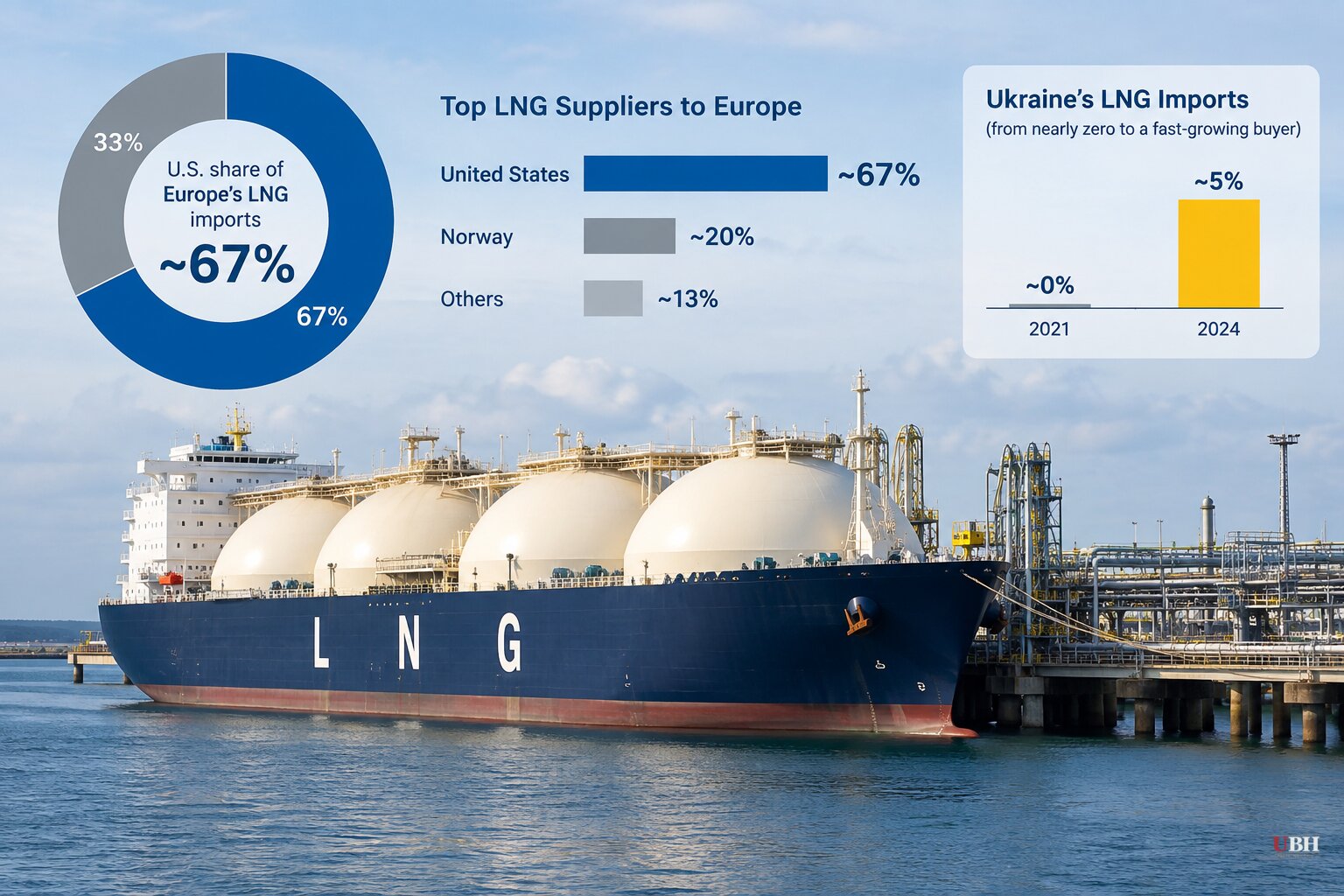
Europe spent years trying to wean itself off Russian pipeline gas. It's succeeding, but the replacement is increasingly just one country: the United States.
Europe is on track to source roughly two-thirds of its LNG imports from the US this year, according to an Atlantic Council analysis by Stephen Blank, a senior fellow at the Foreign Policy Research Institute. That would put America ahead of Norway as the continent's largest gas supplier. Bloomberg's Stephen Stapczynski reported that the war in the Middle East is accelerating a trend that's been building for years: the world leaning harder on US natural gas.
Ukraine's Rapid Pivot
The clearest example of that shift is Ukraine itself. Before 2025, Ukraine had no meaningful direct LNG relationship with the United States, according to the Atlantic Council. That changed fast.
Russian strikes on Ukraine's domestic gas production destroyed up to 60% of its output capacity in 2025, Blank's analysis found. That forced Naftogaz, Ukraine's state-owned energy company, to rebuild its import strategy almost from scratch.
The numbers show how quickly that happened. Ukraine contracted about 456 million cubic meters of US LNG in 2025. In the first quarter of 2026 alone, it contracted another 381 million cubic meters, according to both the Atlantic Council and Kyiv Post, which cited the same analysis.
Naftogaz built four separate import routes to make this work: Poland's Świnoujście terminal with Orlen, Lithuania's Klaipėda terminal with Ignitis, a floating terminal at Mukran in Germany, and Greece's Revithoussa terminal via the Vertical Corridor, a north-south route through Bulgaria and Romania backed by the Trump administration. In November, Naftogaz signed a deal with Orlen for 300 million cubic meters of US gas, delivered in the first quarter of 2026. In February, Naftogaz landed its first US LNG supply through Germany's Rügen terminal.
A Storage Hub in the Making
Blank argues Ukraine could become something bigger than just a buyer: a storage and redistribution hub for American gas across Central and Eastern Europe. Ukraine's underground storage operator, Ukrtransgaz, puts total network capacity at 30.95 billion cubic meters, the largest in Europe, according to Kyiv Post. That figure is storage capacity, not gas currently sitting in the ground.
Much of that capacity sits in western Ukraine, close to the EU border and deep enough to offer real protection from Russian airstrikes. The surface infrastructure feeding those reservoirs is a different story. A Russian attack on a Naftogaz storage facility in March 2024 damaged equipment, though the company said storage operations continued, Kyiv Post reported.
The idea ties into the Three Seas Initiative, a program linking 13 EU states from the Baltic to the Adriatic and Black Seas around new north-south energy infrastructure. The initiative was launched by Poland and Croatia in 2015-2016, before Trump's first term began, though his administration later backed and engaged with the effort, including Trump's participation in the 2017 Warsaw summit. Blank says realizing Ukraine's potential role would require sustained investment and US institutional backing. Kyiv Post noted the Trump administration "doesn't show signs of willingness to do that," though no administration official is quoted confirming or denying that position, and no formal US decision on funding has been announced.
The Commercial Side Keeps Growing
While the geopolitics play out, the business side of US LNG keeps locking in long-term contracts. On October 1, Venture Global (NYSE: VG) and ConocoPhillips (NYSE: COP) announced a 20-year Sales and Purchase Agreement under which ConocoPhillips will buy 1.0 million tonnes per annum of LNG starting in 2030, according to a release carried by Morningstar. Venture Global CEO Mike Sabel called it proof of "continued market confidence" in the company's ability to deliver US LNG reliably and at scale. Venture Global says it has more than 100 million tonnes per annum of capacity in production, construction, or development, spread across its Calcasieu Pass, Plaquemines, and CP2 facilities in Louisiana.
The Concentration Question
Bloomberg's framing raises a legitimate concern: Europe and Ukraine are trading dependence on Russia for dependence on a single alternative supplier, the United States. If one country controls two-thirds of a continent's gas imports, that country has enormous pricing leverage, and buyers are exposed if US export policy, production, or politics shift.
But this concern also deserves to be weighed against the alternative it replaced. Russia weaponized its gas exports directly, cutting supply to Ukraine and parts of Europe as leverage during the war. A market built on 20-year commercial contracts with a rule-of-law trading partner and a NATO ally is a materially different kind of exposure than reliance on a hostile state actively bombing its customer's infrastructure.
What's unresolved is whether Washington will back the infrastructure investment Ukraine's storage ambitions require, or whether that effort stalls without a clear funding commitment from the Trump administration. Naftogaz's next move, and whether Three Seas partners put money behind Ukraine's storage network, will determine whether this becomes a durable piece of European energy security or just a wartime stopgap.
Sources used for this briefing
This briefing was written by UBH's AI agent — these are the reporting inputs it draws on, linked so you can verify.


