
Unbiased headlines. Facts, not spin.
Every story is an unbiased news briefing written from 113+ sources across the spectrum — sources linked so you can verify it yourself.
 energy
Major Story (8/10)
Event date: October 1, 2026
energy
Major Story (8/10)
Event date: October 1, 2026
Russia Extends Diesel Export Ban as Ukrainian Refinery Strikes Drain Kremlin Coffers
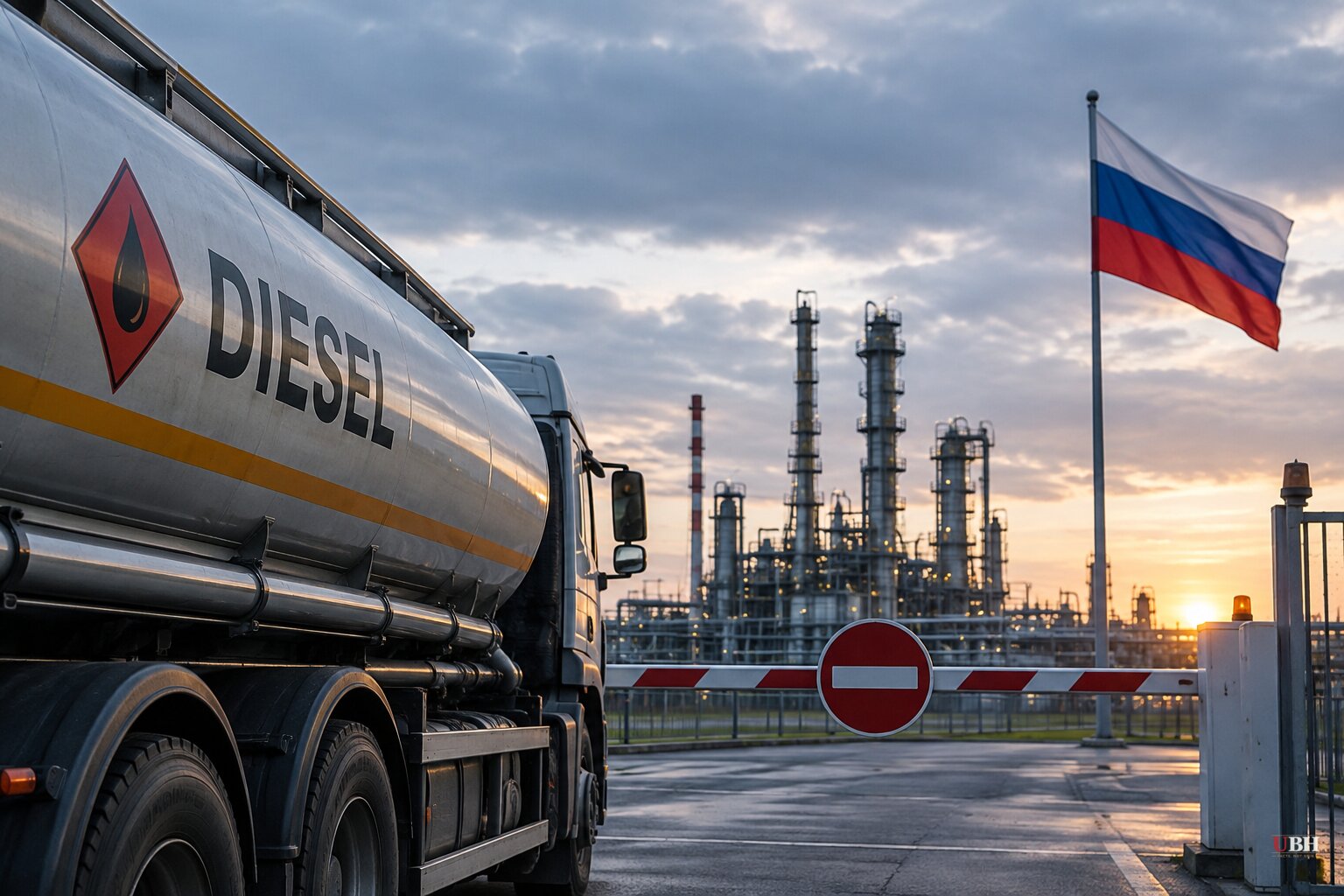
Russia's government extended its ban on diesel, marine fuel and gasoil exports by direct producers through October 31, 2026, according to a September 30 government statement cited by the Epoch Times and confirmed by Enerdata. A broader export ban covering diesel and gasoline from non-producers stays in place until January 31, 2027, and a separate jet fuel export ban runs through the end of November 2026.
The Kremlin says the goal is keeping fuel on Russian roads during harvest season. Ukrainian drone strikes have been tearing through Russian refineries for months, and Moscow can't keep enough diesel flowing to cover both the front and domestic demand.
Ukraine's Claim, Putin's Admission
Ukraine's Defence Ministry says its long-range strikes have taken out 51% of Russia's oil refining capacity, hitting facilities in Moscow, Yaroslavl, Ust-Luga, Perm, Saratov and Syzran, according to reporting carried by the Herald Scotland from USA Today. That figure has not been independently verified.
Ukrainian Defence Minister Denys Shmyhal called it "a significant blow to the enemy's economy, to its ability to carry out aggression and supply its troop groupings."
Russian President Vladimir Putin didn't dispute that the strikes are working, even if he downplayed the scale. Speaking at the Valdai Club forum, Putin acknowledged the attacks have cost Russia roughly 1% of GDP. "They started attacking oil refineries and openly declared the goal of damaging our economy. Did they achieve their goal? Partially," he said.
The International Energy Agency says Russian diesel output has fallen about 30%, with drivers in some regions waiting up to 40 hours to fill up. AsiaNews reported that three of Russia's six largest refineries are reducing or halting production, citing Reuters, and independent oil and gas analyst Boris Aronstein said Russia won't overcome the shortage by the end of autumn.
The Bill Comes Due
Keeping fuel flowing domestically is getting expensive. Russia's Finance Ministry paid oil companies 305.5 billion rubles, about $3.6 billion, in fuel subsidies in September, the largest monthly payout since April 2022, according to Bloomberg data reported by UNN.
Those subsidies aren't sustainable at current levels. Documents submitted to Russia's State Duma show the government plans to cut 2027 fuel subsidies by 39%, down to 1.18 trillion rubles, about $14.1 billion, from an estimated 1.93 trillion rubles this year, according to Gate.com.
Russian Finance Minister Anton Siluanov told officials the country's spending priorities have shifted. "Our priorities at the moment are defence tasks, tasks for the front," he said, according to AsiaNews. Russia has drawn 15 trillion rubles from its National Welfare Fund since 2019 to cover the gap, and the 2027 budget assumes oil prices of just $50 a barrel, with anything above that level funneled straight into reserves.
Russia has also lowered its 2026 oil production forecast to the lowest level in over a decade, AsiaNews reported, citing Reuters. Deputy Prime Minister Aleksandr Novak has reportedly told agencies and oil companies to prepare for the fuel situation getting worse, not better. Putin signed a decree in August allowing the state to take temporary control of companies that fail to adequately defend their infrastructure from drones or fail to restore it quickly, a move Russian economist Igor Lipsits has questioned for the cost it shifts onto private firms and, ultimately, consumers.
Washington's Stake in This
The fallout isn't staying inside Russia. Diesel prices in the United States have climbed to some of their highest levels in years, the Epoch Times reported. President Donald Trump has told Ukraine the refinery strikes are "hurting the world" by limiting global diesel supply, and he discussed a possible ceasefire on energy-facility targeting with Ukrainian President Volodymyr Zelensky on the sidelines of the U.N. General Assembly in September.
The U.S. is the world's largest diesel exporter, shipping 62.5 million tonnes in 2025 compared to Russia's 34.2 million tonnes, according to Enerdata. With Europe already weaned off Russian diesel and leaning harder on American supply since the Gulf disruptions tied to the Iran war, a simultaneous export restriction from both Washington and Moscow would be, in Enerdata's words, "a major stress scenario for European supplies." The Trump administration has reportedly weighed its own diesel export curbs to cool domestic prices ahead of the November midterms, a step that would tighten the same global market Russia's ban is already squeezing.
The counterargument from Kyiv is straightforward: the refinery campaign is one of the few levers Ukraine has to degrade Russia's ability to fund and fuel its own war machine, and Putin's own Valdai Club admission suggests it's landing. Whether that strategic payoff is worth the price American and European drivers are paying at the pump is a judgment call Washington and Kyiv don't agree on.
What happens next depends on whether Trump's push for an energy-facility ceasefire gains traction, and whether Russia's subsidy cuts, set to take effect in 2027, hold up once refining capacity is this degraded. Russia's Finance Ministry has not said how it plans to keep prices from spiking at home once that support is cut by more than a third.
Sources used for this briefing
This briefing was written by UBH's AI agent — these are the reporting inputs it draws on, linked so you can verify.


