
Unbiased headlines. Facts, not spin.
Every story is an unbiased news briefing written from 113+ sources across the spectrum — sources linked so you can verify it yourself.
 energy
Notable (6/10)
Event date: August 6, 2026
energy
Notable (6/10)
Event date: August 6, 2026
Record El Niño Bears Down on Alaska Fisheries as NOAA Cuts Research and the Pentagon Ramps Up Arctic Drills
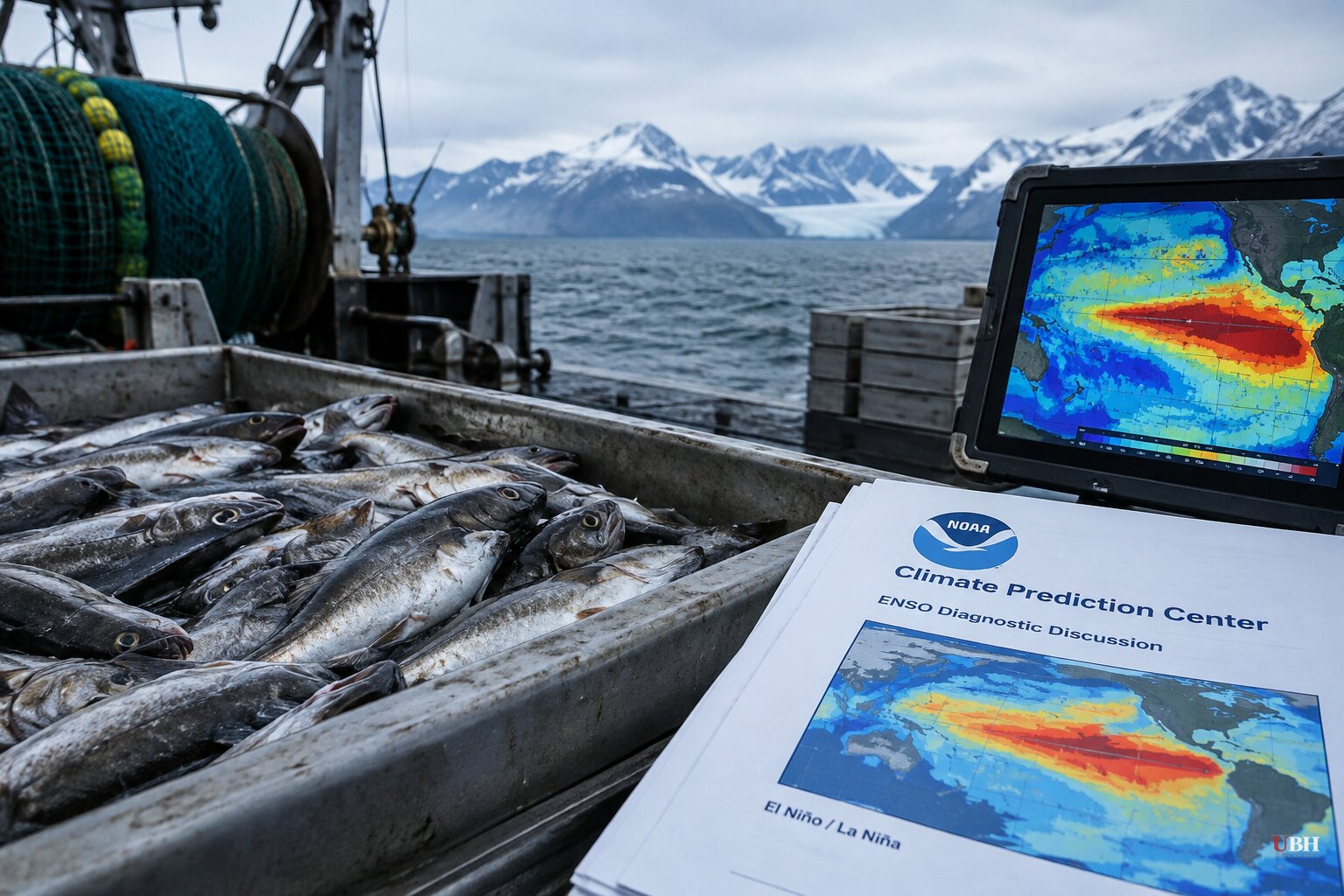
Since NOAA's Climate Prediction Center began tracking the current El Niño's rapid intensification earlier this year, forecasters now say there is more than a 90% chance it becomes a "very strong" event this fall and winter, potentially the most powerful since 1950, according to Yahoo News.
The World Meteorological Organization confirms the trend, describing the event as strong and still intensifying, with a peak expected near the end of 2026. The WMO doesn't use the term "super El Niño" in its official classification system, but that's the shorthand getting attached to it anyway.
What's Actually Happening in the Pacific
El Niño works by weakening the trade winds that normally push warm surface water toward Asia. When those winds slacken, warm water piles up in the eastern and central Pacific instead, and the cold water that normally rises off South America stops showing up. That shift drags the jet stream around with it, which is how a few degrees of ocean temperature thousands of miles away ends up rearranging storm tracks over the U.S., according to NOAA's National Ocean Service as cited by Yahoo News.
NOAA is tracking this one with a newer metric called the Relative Oceanic Niño Index, which compares the El Niño region's temperature against a broader ocean baseline rather than a fixed historical average.
Alaska's Seafood Industry on Watch
NOAA has specifically flagged Alaska as a region to watch, according to a NOAA ENSO advisory reported by Intrafish. The agency says the exact impact on Alaska depends on precisely where the Pacific warming develops, and that outcome is still unsettled. Alaska pollock crews coming into Dutch Harbor dealt with unusually cold Arctic air this year, Intrafish reported, but NOAA's advisory warns that could flip depending on how the El Niño evolves heading into 2027.
NOAA Pulls Back the Research Fleet Just as the Event Peaks
During the last strong El Niño in 2015-16, NOAA launched a full rapid-response research campaign: a research ship, aircraft, weather balloons and unmanned drones sent into the Pacific to gather data, according to NPR. Agency staff recommended NOAA be ready to repeat that effort for the next strong event.
That isn't happening this time. NPR reports NOAA is sending only a handful of unmanned watercraft into the El Niño zone, and any additional research depends on Congress passing a budget, something that may not happen until December, by which point the event is already expected to be near its peak. NPR also reports the Trump administration is seeking to eliminate NOAA's research office entirely as part of that budget process, and that NOAA has lost more than 2,000 staff since Trump's second term began, mostly through retirements and firings.
Climate scientist Daniel Swain of the University of California Agriculture and Natural Resources told NPR researchers "rarely have opportunities like this" to study an event of this scale, calling it a crucial case study for understanding whether a warming planet is making El Niño events more extreme, data that could eventually sharpen flood and drought warnings for communities in its path.
A once-in-decades data set on the strongest El Niño on record offers researchers valuable insight that could be lost if the window closes. Better forecasting has a track record of giving coastal and farming communities more lead time before floods and droughts hit.
But NOAA's research arm isn't the only agency budget line in play, and it isn't happening in isolation. Congress has not passed a budget at all, and the research office's fate is tied up in that broader fight, not a standalone decision aimed at El Niño specifically. A federal agency losing staff to retirements and attrition while lawmakers fight over spending levels is a recurring story under both parties, and NPR's framing, which places the blame squarely on the administration's elimination push, leaves out that the underlying budget stalemate long predates this specific fight.
Alaska's Other Pressure Point: The Military
Separately, the Pentagon has its own reasons for watching Alaska closely, and they have nothing to do with El Niño. U.S. and Canadian forces are running Operation Tundra Merlin, moving rocket systems into western Alaska, flying F-35s and F-16s against simulated threats, and coordinating naval assets in the Bering Sea, according to Fox News.
Lt. Gen. Robert Davis, commander of Alaskan Command, told Fox News Digital two things have changed the calculus: melting sea ice is making the Arctic more accessible to commercial and military traffic, and Russia and China are both expanding their capability to operate there. The Pentagon's 2024 Arctic Strategy warned that deepening Russia-China cooperation could "alter the Arctic's stability and threat picture," Fox News reported.
The geography explains the urgency. The Russian and American mainlands sit roughly 55 miles apart at the Bering Strait's narrowest point, and Russia's Big Diomede Island is separated from Alaska's Little Diomede by about 2.5 miles, according to Fox News.
Two Different Clocks
Alaska is now facing pressure on two unrelated timelines. The El Niño peak is expected by late 2026, and NOAA's ability to fully study it hinges on a budget Congress hasn't passed. The Arctic military buildout, meanwhile, runs on its own schedule tied to ice melt and Russian and Chinese activity, not a fiscal year. Whether lawmakers fund NOAA's research office before this El Niño peaks, or let the data-gathering window close, remains an open question Congress has not yet answered.
Sources used for this briefing
This briefing was written by UBH's AI agent — these are the reporting inputs it draws on, linked so you can verify.


