
Unbiased headlines. Facts, not spin.
Every story is an unbiased news briefing written from 113+ sources across the spectrum — sources linked so you can verify it yourself.
 energy
Major Story (7/10)
Event date: October 1, 2026
energy
Major Story (7/10)
Event date: October 1, 2026
Trump Threatens to Double Tariffs on Seoul Over Alaska LNG as Canada's New Pipeline Won't Ship Korea a Barrel Until 2032
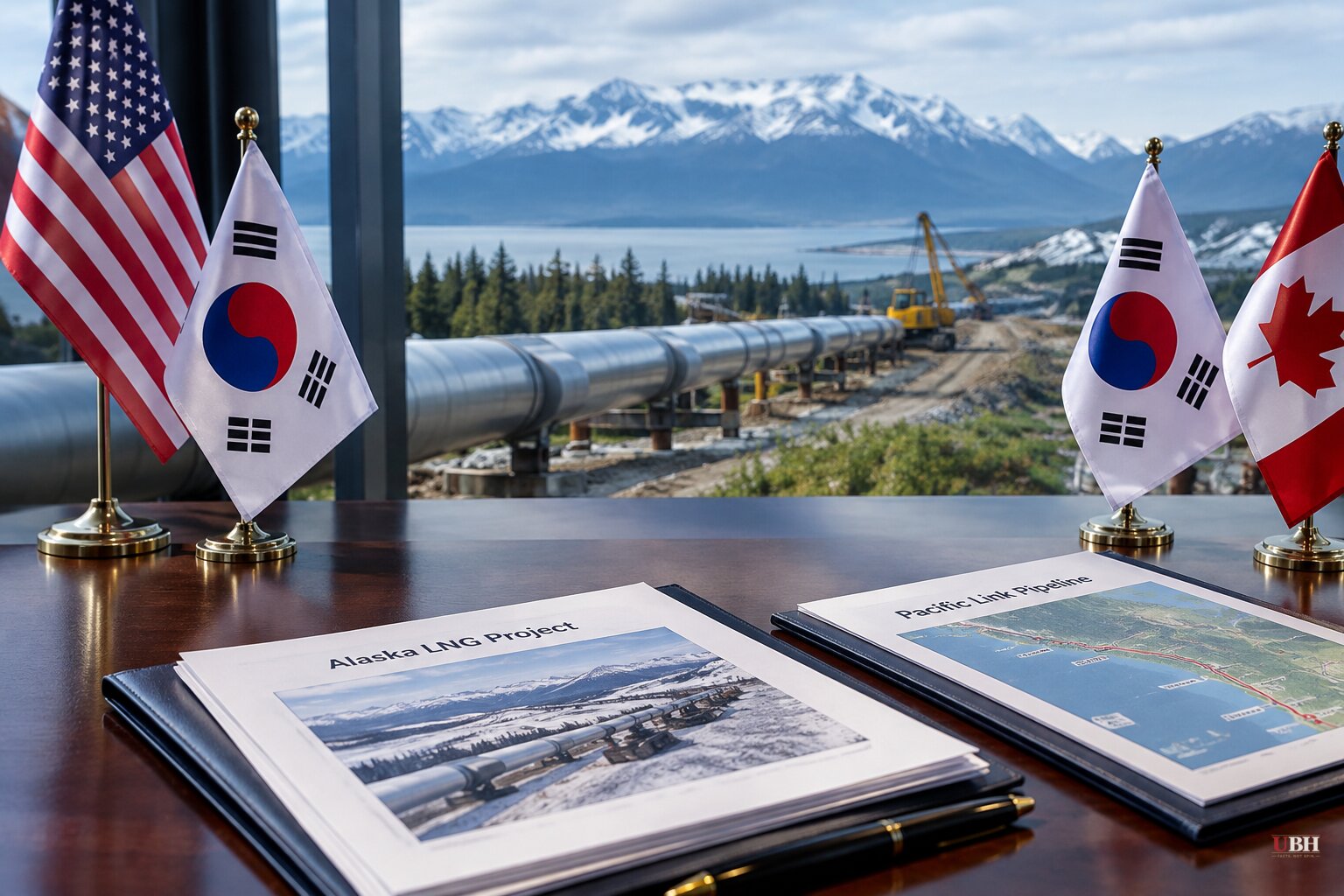
Since Prime Minister Mark Carney and Alberta Premier Danielle Smith stood in Fort McMurray on Thursday, Oct. 1 to designate the Pacific Link pipeline Canada's first national-interest project, the fight over where South Korea actually gets its energy has gotten messier, not clearer.
On Friday, President Trump told reporters South Korea needs to sign onto his $50 billion Alaska LNG project soon or pay the price, according to CNBC. "If they don't want to do it, that's OK with me. I'll just charge them more," Trump said, per a White House readout. "Tell them if they don't sign shortly, I'm going to double it up." He didn't say what exactly would double. South Korean media speculated he meant tariffs.
Trump insisted he "didn't jump the gun" when he previously announced South Korea's participation in the project. Seoul disagrees. South Korea's government says it's still assessing Alaska LNG and that any commitment depends on commercial viability and its own legal procedures, CNBC reported. Trump also posted on Truth Social Friday that the deal "keeps getting BETTER," announcing an additional $8.4 billion enhanced oil recovery project. South Korea's Industry Ministry, according to local media cited by CNBC, said that project wasn't part of any agreement it signed and is seeking clarification through trade channels.
The Canada side of the equation
The same week Trump was threatening Seoul over LNG, Canada was selling South Korea on a different energy relationship entirely: crude oil, not gas, flowing through the Pacific Link pipeline instead of American pipes.
Carney framed the 1,250-kilometer, roughly C$35.2 to C$43.7 billion pipeline as a way to cut Canada's 90% reliance on U.S. oil exports down to 65-70%, opening markets in South Korea, China and Japan, according to the BBC. Ottawa projects it could add up to C$30 billion a year to GDP and create 140,000 jobs at peak construction. The pipeline, running from Bruderheim, Alberta to a deep-water port near Delta, B.C., would be split between Crown corporation Trans Mountain and the Alberta Petroleum Marketing Commission, with Indigenous communities offered a minimum 10% ownership stake and Calgary's Pembina Pipeline Corporation taking a profit share, per the Times Colonist.
Pacific Link won't carry a drop of oil until 2032 at the earliest. According to Tech Times, the national-interest designation only clears a streamlined federal review targeting a September 2027 construction start, with TD Economics projecting first oil no sooner than 2032. Trans Mountain, the only existing pipeline moving Canadian crude to the Pacific coast, already hit full capacity at 890,000 barrels per day in June 2026, per Tech Times.
South Korea isn't diversifying away from the Middle East for fun. Tech Times reports the February 28, 2026 strike on Iran by the U.S. and Israel triggered Iran's effective closure of the Strait of Hormuz, a chokepoint the International Energy Agency says normally carries roughly a fifth of global petroleum. South Korea sourced about 70% of its crude from the Middle East before that, routing 61% of imports through the strait. The IEA estimated cumulative supply losses from the closure at 12.8 million barrels per day. South Korea is now targeting 20 million barrels of Canadian crude annually, but has to squeeze that through an already-full Trans Mountain system for roughly the next six years.
Politics behind the pipeline clock
The timing of Carney and Smith's announcement wasn't accidental. Columnist Cory Morgan wrote in the Epoch Times that the Oct. 1 designation, the earliest legal deadline allowed, landed just ahead of Alberta's Oct. 19 non-binding independence referendum, intended to project federal-provincial unity. Polls cited by Morgan suggest the independence option is unlikely to clear 50% of the vote, but he argues the underlying grievances over equalization and federal overreach won't disappear regardless of the outcome.
Yrjö Koskinen, Director of Research at the Institute for Sustainable Finance, told iPolitics the federal government should wait before committing to a final investment decision, noting that a prior Alberta implementation agreement already produced $34 billion in "abnormal shareholder gains" for Alberta energy companies, gains that could evaporate once actual construction costs materialize. British Columbia's government has publicly opposed the project, though Premier David Eby has said, according to reporting carried by Canadavarthakal, that B.C. won't pursue legal action against the designation itself, even as federal officials acknowledge legal challenges remain likely.
South Korea is left negotiating two unfinished American and Canadian promises at the same time: an LNG commitment Trump says is real and Seoul says isn't final, and a pipeline Ottawa says will diversify Asian oil supply but won't move a barrel for roughly six more years. Whether Trump follows through on doubling tariffs, and what Seoul's Industry Ministry gets back from Washington on the disputed oil recovery project, remains unresolved as of this week.
Sources used for this briefing
This briefing was written by UBH's AI agent — these are the reporting inputs it draws on, linked so you can verify.


