
Unbiased headlines. Facts, not spin.
Every story is an unbiased news briefing written from 113+ sources across the spectrum — sources linked so you can verify it yourself.
 energy
Notable (6/10)
Event date: September 30, 2026
energy
Notable (6/10)
Event date: September 30, 2026
Czech Republic Hits Third-Driest Year Since 1961 Just as Government Backs $4.76 Billion AI Data Center Bid
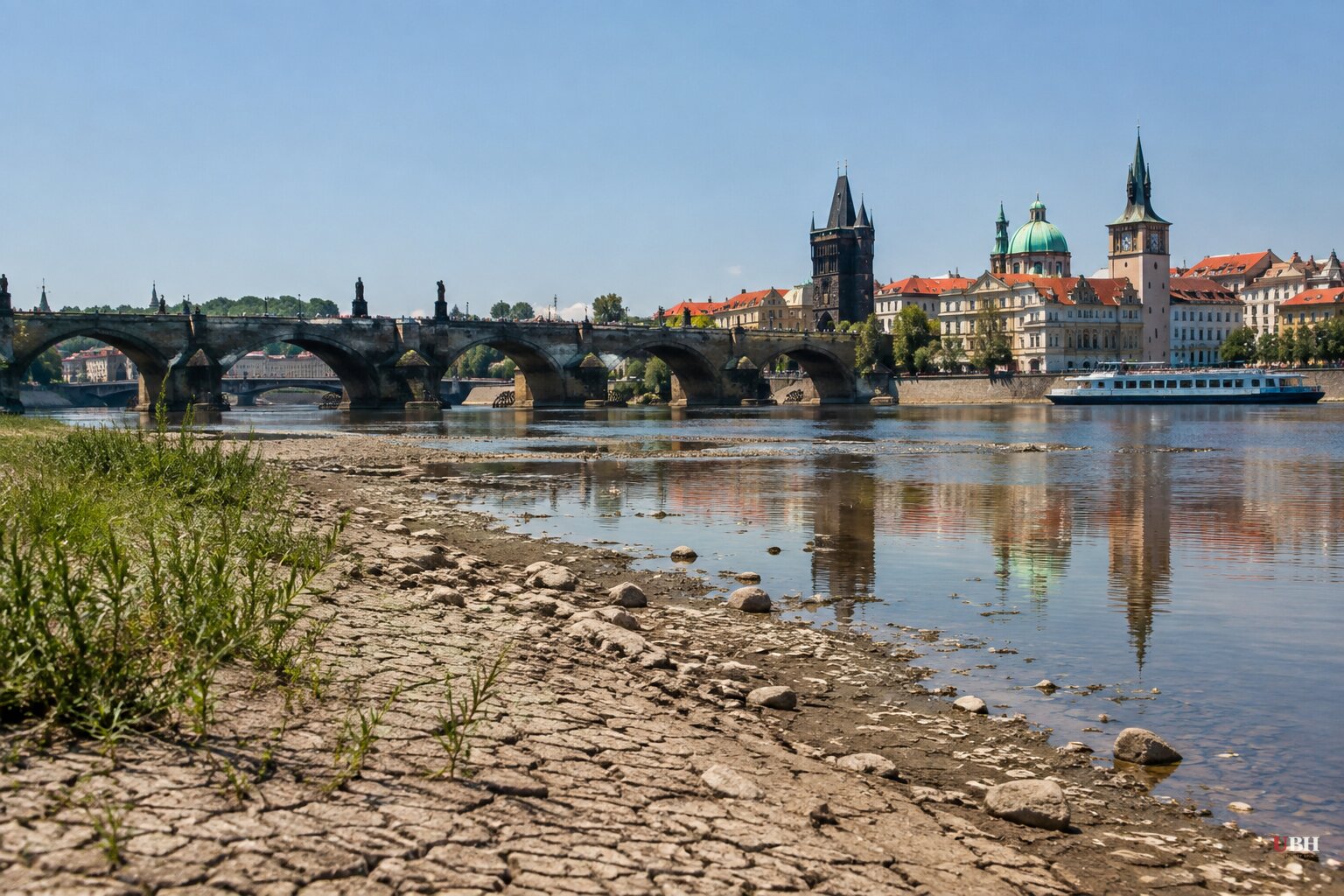
The Czech Hydrometeorological Institute (HMÚ) confirmed in its October bulletin that the country just closed its driest nine-month stretch since 1961, outside of 2003 and 2015. Only 395 millimeters of rain fell across Czech territory between January 1 and September 30, 2026, about 73 percent of the 1991-2020 average, according to HMÚ data reported by Tech Times and corroborated by expats.cz.
The numbers get worse at the regional level. South Moravia, the country's agricultural core, averaged barely 300 millimeters through September. The Churáňov station in the Šumava mountains recorded just 61 percent of its long-term norm, the lowest total since that station began measuring in 1953. A border-ridge station at Blatný vrch came in at 60 percent of average.
The Vltava River in Prague fell below the official hydrological drought threshold as of October 2, 2026, with 48 river monitoring profiles nationwide below drought levels, Tech Times reported. Hydroelectric output has dropped by as much as 50 percent this year. Rivers hit their lowest early-August flows since 1921. The government has already paid out CZK 3.8 billion, roughly $181 million, in compensation to farmers hurt by the dry conditions.
This is considerably worse than 2025, itself a dry year. The first nine months of 2025 brought 456 millimeters of rain, 84 percent of normal, meaning the deficit deepened sharply this year.
The AI Gigafactory Bid
In the same year as this drought, the Czech government approved a bid to host a CZK 100 billion, roughly $4.76 billion, AI data center campus described by Tech Times as one of Europe's largest planned AI infrastructure projects. Andrej Babiš, whose ANO party won the Czech parliamentary election held October 3-4, 2026, has not yet been sworn in as prime minister as government-formation talks continue, so it is not yet established which administration — the outgoing government or an eventual Babiš-led one — bears responsibility for the project going forward. It's a bid for site selection, not yet a finished, operating facility, and no source reviewed here lays out exactly how much water the specific project would draw or what cooling technology it would use.
Not every data center is a heavy water consumer. Modern hyperscale facilities increasingly use closed-loop liquid cooling or air-based systems specifically to cut water draw, and companies building them point to local job creation and tax revenue as the upside. Amazon, for instance, announced in early October it will invest more than $1 billion over five years in communities that host its data centers across the United States, according to Breitbart, a move widely read as an attempt to get ahead of local backlash.
That backlash is already underway on this side of the Atlantic. A Quad-City Times report on AI's water footprint pointed to protest signs reading "Protect our water," "Water for people not AI," and "Don't mess with our water" cropping up from Texas to New Mexico to Arizona, as residents react to the rapid buildout of data centers that rely at least partly on water for heat absorption and cooling.
A Second Stress Point: Cybersecurity
Water systems are also under a different kind of pressure. EPA Assistant Administrator for Water Jess Kramer told Fox News Digital that cyberattacks on drinking water and wastewater systems have increased "several fold" in recent years, with attackers shifting from ransomware extortion toward attacks meant purely to disrupt service.
"Everyday life completely crumbles" without reliable water infrastructure, Kramer said, citing hospitals and daycares among the facilities that depend on it. EPA Assistant Administrator for Enforcement and Compliance Assurance Jeff Hall added that many utilities are running aging systems without basic protections like firewalls or VPNs, leaving them vulnerable to attackers who manipulate human-machine interfaces to change critical settings.
Fox News cited a July incident in which hackers targeted computerized controls at more than 30 Minnesota water systems, forcing some utilities onto manual operations and backup procedures. That followed earlier breaches of water utilities in Colorado.
The Bigger Picture
Allianz Global Investors, in a note on infrastructure investment trends, described AI-driven data centers as a source of "structural growth in energy demand" that is reshaping how governments and private investors think about grids, water, and power. The firm estimates $139 trillion to $151 trillion in global infrastructure spending will be needed by 2050, with digitalization and AI as one of the core drivers alongside the broader energy transition.
None of this proves the Czech Gigafactory will worsen the country's water crisis. It's a bid, not a built facility, and the companies involved haven't published water-use projections in any source reviewed here. Critics of rapid AI buildout argue that approving a data center campus of this scale during the worst nine-month drought in six decades is, at minimum, a planning question Czech officials — whether the outgoing government or an incoming Babiš-led one — owe the public an answer to before ground gets broken. Whether Czech officials release specific water-allocation figures for the project is the open question that will determine whether this is a real conflict or a coincidence of timing.
Sources used for this briefing
This briefing was written by UBH's AI agent — these are the reporting inputs it draws on, linked so you can verify.


