
Unbiased headlines. Facts, not spin.
Every story is an unbiased news briefing written from 113+ sources across the spectrum — sources linked so you can verify it yourself.
 energy
Major Story (7/10)
October 6, 2026 at 11:29 AM
energy
Major Story (7/10)
October 6, 2026 at 11:29 AM
Emera Strikes $72 Billion Merger With Canadian Utilities and ATCO as North America's Energy Infrastructure Bets Pile Up
Three energy stories, three very different lessons about how North America builds and pays for power.
The $72 Billion Merger
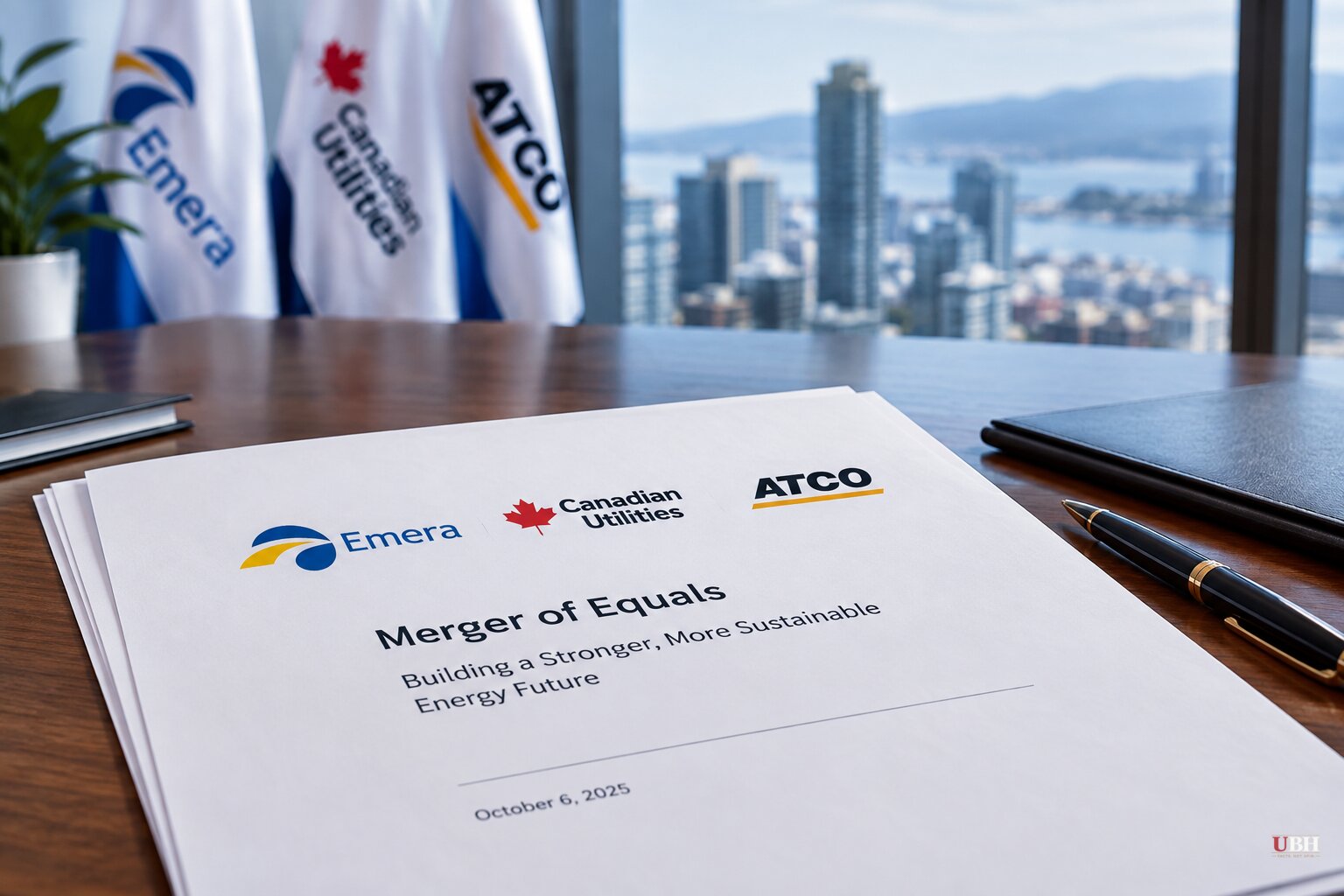
Emera, ATCO and Canadian Utilities announced a definitive agreement on October 6, 2026 to merge Emera and Canadian Utilities into what the companies call "a Canadian utility and energy infrastructure powerhouse," according to a joint release carried by Newswire.ca and Financial Content. The combined company, which will keep the Emera name, is projected to carry a pro forma enterprise value of approximately $72 billion, a rate base of about $45 billion, and roughly six million customers across Canada, the United States and international markets.
Under the terms reported by Mugglehead, Canadian Utilities Class A shareholders other than ATCO will receive 0.755 of an Emera share for each share held, Class B holders get 0.819, and ATCO shareholders get 0.865 of an Emera share plus one share in a new spinoff company, New ATCO. At Toronto's October 5 close, Emera traded at C$68.30 and Canadian Utilities at C$51.20, which Mugglehead calculated implies roughly a 0.7% premium for Canadian Utilities Class A holders.
Emera shareholders will own about 60% of the combined company, Canadian Utilities shareholders about 40%. The companies, per Mugglehead, estimate 95% of combined earnings will come from regulated utilities, with roughly 80% split between Florida and Alberta. This geographic bet pairs Emera's heavy Florida exposure (about 70% of current operating earnings) with Canadian Utilities' concentration in Alberta (about 80%). The companies are projecting a $32 billion capital plan through 2030 and 7-to-8% average annual rate-base growth, according to rallies.ai, which also reported the deal is targeted to close in the third or fourth quarter of 2027.
ATCO will spin off its housing, defence, ports and retail energy businesses into New ATCO, a separately traded company. Emera CEO Scott Balfour said in the companies' release that the merger "creates a Canadian utility and energy infrastructure powerhouse with the scale, financial capacity and expertise to invest in the systems our customers will rely on for decades." The deal requires regulatory and shareholder approvals before it closes.
Ottawa's $70 Billion Hydro Bet
While private capital consolidates, governments are making their own massive infrastructure wagers, and not everyone buys the math. On August 17, 2026, Ottawa, Quebec and Newfoundland and Labrador announced a nearly $70 billion package billed as nearly tripling the power generation capacity of the Churchill Falls hydro station, already Canada's second-largest hydro facility.
Epoch Times contributor Joseph Fournier argues that framing is misleading. The plan pairs turbine upgrades and a new powerhouse with a 2,000-megawatt wind complex and a new downstream facility at Gull Island, all tied together on new transmission lines. Fournier's concern is that the expanded system will function as what he calls a "wind-subservient hybrid baseload" — essentially a peaker plant that throttles back hydro output whenever regional winds blow strong, rather than running at the current station's 74% capacity factor.
By Fournier's calculations, the $70 billion package would add about 6 gigawatts of capacity but only around 20 terawatt-hours of annual energy on top of the current roughly 35 TWh baseline, well short of tripling. He also argues a comparable investment in natural gas combined-cycle plants could generate far more energy even after Canada's industrial carbon price reaches $140 per tonne by 2040. Those figures are Fournier's own modeling and framing, not an independent government or utility estimate, and the governments announcing the project have emphasized capacity and jobs rather than disputing his energy-output math publicly in the available record.
Pipeline Politics, Ten Years Later
A decade after the Standing Rock protests drew thousands of demonstrators to try to block the Dakota Access Pipeline, the Daily Wire notes the pipeline is still running. Energy Transfer lists the Bakken Pipeline system, which includes Dakota Access, as carrying up to 750,000 barrels of oil a day from North Dakota to Illinois and on to Midwest and Gulf Coast markets.
The Standing Rock Sioux Tribe and allied activists had argued the pipeline's crossing under Lake Oahe threatened the tribe's water supply and sacred sites, and some, including future Congresswoman Alexandria Ocasio-Cortez, cited the fight as formative. The Daily Wire notes she is now weighing a 2028 presidential run. The U.S. Army Corps of Engineers didn't simply wave the project through. On May 21, 2026, it signed a Record of Decision granting the Lake Oahe easement with additional conditions, following a full environmental impact statement.
California shows the other side of that coin. Phillips 66 ended refining at its Wilmington facility in October 2025, and Valero ended refining at Benicia in 2026, together removing 17% of the state's refining capacity, according to the Daily Wire's citation of the U.S. Energy Information Administration. The EIA has warned the shortfall can't easily be covered by refineries elsewhere in the country because of California's limited pipeline connections to Gulf Coast refining hubs, leaving Asian imports as the likeliest and slower replacement for gasoline and jet fuel.
What's Unresolved
The Emera-Canadian Utilities-ATCO merger requires sign-off from provincial regulators including in Alberta and Florida's state commission before its targeted 2027 close. Churchill Falls' actual annual energy output won't be measurable until construction finishes and the wind complex comes online, leaving Fournier's projections untested. California heads into another driving season with less in-state refining capacity than it had a year ago, with the EIA's import-dependency warning still standing.
Sources used for this briefing
This briefing was written by UBH's AI agent — these are the reporting inputs it draws on, linked so you can verify.


